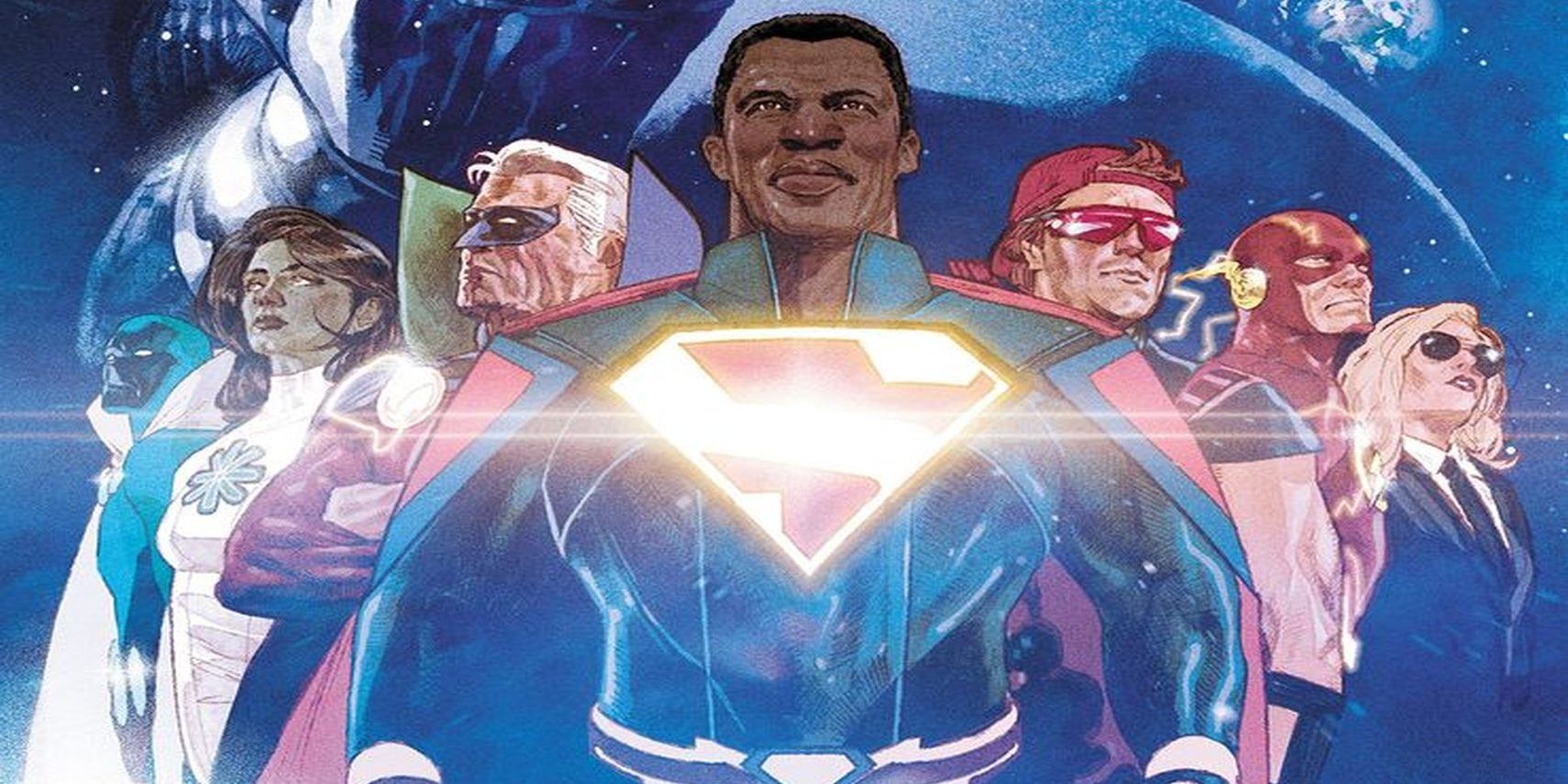
DC’s Infinite Frontier initiative has done more than restore the multiverse from its former death in Dark Knights: Death Metal. It created an omniverse where all lives, deaths, and crises have taken place. Not only are there multiple Earths, but they reside in multiple universes.
Now, a team of heroes from across the galaxy and dimensions tries to solve some of its mysteries in the mini-series Infinite Frontier. The line-up spans generations and ages. It also features heroes who were once dead. To be prepared for the story, there are other tales readers need to peruse to familiarize themselves.
10 All-American Comics Introduced The World To Alan Scott
The Hal Jordan version of Green Lantern isn’t the main character in Infinite Frontier. Instead, it’s the original GL, Alan Scott. The owner of the mystical lamp has more to be concerned about than Hal. Especially since Alan disappeared during the New 52 and returned with other Justice Society members in Doomsday Clock #12 by Gary Frank and Geoff Johns.
To get an idea of who this Lantern is, readers need to peruse the Golden Age All-American Comics. Introduced in issue #16 by writer Bill Finger and artist Mart Nodell, Scott battled super villains, Nazis, and other Axis-related villains. The character also appeared in his own Green Lantern series from 1941 to 1949.
9 Flash #123 Started The Multiverse
There wouldn’t be an omniverse, let alone a multiverse, without “Flash of Two Worlds.” The story by writer Gardner Fox and artist Carmine Infantino appeared in Flash #123. It reintroduced the Golden Age Flash, Jay Garrick, to Silver Age audiences as a citizen of Earth-Two.
Once established, heroes and villains from both Earths regularly interacted. The most regular of these meetings occurred in the annual Justice League-Justice Society team-ups. Though the original multiverse ended in Crisis on Infinite Earths #11 by Marv Wolfman and George Perez, the idea has resurfaced several times since then.
8 Darkseid First Appears In Superman’s Pal Jimmy Olsen #134
In the early 1970s, Jack “The King” Kirby took over the writing and drawing reins for the long-running Superman’s Pal Jimmy Olsen. Instead of continuing the trend of stand-alone stories about Jimmy’s misadventures, Kirby decided to introduce a new concept to the series. This would be his Fourth World characters.
Among these was a villain who would be a menace to the DC Universe for decades — Darkseid. Featured in one panel at the end of issue #134, the ruler of Apokolips would gain a greater presence as Kirby’s Fourth World expanded to series like Forever People and New Gods. In Infinite Frontier, Darkseid plays an important and more powerful role in the quest for answers within the omniverse.
7 Infinity Inc. #1 Introduces Green Lantern’s Children
Alan Scott’s children, Jade and Obsidian, have had a tumultuous time in the DC Universe. Their initial appearance was in the pages of Infinity Inc. Created by Roy Thomas, the siblings were part of a second-generation Earth-Two team comprised of the sons and daughters of other Justice Society heroes.
Things went south after Crisis on Infinite Earths. Jade died and Obsidian turned evil for a time. Then, as a member of the Justice Society, he became a true shadow figure. Both were returned to normal after the events of Doomsday Clock #12.
6 Mr. Bones Made His First Appearance In Infinity Inc. #16
Mister Bones is not part of the main Infinite Frontier series. Instead, he’s the “host” of Infinite Frontier Secret Files #1. As a director of the Department of Extranormal Operation (DEO), he has the lowdown on every superhero and villain currently in action. However, he didn’t always have this role.
When he was introduced in Infinity Inc. #16 by Roy Thomas and Todd McFarlane, Bones was Mister Bones. He was part of a villainous team known as Helix who tried to extort the rest of the Infinitors by kidnapping one of their members, Fury. He later reformed and became a member of Infinity Inc. Eventually, he took on a role at the DEO.
5 Psycho-Pirate Is A Featured Player In Crisis On Infinite Earths
Psycho-Pirate has been around since the Golden Age of comics. However, the version of the villain that appears in Infinite Frontier was introduced in Showcase #56 by Gardner Fox and Murphy Anderson. A nemesis of the Justice Society, particularly Hourman, he battled heroes on Earth-One and Earth-Two.
His biggest role came during Crisis on Infinite Earths. Though recruited by Monitor to help defeat the Anti-Monitor, Psycho-Pirate was taken by that villain. In his service, Pirate caused a captured Flash to no longer believe in himself. Post-Crisis, the character was part of Final Crisis and the New 52.
4 Final Crisis #7 Is The First Appearance Of President Superman
Final Crisis also saw the first appearance of a new Superman in the multiverse. His name is Calvin Ellis, otherwise known as President Superman of Earth-23. Conceived by Grant Morrison and Doug Manhk, the hero has a similar origin to one Clark Kent. The main difference is Calvin was adopted by the Ellis family and, eventually, went into politics.
This version of Kalel had a large role in Morrison’s Multiversity epic during the New 52 era. He was one of the heroes who helped save the multiverse from a corrupt Monitor and a pervasive alien race. Calvin is also a primary character in Alan Scott’s team to solve the mysteries of the omniverse.
3 Heroes In Crisis #1 Revealed Roy Harper’s Supposed Death
Roy Harper has had worse luck in his life than his friend Wally West. Created as the Golden Age Green Arrow’s sidekick by Mort Weisinger and George Papp, the hero known as Speedy started his streak of poor circumstances when he became addicted to heroin. Cleaning himself up, he had a fairly successful adult career as Arsenal and Red Arrow.
However, after losing both an arm and his daughter at the same time, Roy backslid. After the New 52 and Rebirth eras reset the hero, he died at the hands of Wally in the first issues of Heroes in Crisis by Tom King and Clay Mann. Fortunately, with the birth of the omniverse, Roy has recovered and is staying hidden as an instructor at Titans Academy.
2 Doomsday Clock #12 Began To Restore The Multiverse
The cast put together for Infinite Frontier wouldn’t exist if not for Doomsday Clock. Created by Jeff Johns and Gary Frank, the maxiseries worked to correct the events spawned by the New 52 era. Turns out, it was connected to the curiosity of the Watchmen’s Dr. Manhattan.
The hero, who can go back and forth in time at will, decided to mess with the origins of the DC universe by preventing Alan Scott from reaching the mystic lamp. In turn, the Justice Society and many other heroes no longer existed. Luckily, a selfless move by Superman in the last issue of the series motivated Dr. Manhattan to restore the timeline. This brought back the original Lantern and his children.
1 Dark Knights: Death Metal Provides An Infinite Frontier Baseline
For a clear understanding of what Infinite Frontier is all about, readers need to pick up Dark Knights: Death Metal by the power writer-artist team of Scott Snyder and Greg Capullo. A sequel to the popular Death Metal miniseries, it pits the Trinity of Batman, Superman, and Wonder Woman against a Batman Who Laughs with immense powers. At the same time, it deals with the destruction of the multiverse by the nearly omnipotent Perpetua.
In the end, it takes the sacrifice of Wonder Woman to not only restore the multiverse but bring back histories and people who disappeared over the decades. The end of the series ushers in the new era of DC Comics and the Infinite Frontier series.
About The Author