This is “Look Back,” a feature that I plan to do for at least all of 2020 and possibly beyond that (and possibly forget about in a week, who knows?). The concept is that every week (I’ll probably be skipping the four fifth weeks in the year, but maybe not) of a month, I will spotlight a single issue of a comic book that came out in the past and talk about that issue (often in terms of a larger scale, like the series overall, etc.). Each week will be a look at a comic book from a different year that came out the same month X amount of years ago. The first week of the month looks at a book that came out this month ten years ago. The second week looks at a book that came out this month 25 years ago. The third week looks at a book that came out this month 50 years ago. The fourth week looks at a book that came out this month 75 years ago. The occasional fifth week looks at books from 20/30/40/60/70/80 years ago.
Click the button below to start this article in quick view.
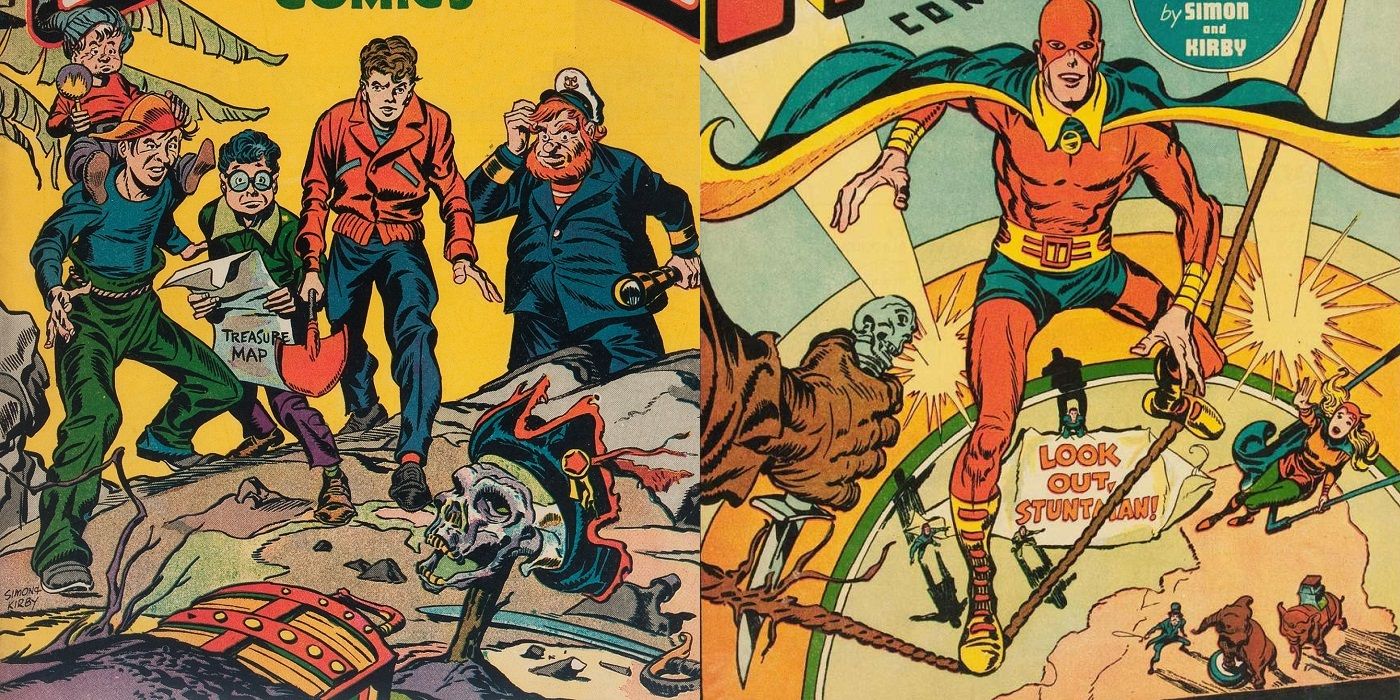
This is late, which is my bad, but to be honest, it sort of works, as I’m not positive which of these came out in March and which came out in April. In any event, today, we go back to March 1946 for Joe Simon and Jack Kirby’s debut as regular creators at Harvey Comics.
As you may or may not know, Joe Simon and Jack Kirby became two of the most notable creators in comic books in 1940 when their new creation, Captain America, was released by Timely Comics (now Marvel Comics). The character (not the first patriotic-themed superhero, but one of the earliest) was such an obviously good idea for a superhero that Simon was able to procure a deal for himself and Kirby that they would get royalties based on the sales of the character. Captain America Comics became a sensation, but Timely owner/publisher Martin Goodman refused to pay the royalties, so Simon and Kirby made the bold decision to leave Timely and set up shop at National Comics (now known as DC Comics), where their star-making skills continued with the creation of both the Boy Commandoes and the Newsboy Legion (as well as revamps of both Sandman and Manhunter).
They were selling comics by the boatload, but sadly, World War II happened, and so Kirby and Simon went into the military (National had them build up as much of a surplus of stories as they could, but obviously eventually had other creators work on the characters). Jack Liebowitz, the head of National Comics, wanted the pair to return to National when the war was over, and they initially did, but Simon had other plans.
He explained it to Mark Evanier at Comic-Con in 1998 (as transcribed into TwoMorrows’ Jack Kirby Collector #25):
We worked for Jack Liebowitz who was running DC Comics when we were up there. We had the utmost respect and affection for Jack Leibowitz. After we went off during the War, we had talks with Alfred Harvey who was very successful at that time. He was stationed in Washington, DC and I was stationed in Washington, DC and Will Eisner was stationed there. Jack was off fighting somewhere, putting up fences in the Army. But I made a deal with Al Harvey to be part of the business and get 50% shared profits. DC had voluntarily been paying us royalties on Boy Commandos–characters we left behind. They did wonderfully by us and we appreciated it, but we just couldn’t pass up this partnership deal with Harvey. And after the War, we went back there. We went back with him. It was just business; not something I’d be proud of, but that’s what you have to do in business. I guess we’re talking about a businessman again. (laughter)
Joe’s wife, Harriet, was also Al Harvey’s secretary (Simon and Kirby had done work on the side for Harvey in the past, so this wasn’t the first time they worked with him).
Simon and Kirby debuted with two new brand-new ongoing series in 1946, released around March/April, and the first one cleverly led to the second one.
The first one was Stuntman #1, where a circus aerialist is the only survivor of a sabotages highwire act that left his two partners dead (in shades of Dick Grayson’s superhero origin).
While investigating their murder, Fred Drake runs into Don Darling, a movie star who investigates murders on the side (hey, it was 1946, you try to come up with a cool idea for a character!). Shockingly, Fred and Don are doppelgangers for each other, so Fred agrees to become Don’s stuntman/double and also fight crime as Stuntman (while helping Don investigate various crimes).
It’s not a terrible concept, really. That same issue had a text story showing how a young group of boy explorers met their new leader, Commodore Sinbad.
That, naturally, led to Boy Explorers #1 the following month.
Now, if you think, “Gee, this sounds like they’re just taking their Sandman/Manhunter and Boy Commandoes/Newsboy Legion ideas and taking them to Harvey,” you’d be pretty much correct, but as it turned out, the market wasn’t looking for new superheroes in 1946 OR boy explorers, so neither series lasted very long, with other stories featuring Stuntman and Boy Explorers burned off as back-ups in other Harvey Comics.
Simon and Kirby stuck with Harvey, though, and in 1950, had ANOTHER “boy” comic, Boy’s Ranch, that proved to be a hit.
Simon and Kirby cut deals with other companies, though, as well, in the late 1940s and they launched the whole notion of romance comics, for instance, with Crestwood Publications, in 1947, while doing crime comics for Crestwood and Hillman Periodicals, as well.
If you folks have any suggestions for April (or any other later months) 2011, 1996, 1971 and 1946 comic books for me to spotlight, drop me a line at brianc@cbr.com! Here is the guide, though, for the cover dates of books so that you can make suggestions for books that actually came out in the correct month. Generally speaking, the traditional amount of time between the cover date and the release date of a comic book throughout most of comic history has been two months (it was three months at times, but not during the times we’re discussing here). So the comic books will have a cover date that is two months ahead of the actual release date (so October for a book that came out in August). Obviously, it is easier to tell when a book from 10 years ago was released, since there was internet coverage of books back then.
About The Author
