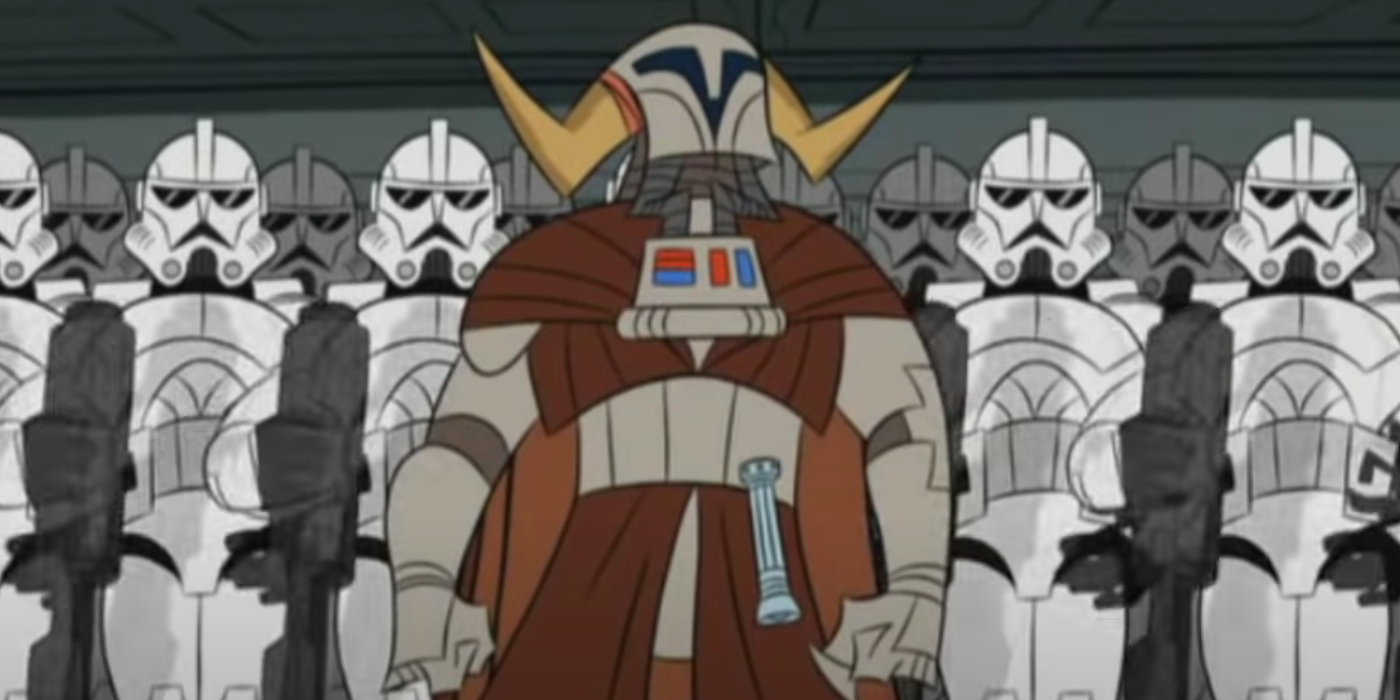
Genndy Tartakovsky’s Clone Wars was the first piece of visual media to actively explore many underdeveloped Star Wars Jedi Masters such as Saesee Tiin, whose only major appearance in the films was his death at the hands of Chancellor Palpatine in Revenge of the Sith. The Iktotchi Jedi Master was given a number of notable moments throughout the series, culminating into an epic space battle above Coruscant, where he led the hijacking of a Trade Federation cruiser.
Tiin first appeared during an unspecified battle in “Chapter 1,” where he dropped off explosive devices from his Jedi interceptor, the Sharp Spiral, against the Separatist droid army. In “Chapter 22,” he was shown flying alongside Anakin Skywalker in a dogfight against several droid tri-fighters, with the younger Jedi Knight saving the elder Master.
Click the button below to start this article in quick view.
“Chapter 23” remains Tiin’s shining moment, however, as he led a Clone battalion into space during the Trade Federation’s invasion of Coruscant. After witnessing the destruction of a Republic Cruiser, Tiin regrouped with an army of Clone jet troopers, who launched an assault on a Trade Federation Providence vessel. This epic moment was highlighted by Tiin’s oxygen mask, which resembled a Mandalorian helmet, as he bravely led his troops into battle. Using his lightsaber, Tiin cut a hole through the enemy’s ship and entered it, taking out numerous droids and before hijacking the ship’s weapons’ systems to attack other Separatist vessels. Although the end of the battle wasn’t shown, it’s assumed Tiin was successful as he later appeared in Revenge of the Sith.
Tiin is often described as one of the Jedi’s ace pilots alongside Plo Koon and Skywalker, which is thanks to Tartakovsky’s Clone Wars. The show introduced the character as an ace flyer, capable of taking down numerous Separatist forces with the Sharp Spiral and even a Separatist cruiser. This eventually paved the way for the Jedi Master’s appearance in the 3-D animated The Clone Wars TV series, as he became an integral part of space battles such as the Battle of Lola Sayu, where he rescued Wilhuff Tarkin and his men from the Citadel prison. Much of Tiin’s demeanor also remained the same from Tartakovsky’s Clone Wars to the larger Star Wars canon, with the character rarely speaking and retaining a serious demeanor.
While Tiin appeared more often during the later incarnation of The Clone Wars, Tartakovsky’s version placed the Jedi Master in the middle of the action, highlighting his skills with a lightsaber blade and a spacecraft simultaneously. It also showed his unique ability as a commander, as he was able to command the Clone troopers well enough to take on the Separatists throughout the war. This version demonstrated how valuable Tiin was toward the Republic’s cause, something that hasn’t been showcased throughout much of Star Wars‘ canon.
Tiin’s soft-spoken demeanor is also a perfect match-up for Tartakovsky’s directorial style, as he focuses on minimal dialogue, preferring the action to be the forefront of his scenes in works such as Samurai Jack. The Jedi Master was completely silent until “Chapter 23,” when he was forced to communicate with Mace Windu and his Clone battalion during his defense of Coruscant. This style allowed Tartakovsky to focus on Tiin’s unique lightsaber form Djem So, which focuses on brute strength and power, with wide, powerful strikes and parries complementing its defensive abilities.
While Tartakovsky’s Clone Wars isn’t canon, the show’s depiction of Tiin helped define his character for later appearances in The Clone Wars and Star Wars canon. His depiction may have been brief, but it was the definitive example of Tiin’s abilities as a master swordfighter and pilot, which were underutilized in his larger appearances.
About The Author
