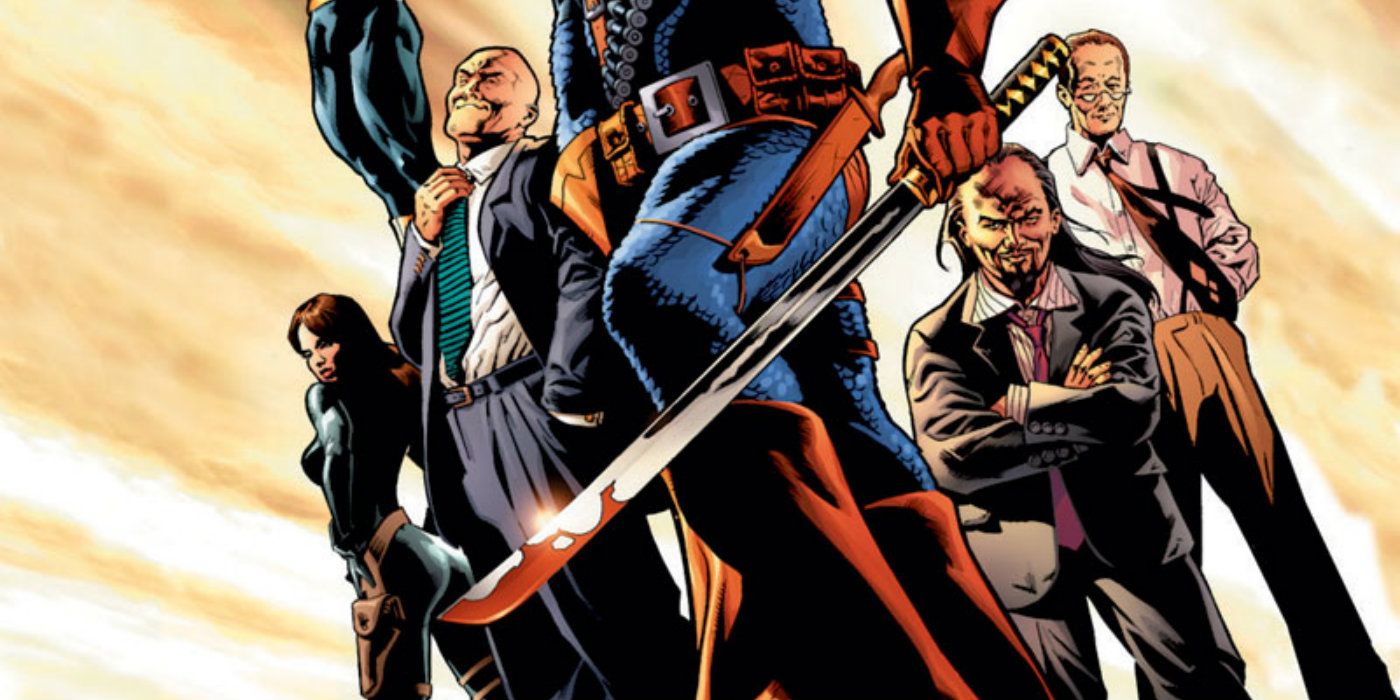
As one of the richest men in the world, and arguably its smartest, Lex Luthor is definitely a force to be reckoned with in the DC Universe. Having gone toe-to-toe with the Man of Steel for decades has cemented Lex as one of DC’s biggest villains, and the entire supervillain community knows it as well, often treating him as their de facto leader.
But in the buildup to Infinite Crisis by Geoff Johns, Phil Jimenez, and Jerry Ordway, Lex’s relationship with his criminal cohorts was forever changed. And when another Lex Luthor from a parallel Earth began usurping his status as the apex predator, Luthor nearly pushed the villain community to the edge to prove himself as the one, true Lex.
Click the button below to start this article in quick view.
Throughout the titles leading up to Infinite Crisis, Luthor had begun organizing his own Secret Society of Super Villains. Working closely with a tight inner circle that included Talia al Ghul, Black Adam, Doctor Psycho, the Calculator, and Deathstroke, Lex consolidated almost every major DC villain into one organization, with a few notable exceptions such as the Joker excluded from the group.
But while it was a Luthor who formed the Society, it wasn’t the Luthor that the other villains were familiar with. In reality, this Luthor was an imposter. Secretly, Alexander Luthor Jr. of Earth-3, the homeworld of the Crime Syndicate of Amerika, had been falsely masquerading as his prime continuity counterpart, much to the real Lex’s chagrin.
It was in the pages of the Villains United miniseries by Gail Simone and Dale Eaglesham that the real Lex began to move against the imposter. While his counterpart was content to use the power of the Earth’s villains to his liking, Luthor came to realize that even if he killed every superhero on the planet from Superman even down to Swamp Thing, he’d still have rivals for control over the Earth: his fellow villains.
In order to manipulate other criminals to his benefit, Lex hid his identity behind the codename Mockingbird and put together a small, elite squad called the Secret Six to disrupt the faux-Lex and his Society’s plans. Choosing members based on their knowledge of other villains, Lex corralled Catman, Deadshot, Cheshire, Ragdoll, Scandal Savage, and a rogue Parademon into doing his bidding.
Lex sent the Six on multiple missions to impede the Society’s progress, even sending them to interrupt a Society operation by stealing Thanagarian technology. Just as Lex had planned, the group was captured in the process, with their shared experience of captivity, torture, and escape bonding them as a unit. After Lex sent the Six to disrupt Queen Bee’s H.I.V.E. operation in Brazil, this war of escalation led to a showdown between the forces of the Society and the Secret Six, with Mockingbird’s squad demanding their freedom upon survival.
When the Six were surrounded by the Society’s forces, it’s revealed that Cheshire has betrayed the team and given the Society the location of their base, only for the assassin to be betrayed by Deathstroke. As supervillain civil war breaks out, the real Lex, content to let his Secret Six die if it furthered his goal of revenge, donned his trademark battle suit to confront his imposter face to face. While the Society’s attack is later called off after Vandal Savage infiltrates their headquarters and threatens Alexander Luthor’s life to save his daughter, Parademon dies in the process, and the group is joined by Knockout, Scandal’s lover and mole inside the Secret Society.
Lex confronts his counterpart in Infinite Crisis #3 by Johns, Jimenez, and Ordway, finding his opponent in what used to be Superman’s Fortress of Solitude, only to be dispatched and dismissed by Alexander’s partner, Superboy Prime. Despite his apparent defeat, Luthor gets the last laugh when he allows a vengeful Joker to murder his multiversal twin at the end of the event in Infinite Crisis #7 by Johns, Jimenez, Ordway, and George Perez.
Lex Luthor knows he is truly one of the most dangerous men in the DC Universe, and it’s something his Earth-3 counterpart learned the hard way. But if his personal war with the Secret Society proves anything, it’s that his greatest asset isn’t his intellect—it’s his ego.
About The Author
