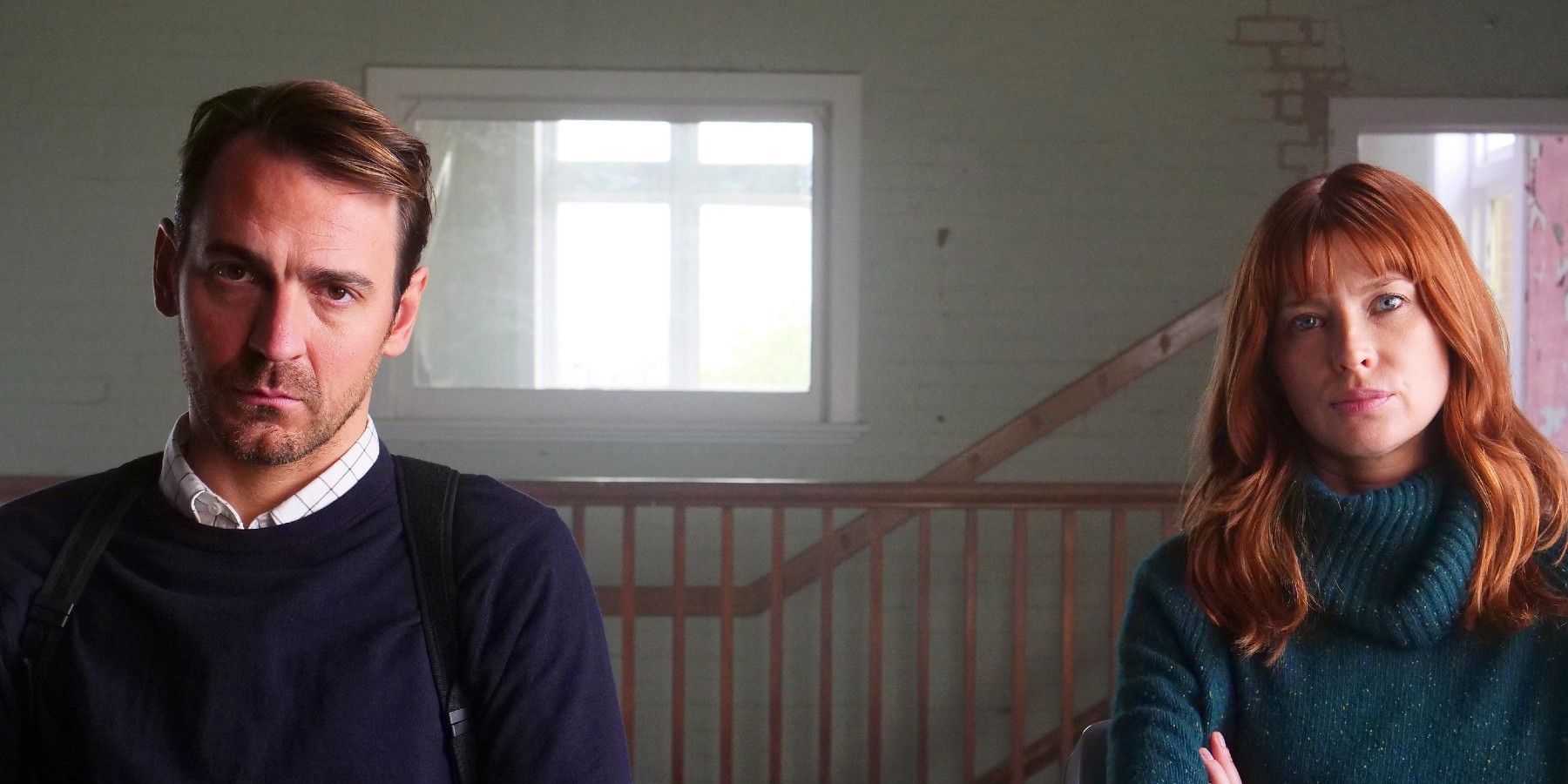
Starz has a new series this Sunday, and it’s The Gloaming. After a woman is found dead in Tasmania, two detectives, Molly McGee and Alex O’Connell, team up to discover the truth; however, as the show develops, the police procedural becomes a supernatural murder mystery. Alex O’Connell’s actor, Ewen Leslie, sat with CBR for an exclusive interview to discuss his character and this Tasmanian Gothic noir.
My first question for you is what makes The Glomming stand out from any other murder mystery show that’s currently on air right now?
Look, I think one of the big things that make it stand out and one, I suppose in a way it was always sort of the main character of the show, is the setting and where we actually shot it. Tasmania is such an extraordinarily beautiful part of the world, and it’s a part of the world that hasn’t really been seen on screen that much. And then we’ve made some films here in Australia, one called The Nightingale, and Vicki Madden made another series there called The Kittering Incident, so I suppose, in a way, that was always one of the big sort of lures of it for me.
I remember when I got off the plane when I first arrived, and I was in the car driving from Hobart, and I looked out at the mountains, and there was just sort of beautiful, lush green mountains and then this big fog that was sort of hanging low over it. I remember thinking, “Well, that’s the show, as long as we can get that.” This kind of mist and fog hangs very low over everything, sort of obscuring your vision, and kind of blurring the line between what’s real and what’s not seemed to be kind of a really sort of interesting place to shoot [The Gloaming].
I suppose that the other element is the supernatural element. It’s not just a sort of procedural cop show. It’s absolutely a ghost story, and the further it goes along, I think the more it becomes a ghost story. I think, for those reasons, it’s taking sort of the Scandi noir template and bringing sort of Tasmanian Gothic elements into it, and natural elements as well.
And when it came to those supernatural elements for you, how did that inform or affect your performance?
All you can really do is go into it and play it as truthfully as as possible. One of the first things I had to do was go, “Alright, does this guy believe in ghosts?” And I suppose going with a more interesting choice is to go with no. This is someone that doesn’t believe in ghosts, that all of a sudden is having to deal with the supernatural elements. I suppose the way of dealing with that is that there’s sort of two things going on in that there’s the literal ghosts that these characters are being haunted by, especially him. Then there’s sort of the figurative ghosts, as in the ghosts of the past and this disgrace and trauma from his past and the relationship that he’s had with this woman, Molly McGee, that’s completely unresolved from his past, that he’s sort of been running from and hiding from for the last 20 years. You might be done with the past, but the past is not done with you.
I suppose in a way, that’s the way I approached it was sort of grief and horrific trauma from the past that he hadn’t yet dealt with. That the second that he arrives back in Tasmania, he just sort of feels [the past] closing in on him. Sort of like the secondary lands… all of a sudden, the spirits sort of start closing in around him. Ultimately, I think there’s a point during the season where he realizes that he has to be a lot more proactive about it, and this is stuff that you’re going to have to fight. Ultimately, in the end, he’s the one that has to walk through the door, so to speak, to confront this history and hopefully find some sort of resolution.
Right, and kind of jumping off that, one thing I found very interesting with your character is how he’s simultaneously an outsider with this case but not, given the trauma you’re talking about in his past. What was it like to play a character that was separate but not from the main mystery of the show, if that makes sense?
No, it totally makes sense. Look, it’s really streamlined because you’re playing… I guess the challenge of it is, and I think Emma had a similar challenge playing Molly. I suppose as an audience, you’re kind of given more time with her early on, or certainly given more time into her life and stuff like that, whereas we never meet me back in Melbourne. I think the throughline for it is that you’re playing someone who is very closed off and very insular. But at the same time, he’s also very vulnerable, so you’re constantly trying to find a line between places that you can be very closed off and shut people out and even shut the audience out at a time, but then find the moments where they’re sort of flickers a vulnerability, or that you can find places to be available to let the audience in and let the other characters in.
You know, I was lucky in that Vicki sort of charted… you know, early on, it was very tricky. But as we went along, I think we charted a very clear journey for Alex, so that the further I went along, the more I kind of realized that [Vicki Madden] did a lot of that work for me. You know, I was in New Zealand, shooting a show called The Luminaries that I think just screened on Starz, and literally due to the schedule of the shows, I ran The Luminaries, flew to Tasmania, and I think I was shooting a few days later.
Oh, wow.
It was kind of helpful for the character of mine because I quite literally ended in Hobart, and I had my hair cut, so I was given a trench coat and met Emma and had some discussions, but I was really thrown into it very quickly, and you can either kind of fight against that, or you can go with it. I just let that sort of inform the process.
Great, and going back to how you’re talking about your dynamic with Emma, what was the most exciting thing about working with her on the show?
Look, I’ve been a big fan of hers for a long time, and I’ve seen her in a film called Hounds of Love, that is a very dark. It’s a very, very heavy film, but her performance in it is transformative. I mean, if you’ve never seen her, having watched The Gloaming, you would not believe it’s the same person. I had long really wanted to work with her because I’ve seen her in other things.
But at the same time, even though we’ve actually done a short film together for… I think we worked together for a day and that was like… I think it could have almost been 10 years beforehand. But we both grew up in Fremantle in Western Australia. We didn’t know each other there, but we both grew up in Fremantle. We both had family who lived down the south coast of Western Australia, and we both had done television as kids in WA, Western Australia, when we were growing up, separate shows. So I think it was kind of helpful in that — although I’d never worked with her before, and I hadn’t spent much time with her before — we really sort of had this shared history of where we come from and what our experiences were. To be honest, it was a very easy thing to sort of fall into.
Emma’s a very reactive actor. You can kind of throw anything at her, and she’ll go with anything. I suppose we were very lucky in that, you know, obviously in terms of the show there’s a case to be solved, but at the center of it and at the heart of it, I think it’s truly a relationship drama, and it’s these two people over the course of the eight episodes, learning how, just two broken people learning how to heal themselves, but also learning how to heal each other. And I was very lucky that I went through that… I was able to go on that journey with Emma.
Wonderful and compared to past work you’ve done and other roles you’ve had, how has being Alex differed from what you’ve done in the past? What’s been the most different, the most challenging for you?
I mean firstly, I’ve never done a police procedural before, and that is something that requires getting your head around. I suppose a lot of the stuff I’ve done before had been sort of… in a way I guess I’ve done a lot of sort of shows that you would classify as melodrama. Sometimes melodrama gets a bad word or a bad rap, but a lot of kind of dramas that we’re creating today. I like that sort of high concept thing, and I’ve been in series like Top of the Light, where I play sort of like a nice, open guy, and then I’ve done a show called The Cry, where I played kind of a borderline sociopath, and then I went and did The Luminaries, where I played, you know, sort of a Northern English prospector. As opposed to my… I’m trying of find the answers. That’s probably quite frustrating, so I apologize.
No, you’re good.
I think a lot of the people I played in the past had been very proactive characters. I mean, they weren’t necessarily people that you were like, “Wow, I wonder what that character is thinking?” People who told you what they were thinking and were very on the front foot in going about what they were asked. And [Alex] was someone who was very much the opposite of that, and he was very on the backfoot; he was very closed off.
You know, at the beginning of the series, we meet him. He’s essentially going, “I’m going to come here and do this, then I’m gonna get out and get back to my life, and I don’t want to deal with any of this.” You know, he’s someone who’s not there to make friends, and I think that was a big difference in regards to people I’ve played before, but also one of the great challenges of mine.
I was wondering what you hope audiences take away from the show?
I hope that they go on the journey with the characters. And then one of the things I really liked about the scripts when I first read them is that — the first four scripts that I was given — it didn’t do what I expected it to do, in that in the very first episode you know who the killer is. Like I think even from the very first scene you know who the killer is, so it doesn’t really become a who done it. It becomes a why done it, and I think that’s what immediately grabbed me about it.
And the other thing is that the scenes, it didn’t do what I expected it to do. But then the scenes that I didn’t expect it to do happen at times when I didn’t expect them to, if you understand? Like, there were things that happened sort of Episode 4 that I was like, “Oh, wow. I didn’t think you’d be doing that until Episode 8.” And, you know, I think it takes twists and turns that people don’t fully expect and don’t realize are going to happen. Ultimately there’s story at the center that people get invested in and go with, and that certainly seems to have been the case here in Australia, so I’m looking forward to it going overseas.
Wonderful, and my last question for you is if you could describe the show in three words, what would they be?
In three words?
Yeah.
Tassie noir. As in Tasmanian noir.
I like that.
Tasmanian noir. No, no. I have three words. Tasmanian noir mystery.
The Gloaming stars Emma Booth, Ewen Leslie, Martin Henderson, Aaron Pedersen, Rena Owen and Lily Broomhall. The series airs Sundays at 9:00 p.m. ET/PT on Starz.
About The Author
