WARNING: The following contains spoilers for Zack Snyder’s Justice League, now streaming on HBO Max.
With the release of Zack Snyder’s Justice League, the director is finally able to deliver the 2017 film as he originally intended, right down to a 4:3 aspect ratio that looks weird on modern television screens, and an ending that sets up a sequel — or sequels — and a vision for what was supposed to be the next several years of the so-called DC Extended Universe.
It’s not exactly the “massive cliffhanger” Snyder touted in recent interviews, but it undoubtedly provides the director with some sense of creative closure, even as it teases a cinematic future that, by all accounts, fans will never see.
Still, with its nearly 30-minute “Epilogue,” Zack Snyder’s Justice League presents a lot for us to unpack, with the introduction of the fledgling team’s seventh member, with potential for an eighth), a new partnership between Lex Luthor and Deathstroke, a Knightmare vision, and additional layers to the Batman/Joker relationship.
Introducing … The Atom?
Cut from the film’s theatrical release, the scenes featuring Ryan Zheng as Silas Stone’s assistant, Ryan Choi, are restored in Zack Snyder’s Justice League. Although his importance to the film’s storyline is limited (he was relegated to a mere Easter egg in Joss Whedon’s version), Snyder clearly planned a larger role for the character in a sequel.
For evidence, look no further than the prominence of Choi in the epilogue’s montage depicting the heroes beginning new phases in their lives. In the brief scene, Choi is named Stone’s replacement as director of nanotechology at S.T.A.R. Labs, hinting at his potential future costumed identity: In DC comics, Ryan Choi is the third hero to use the name Atom. A protege of the previous Atom, Ray Palmer, Choi used his size-manipulating bio-belt to take up the mantle, and, eventually, became a member of the Justice League.
Lex Luthor & Deathstroke Have a Different Sort of Alliance
The Joss Whedon-directed mid-credits scene from the theatrical release, depicting the start of a race between Superman and The Flash, has been jettisoned, but the original post-credits scene remains — albeit with some noteworthy differences.
In its 2017 form, the scene opens with a prison guard discovering that Lex Luthor (Jesse Eisenberg) has escaped, replaced in his cell by another inmate. Luthor is revealed to be relaxing miles away on a yacht, where he’s joined by Slade Wilson, aka Deathstroke (Joe Manganiello). Luthor informs the assassin that the newly resurrected Superman has joined with other heroes to form a league, and recommends they “level the playing field” by creating “a league of their own.” That was not only a setup for Manganiello’s intended role in Ben Affleck’s The Batman, but also either for a rumored plan to assemble a Legion of Doom across multiple films, or else Snyder’s own idea for a Justice League sequel.
Snyder’s take, part of a larger epilogue instead of a post-credits sequence, firmly establishes the location of Luthor’s detention as Arkham Asylum (or, rather, “Arkham Home For the Emotionally Troubled”), but otherwise the first part of the sequence plays out as we remember. That changes when the action moves to the yacht, where Luthor’s proposal is radically altered. He doesn’t offer Deathstroke founder’s status, but instead something far more valuable for someone who’s accepted a contract (free of charge) to destroy Batman: the vigilante’s secret identity. Granted, considering the Dark Knight intends to use the ruins of Wayne Manor as the Justice League’s headquarters, that information may not hold as much currency as it once did.
A Fuller, More Twisted Knightmare Vision of the Future
Few scenes in Snyder’s Batman v Superman: Dawn of Justice have been as pored over by fans as the Knightmare, which offered a glimpse of a possible apocalyptic future in which Superman effectively turns evil after Darkseid kills Lois Lane. The defeat of the insurgency led by Batman leads Barry Allen (Ezra Miller) to travel back through time to present a warning to Bruce Wayne (Ben Affleck). It’s little surprise, then, that Zack Snyder’s Justice League further showcases the nightmare scenario that so resonated with the filmmaker and his devotees.
The groundwork is laid earlier in the film, as the heroes set out to resurrect the fallen Superman (Henry Cavill) so they might have a fighting chance against Steppenwolf and the forces of Apokolips. As he interfaces with the Mother Box, Cyborg (Ray Fisher) receives hellish flashes of an Earth conquered by Apokolips: Wonder Woman (Gal Gadot) burned on a funeral pyre by grieving Amazons as Darkseid sits on the throne of Themyscira; King Arthur, aka Aquaman (Jason Momoa), impaled with his own trident; and an enraged Superman (Henry Cavill) holding the charred, skeletal remains of Lois Lane, and then hovering above the ruins of the Hall of Justice, the body of the Green Lantern Kilowog visible amid the rubble.
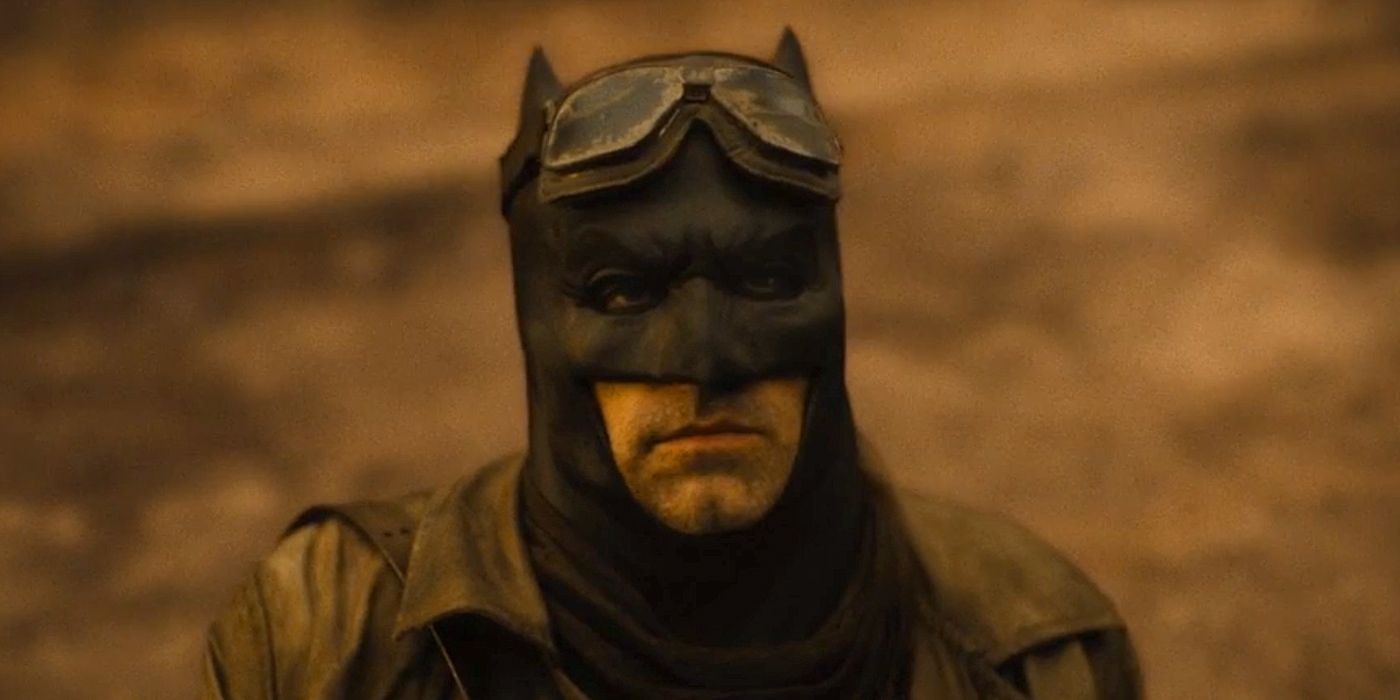
The film’s penultimate scene picks up on a scorched Earth, as Batman, in his now-familiar leather duster, evades Parademons alongside his fellow insurgents: Cyborg, The Flash, Mera (Amber Heard), Deathstroke and, yes, The Joker (Jared Leto), who wasn’t part of Snyder’s original plan.
While Snyder intended to more fully explore this Knightmare timeline in Justice League sequels, it’s important to remember that here, at least, this is playing out in Bruce Wayne’s head. It’s certainly possible the vision is residue, of sorts, from The Flash’s time-travel shenanigans in Batman v Superman. Otherwise, there may be a few more bats in the belfry than anyone previously suspected. If this is Bruce’s subconscious at work, then a Mera thirsty for vengeance is understandable. But The Joker playing the role of his conscience — his twisted, gun-toting Jiminy Cricket, if you will — requires further dissection.
This isn’t exactly Leto’s Joker from 2016’s Suicide Squad, of course. The absence of facial tattoos in the first look signaled as much, and Snyder confirmed in February that Batman’s arch-nemesis would be part of a Knightmare scene. It goes beyond that, though. Here, The Joker is more withdrawn, which is no doubt owing to the way the scene was stitched together, with new footage. Yet Leto plays the character differently, too, as if he’s channeling a young John Travolta. Snyder characterized his role as “sort of the Ghost of Christmas Yet To Come,” but he’s also a grim reminder of the failures of Batman’s past.
When Mera asks what the Dark Knight knows about love and loss, The Joker is eager to chime in with well-placed barbs about his parents, and “an adopted son,” a reference to the fallen Robin memorialized in Batman v Superman. This would seem to be the dream-Joker giving voice to Bruce’s own guilt, not only about the death of his sidekick but also about possible future failures (including his inability to save Lois Lane, and the destruction of the world in multiple alternate timelines). That’s next-level self-torment.
Yet there are still more layers to the exchange, as Batman repeatedly warns The Joker not to cross the line, prompting what will undoubtedly be the most talked-about line in Zack Snyder’s Justice League: “You won’t kill me. I’m your best friend. Besides, who’s gonna give you a reach-around?”
Again, if this is purely Bruce’s subconscious and not some echo of future events, then the first part is recognition by the vigilante that he and his archenemy share a kind of kinship — and that they need each other. (No, not in that way — or at least not only in that way.) As for the second part … Plenty has been written about the psychosexual nature of the Batman/Joker dynamic; filmmaker John Carpenter even wrote a comic story in which the villain’s sadomasochistic kink is revealed to be getting choked to death by the Dark Knight. However, it’s unlikely anyone expected Zack Snyder to contribute to that discussion. Fair warning: Expect a lot of “reach-around” references on social media over the next few days (well, a lot more than usual).
The Seven, (Almost) United
For anyone paying attention to the winding journey of the Snyder Cut, and the director’s trail of breadcrumbs on social media, the inclusion of Martian Manhunter isn’t exactly a surprise. After all, the director teased as early as 2019 that he intended for Harry Lennix’s General Calvin Swanwick to be revealed as J’onn J’onnz, validating fan theories that date back to the release of Man of Steel. Far more recently, Snyder teased concept art of the hero, which was followed months later by Lennix confirming he had shot scenes for the Snyder Cut. And so, yes, Martian Manhunter appears, in a pair of scenes, one early on and the other at the very end.
Overlooking the unpolished nature of the CGI (a problem throughout the film, from the ancient battle against Apokolips to Cyborg’s armor), the official introduction of Martian Manhunter is still undeniably weird. Masquerading as Martha Kent (Diane Lane), the shape-shifting alien pays a visit to a grieving and withdrawn Lois Lane (Amy Adams) to encourage her to “come back to the living.”
J’onn J’onnz is a telepath who counts invisibility among his many powers, so it stands to reason that he might be intimately familiar with the finances of Superman’s widowed mother, even if the ethics of how he gained that knowledge are highly suspect. That said, we’re left to wonder why he seeks out Lois: Is he simply trying to help someone whom he knows is in pain, or does he recognize the larger role she has to play, both in the Man of Steel’s resurrection and in his potential downfall?
Whichever’s the case, it seems clear Snyder views Martian Manhunter as an inspirational figure, on par with Superman. Why else would the director parallel the sonic boom that heralds the arrival of the evil Man of Steel in the Knightmare vision with the one signaling the approach of J’onn J’onnz, just as Bruce wakes at the Glasshouse? In flight, Martian Manhunter cuts a figure virtually identical to that of the Last Son of Krypton (it’s certainly possible some of the CGI is recycled), but it’s in his words that the comparison really shines through.
“There’s a war coming, and I’m here to help,” he tells a bleary-eyed Bruce, unfazed by the unannounced appearance on his doorstep of a flying green alien. “I’ve gone by many names, and taken many forms. And, like you, I’ve realized I have a stake in this world, and it’s time I started fighting for it.”
As hopeful as those words are, they also hint at long period on Earth, spent in secrecy, something only underscored by his assertion, “You know, I never thought I’d see the defenders of Earth united and fighting as one. It wouldn’t have happened without you, Bruce. Your mother and father would be proud.” If those words suggest J’onn J’onnz knew Thomas and Martha Wayne, their potential significance apparently escapes the World’s Greatest Detective.
As final scenes go, it’s certainly anticlimactic, likely leaving the audience — or at least those members who aren’t die-hard Martian Manhunter fans — as unimpressed as Bruce Wayne was by his surprise visitor. But you have to wonder if it might have been viewed more kindly in 2017, before the actual cliffhanger of Avengers: Infinity War, at a time when a Justice League sequel, or even a trilogy, was still a possibility.
Streaming now on HBO Max, Zack Snyder’s Justice League stars Ben Affleck as Batman, Gal Gadot as Wonder Woman, Henry Cavill as Superman, Amy Adams as Lois Lane, Jason Momoa as Aquaman, Ezra Miller as The Flash, Ray Fisher as Cyborg, Jeremy Irons as Alfred Pennyworth, Diane Lane as Martha Kent, Ray Porter as Darkseid, Ciarán Hinds as Steppenwolf, Jesse Eisenberg as Lex Luthor and J.K. Simmons as Commissioner Gordon.
About The Author