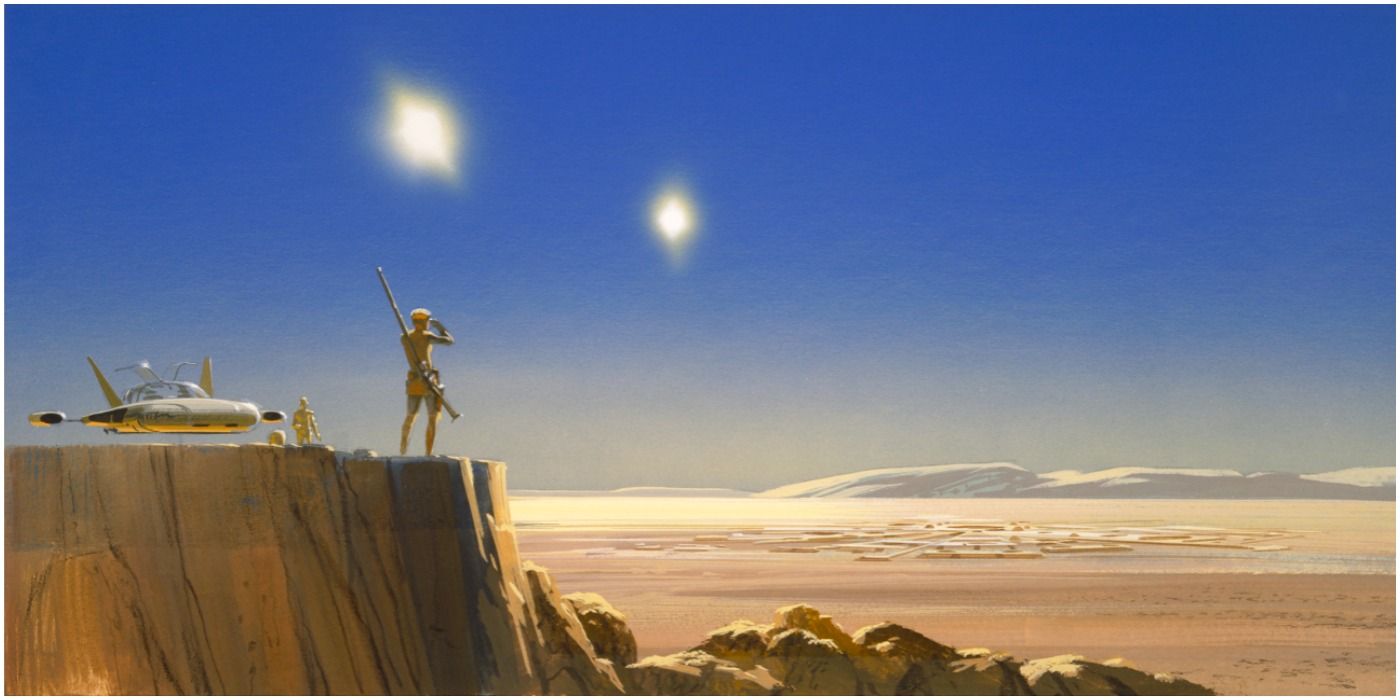
Star Wars has often come under fire from sci-fi purists for its use of single biome worlds — worlds dominated by one ecosystem instead of the variety we find on Earth. The easy response has simply been to cite its status as space fantasy, which frees it from scientific confines and lets it be whatever it wants to be. Further, there’s the simple fact that single biome worlds are cool and provide easy visual stamps and thematic texture to let audiences know where we are in the story. In the Star Wars Universe, different planets have unique visual identities. For example, Jakku and Tatooine both look distinctive, despite both being desert planets. Jakku’s scenes were filmed in the UAE, while Tatooine was famously shot in Tunisia.
Click the button below to start this article in quick view.
But those reasons, while sufficient, still imply a certain shabbiness that Star Wars simply doesn’t deserve. It simply isn’t the case that Star Wars does space fantasy because it’s easier than doing the work required for something weightier. The presence of single-biome worlds in the franchise isn’t just scientifically plausible, but necessary for the story’s themes to work.
Single Biome Worlds Are Nothing New, in Science Fiction or Reality
Star Wars has its roots in the pulp serials of the 30s, and before that the works of authors like Edgar Rice Burroughs. The romanticism of far-flung locales was an easy way to generate interest, and transposing it to alien landscapes could enhance the drama quickly without getting down into the weeds about how and why a certain planet was the way it was.
Star Wars, first and foremost, was an effort to recreate those pulp-style adventures without the cheapness or slapdash approach that marked their inception. Lucas went to North Africa rather than settling for Ventura for his desert. He took the time to get as many different interesting aliens into the Cantina as he could, rather than relying on a single uniform look to save money. The result was a world that felt real and had a past that could be grasped instantly. That it was also an inhospitable global desert allowed Lucas to tip his cap to the best parts of his inspiration without succumbing to the worst.
Furthermore, if one returns to those pulp roots – specifically Burroughs and his Mars series – suddenly we see real-world astronomy afoot. Science knew that Mars was a desert planet when Burroughs wrote his novels. Burroughs simply responded to the science as “proper” science fiction does. Just examining our own solar system, proves that single biome planets are the norm rather than the exception. Jupiter’s moon, Europa, is covered in ice. Neptune is a uniform blue. The clouds of Venus hide a volcanic landscape very similar to Mustafa. Earth may be alone in the diversity that Star Wars critics claim is scientifically accurate.
Symbolism Matters in Good Science Fiction, and That Applies to Environments Too
It’s ironic that Lucas wore his influences on his sleeve. Frank Herbert was notoriously dismissive of Star Wars: intimating that Lucas had “stolen” Arrakis from his Dune series for Tatooine. Both are desert planets and home to a messiah. But Herbert’s criticism is disingenuous because he was simply pulling from common religious symbolism that had existed for thousands of years. Prophets like Moses came from the desert in mythic stories because the desert was intended as a crucible to confront one’s own mortality and the existence of life after death. Herbert pulled from it for the same reasons Lucas did: the environment fit his purposes.
Nor is such symbolism limited to mystic or theological themes. Rebel forces hide on desolate planets because no one went looking for people there, and it would only follow that such planets held harsh emotional extremes. For all of the religious significance of the desert environment, Tatooine was also presented as a place that both Luke and Anakin wanted to get far away from. Even alien worlds get boring for those who grow up there.
Part of George Lucas’s genius in Star Wars was seeing the potential in earlier films and ideas and showing them to the world in a new way. The “theme planets” with single biomes were a key part of that, and those who dismiss them as lazy or unrealistic ignore how important they are to the fabric of the stories being told. Star Wars endures not despite such qualities, but because of them.
About The Author
