Warning: The following contains minor spoilers for Eternals #3, by Kieron Gillen, Esad Ribic, Matthew Wilson and VC’s Clayton Cowles, on sale now.
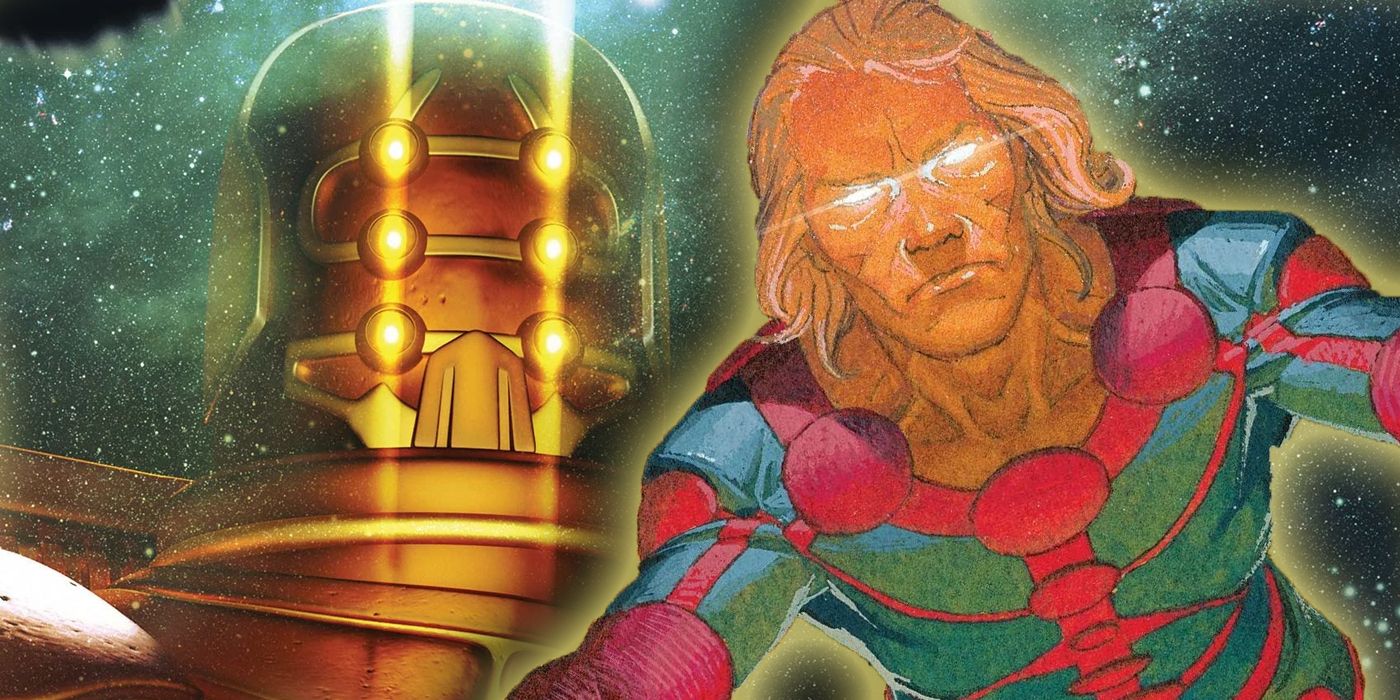
The Eternals‘ history with the Celestials dates back throughout the history of humankind. Without the Celestials, the Eternals wouldn’t exist in the first place. However, the Eternals recently cut ties with their creators.
In Eternals #3, Thena is confronted about her conversation with Zuras by Kingo, Sersi and Sprite. It’s revealed that Thena spoke to Zruas about her plans for the Eternals. While their “natures” remain the same, Thena elaborates, their duty to the Celestials is over. Considering the longstanding connection between the Eternals and the Celestials, Thena presents some strong new ideas going forward. As a people, the Eternals have essentially been redefined.
Click the button below to start this article in quick view.
The Celestials’ First Host, where they first visited Earth, set the stage for their relationship with the Eternals. In Uncanny X-Men Annual #13, in a story by Peter Sanderson and Mark Bagley, the details of the First Host were unveiled. About one million years ago, the Celestials arrived to alter the genetic makeup of humankind. Three distinct races were formed: Eternals, Deviants and ordinary humans.
The Celestials also planted latent genes in humans which would later produce superhumans. This First Host spawned the Eternals as god-like beings, who, for the longest time, believed their purpose was to protect humanity. The Eternals’ purpose continued during the Second Host, in Amazing Spider-Man Annual #23, by Sanderson and Bagley. When the Deviants attacked, the Celestials enacted the Great Cataclysm, flooding the planet and sinking Atlantis. The Deviants were decimated, along with most humans, but Eternals such as Ikaris managed to save a few humans by placing them in an ark.
To protect humanity, the Eternals generally sought to serve the Celestials’ goals as well. In Thor Annual #7, by Roy Thomas and Walter Simonson, the Eternals erased Thor’s memories of an encounter in which he clashed with the Deviants. With Thor mind-wiped, he would retain no knowledge of the Celestials, so they could return for the Third Host.
During the Third Host, the Eternals worked alongside the Celestials to cultivate humanity. Outside forces like the Asgardians and Olympians were forbidden from interfering with humankind until the Fourth Host. At the same time, the Eternals and the Deviants made a truce so that they wouldn’t interfere with humanity either.
It wasn’t until Thor #300, by Ralph Macchio, Mark Gruenwald and Keith Pollard, that the Celestials returned for the Fourth Host. At this point, however, the Eternals fought the Celestials so they could defend humanity. Working alongside Odin and his Destroyer armor, the Eternals formed a Uni-Mind to stop the Celestials. Ultimately, however, these efforts weren’t enough. The Celestials had to be appeased somehow, so Gaea, an Elder God of Earth, offered the deities twelve young gods from each pantheon.
The Eternals truly reached their breaking point with the Celestials in 2018′ Avengers #4, by Jason Aaron, Ed McGuinness and Paco Medina. During this storyline, Zgreb, a fallen Celestial, infected the planet. Awakened by Loki, Zgreb killed a few of its fellow Celestials and transformed others into Dark Celestials. The Avengers went to get help from the Eternals, but by the time they arrived in Olympia, the cosmic beings were dead.
Apparently, the Eternals had learned that their true purpose was not to protect humanity. Instead, the Eternals were to cultivate superhumans as a pathogen against the Horde, an evil group of insect-like beings. The truth drove the Eternals mad and led them all to commit suicide. It makes sense that this knowledge would turn the Eternals against their creators, as their entire existence turned out to be a lie.
Rather than the benevolent deities they believed themselves to be, the Eternals were essentially tools to cultivate superhumans. This state of disillusionment is likely what deterred the Eternals from ever serving the Celestials again. Moreover, the pain of this truth led to a mass suicide, which cemented the devastation of this truth. Now, with the Eternals back in the land of the living, they have a chance to create their own purpose, carving a new place for themselves.
About The Author