Usually, supervillains will be slotted into the rogues gallery of the superhero whose series they debuted in; their first appearance is used to establish the animosity, then if readers like the villain enough, they’ll return in short order. It’s a proven formula that has governed superhero storytelling for decades.
However, this isn’t always the case; sometimes, a villain will first appear as an antagonist of one hero then migrate to a different series. TV Tropes has dubbed this phenomenon “the Rogues Gallery Transplant” and it’s one most frequently seen in comics.
10 Vermin Debuted Against Captain America Then Fought Spider-Man
Vermin was created by writer J.M. DeMatteis and artist Mike Zeck during their run on Captain America; once geneticist Edward Whelan, he was mutated into a rat-like monster by Baron Zemo & Arnim Zola. After being defeated by Cap, the two battled again in Marvel Team-Up #128 (by DeMatteis & Kerry Gammill); this time, Vermin was defeated with the help of Spider-Man. Since then, Vermin has become more of a Spider-Man villain than a Captain America one; he was used again by DeMatteis & Zeck during their 6-part Spider-Man epic, “Kraven’s Last Hunt.”
9 The Shade First Fought The Flash, But He’s Most Famous For Battling Starman
The Shade is one of the oldest villains in the DC Universe; created by Gardner Fox and Hal Sharp, he debuted in Flash Comics #33 as an enemy of the Jay Garrick, the Golden Age Flash – he later returned in the Silver Age for the iconic “Flash Of Two Worlds” story by Fox & Carmine Infantino, battling Garrick and the Earth-1 Flash, Barry Allen.
The darkness-controlling villain is still associated with the Flash, appearing in Justice League Unlimited and The CW’s The Flash. However, his most famous comic role was in James Robinson’s Starman; the first Starman (Ted Knight) had been an enemy of the Shade’s, but he became something of a mentor figure to the second, Ted’s son Jack.
8 The Floronic Man Bounced Around Before Becoming One Of Swamp Thing’s Foremost Foes
It took a while for Jason Woodrue to settle into one hero’s rogues gallery. He debuted alongside Ray Palmer in Atom #1 (Gardner Fox & Gil Kane) then became the Floronic Man in The Flash #245 (Cary Bates & Irv Novick). After battles with Green Lantern, Wonder Woman, and the Justice League, Woodrue finally found his niche with the help of Alan Moore.
In Moore and Stephen Bisette’s Saga Of The Swamp Thing #21 (“Anatomy Lesson”) Woodrue is hired by Avery Sunderland to research an inert, presumed dead Swamp Thing. Woodrue discovers that Swamp Thing is not Alec Holland transformed into a plant-being, but a plant creature with the dead Holland’s memories. Freeing Swamp Thing and informing him of this truth, Woodrue becomes the villain of Moore and Bisette’s first arc. Since then, the Floronic Man has mostly fought Swamp Thing, for they’re natural foils: Woodrue is a man trying to be a plant, and Swamp Thing is a plant who wishes to be a man.
7 Mystique First Appeared In “Ms. Marvel” But She’s Definitely A X-Men Villain Now
Mystique was created by Chris Claremont & Dave Cockrum while the writer-artist team was working on Ms. Marvel, and so she debuted as an adversary of Carol Danvers. After Claremont began writing the resurgent X-Men, he brought Mystique back; her return appearance in “Days Of Future Past” had her leading a new line-up of the Brotherhood of Mutants.
Since then, Mystique has unquestionably become an X-Men villain. All of her closest relationships in the Marvel universe, including the ones with her adopted daughter Rogue and her son Nightcrawler, are with her fellow mutants. She’s also appeared in almost every X-Men adaptation, from animation to film.
6 The Purple Man Began As A Daredevil Villain, But Now He’s Jessica Jones’ Arch-Enemy
Zebediah Killgrave, the purple-skinned, mind-controlling supervillain, first appeared as an enemy of Daredevil. Similar to Woodrue over at DC, Killgrave bounced between different villains; for the 20th century, his most famous appearance was in Avengers story “Emperor Doom,” where he was just a pawn of the true, titular villain.
This changed after the turn of the millennium; Brian Michael Bendis and Michael Gaydos’ Alias, the debut appearance of Jessica Jones, revealed that the heroine had fallen under Killgrave’s control, and it was this episode that ended her superhero career. Netflix’s Jessica Jones, based on Alias, featured the Purple Man (known only as “Kilgrave”) as the villain of its first season.
5 Vandal Savage Was Once Just A Green Lantern Villain, But He’s In Bigger Leagues Now
Created by Alfred Bester and Martin Nodell, the immortal Vandal Savage debuted as a one-off villain of Alan Scott, the first Green Lantern. Years later, in Robert Kanigher’s All Star Comics #37, he resurfaces as a member of the Injustice Society. For much of Pre-Crisis DC history, Savage remains a foe of the Justice Society.
Post-Crisis, however, with the JSA and JL’s histories and worlds merged, Savage has since not restricted himself to a vendetta against one group or individual. It’s more accurate to describe him as a villain of the DC universe as a whole, reflected by his appearance in Young Justice as the head of villainous alliance “The Light.”
4 Solomon Grundy Is Another Former Green Lantern Villain Who Now Menaces The Whole DC Universe
Solomon Grundy followed much the same path as Vandal Savage; created by Bester and Paul Reinman as an adversary of Alan Scott, the undead villain (once known as Cyrus Gold) has since become unbound, less of a villain for any specific hero than one for the entire DC Universe. Though not in the same league as Savage, Grundy has menaced Superman, Green Arrow, and the Justice League.
There have been attempts at tying him to Batman, but Grundy is too frequently seen elsewhere to be counted exclusively as a Batman villain.
3 Deathstroke Is A Major Teen Titans Villain, But He Fights Batman More These Days
A more successful addition of an established villain to Batman’s rogues gallery has been Deathstroke. Debuting in Marv Wolfman and George Pérez’s The New Teen Titans, Slade Wilson was initially thought of as the arch-enemy of Dick Grayson. In recent years, however, he’s graduated from the Robin to the Bat, frequently clashing with the Dark Knight. When The Batman was still starring Ben Affleck, Deathstroke was set to be its villain.
Though lambasted by some as a cynical branding exercise, there is a reason for it; Batman doesn’t have many villains who pose a physical threat to him, and since Deathstroke likewise relies mostly on athleticism and gadgets, duels between the two are always exciting.
2 Sabretooth Was Once A Minor Iron Fist Villain, Now He’s Wolverine’s Arch-Enemy
Victor Creed is another Claremont-created villain who was imported to the X-Men. Debuting in Iron Fist #14 by Claremont and John Byrne, Creed faced off with Iron Fist several times. However, in 1986’s “Mutant Massacre,” he appeared in the employ of Mister Sinister and was revealed as a mutant. Since then, Sabretooth’s history with Iron Fist has been virtually forgotten; now, he’s the nemesis of Wolverine. Creed makes a better foil to Logan than he ever did to Danny Rand; while Wolverine suppresses his savagery, Sabretooth embraces it.
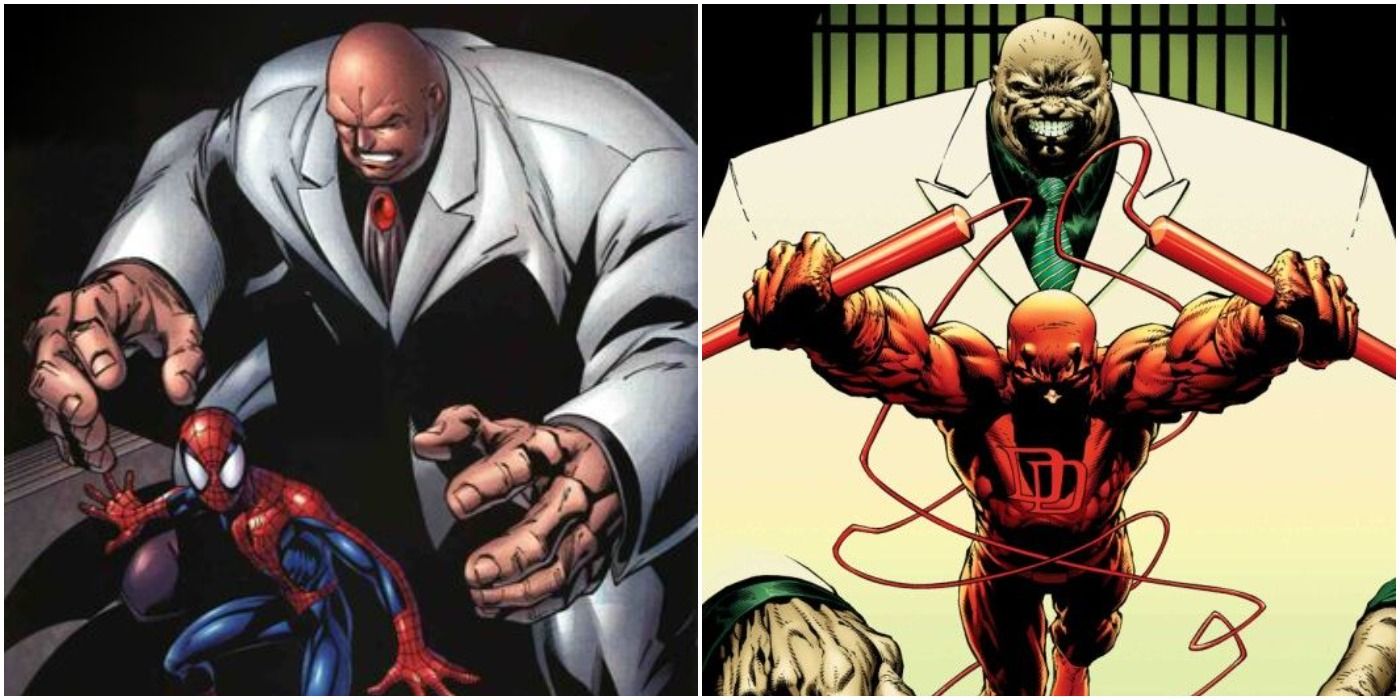
1 Kingpin Started As A Spider-Man Villain, But His Rivalry With Daredevil Is Even Bigger
Easily the most famous case of this phenomenon is how the Kingpin went from a recurring Spider-Man villain to the arch-nemesis of Daredevil. When Frank Miller took over Daredevil, he brought a gritty, noir atmosphere – part of that involved ditching much of Daredevil’s villains for more realistic gangsters. For the main villain of the book, Miller brought in the Kingpin; their rivalry comes to a head in “Born Again,” when Fisk discovers Matt Murdock’s identity and makes life hell for the Devil.
Now, Fisk still frequently appears in Spider-Man media, but his rivalry with Daredevil undoubtedly has more bad blood on both sides. Indeed, both live-action Daredevil adaptations (the 2003 movie and 2015 Netflix series) use the Kingpin as the main antagonist.
About The Author