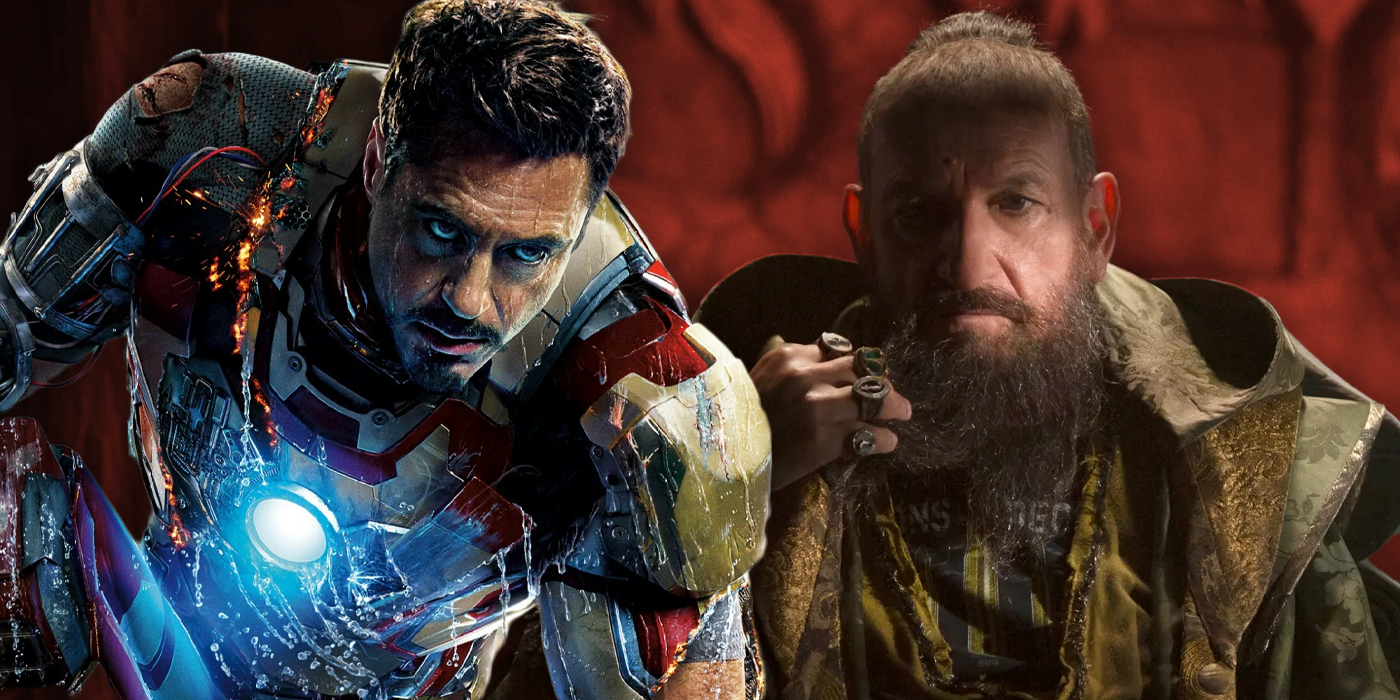
Iron Man 3 is certainly one of the Marvel Cinematic Universe’s most controversial films. Though it has its supporters, others have laid many criticisms against the film since its release in 2013. In large part, this comes from the film’s portrayal of The Mandarin, one of Iron Man’s most popular villains. Many have argued that the film, which reveals that The Mandarin is nothing more than a stage name put on by actor Trevor Slattery in order to intimidate the public, has tarnished the character’s legacy in favor of a cheap joke. But in truth, The Mandarin twist is far from the film’s worst flaw; in fact, it’s merely a piece of a much more substantial issue.
In defense of the twist, it was almost certainly the best way to avoid the potential racial insensitivity of the character. The classic comic book incarnation of the character has a long history of racist undertones that would’ve been horrible if adapted accurately. And to that end, the film did a fairly good job; name aside, the MCU version of the character manages to avoid the majority of the racial stereotypes associated with the comics character. But unfortunately, that was never the biggest problem with the twist. Instead, the film’s greatest struggle is with setup and payoff.
In storytelling, there’s a common technique called setup and payoff. This concept explains that the most satisfying conclusions to stories are the ones in which all the key components have been established prior — think Chekhov’s gun, recurring jokes and basic character arcs. Setup and payoff is designed to establish everything the audience needs to know ahead of time, and in doing so makes the payoff of those setups feel all the more earned. And this is the core flaw of Iron Man 3: though its setups are exceptional, the payoffs range from underwhelming to insulting to even nonexistent.
Take, for example, the scene in which Tony has to rescue the passengers of a crashing plane. His armor is damaged, the passengers are scattered all over the place, and he doesn’t have time to save them all. But just in the nick of time, through his sheer determination and intelligence, he manages to rescue each and every one of them. It’s a powerful moment, one that showcases Tony Stark’s greatest traits… that is, until it’s revealed that he was never even inside the armor, and instead was simply controlling it remotely. Though a seemingly minor thing, it takes away from a great payoff by minimizing Tony’s involvement.
Or, for another example, The Mandarin himself. Initially, the character is established as an imposing threat, the mastermind of a global scheme of destruction. Not only that, but he claimed to have ties to the Ten Rings, the organization responsible for abducting Tony and inadvertently turning him into Iron Man in the first place. This sets him apart from the previous films’ evil business rivals, instead portraying him as a truly terrifying threat with deep connections to Tony’s past. Until, of course, it’s all exposed as a scam; The Mandarin is nothing more than a goofy actor covering up the schemes of yet another evil business rival.
And all this pales in comparison to the most disappointing payoff of all: Tony’s arc. The film spends much of its runtime questioning whether Iron Man is the armor or the hero inside it. Nearly every aspect of the film, from the destruction of Tony’s armor to Rhodey becoming Iron Patriot to Tony’s newfound struggles with PTSD is in service of analyzing whether Tony is anything without his suit. And for the most part, the film does an excellent job of proving why no one else can be Iron Man; he manages to get by on nothing but his wits and courage, even breaking into The Mandarin’s mansion at one pivotal point in the film. But all of this is undercut by the climax, when Tony proves he’s more than just his armor by… summoning an army of armors that he burns though like they’re nothing, only for Pepper to land the final hit anyway just as Aldrich Killian is about to strike the killing blow. This doesn’t just fail to prove the value that the rest of the film kept insisting Tony had, it actively undermines it by having him fail even with his armors.
The tragic truth is that, comic-accurate or not, Iron Man 3 still fails to tell the story it wanted. Its inability to satisfyingly pay off the established setups makes for an ultimately underwhelming story that winds up leading nowhere. Does that make it the worst movie ever made? Yes. (No, not really.) But nevertheless, it serves as a cautionary tale about the value of setups, expectations and payoffs.
Iron Man 3, and the rest of The Infinity Saga, is available to stream on Disney+.
About The Author
