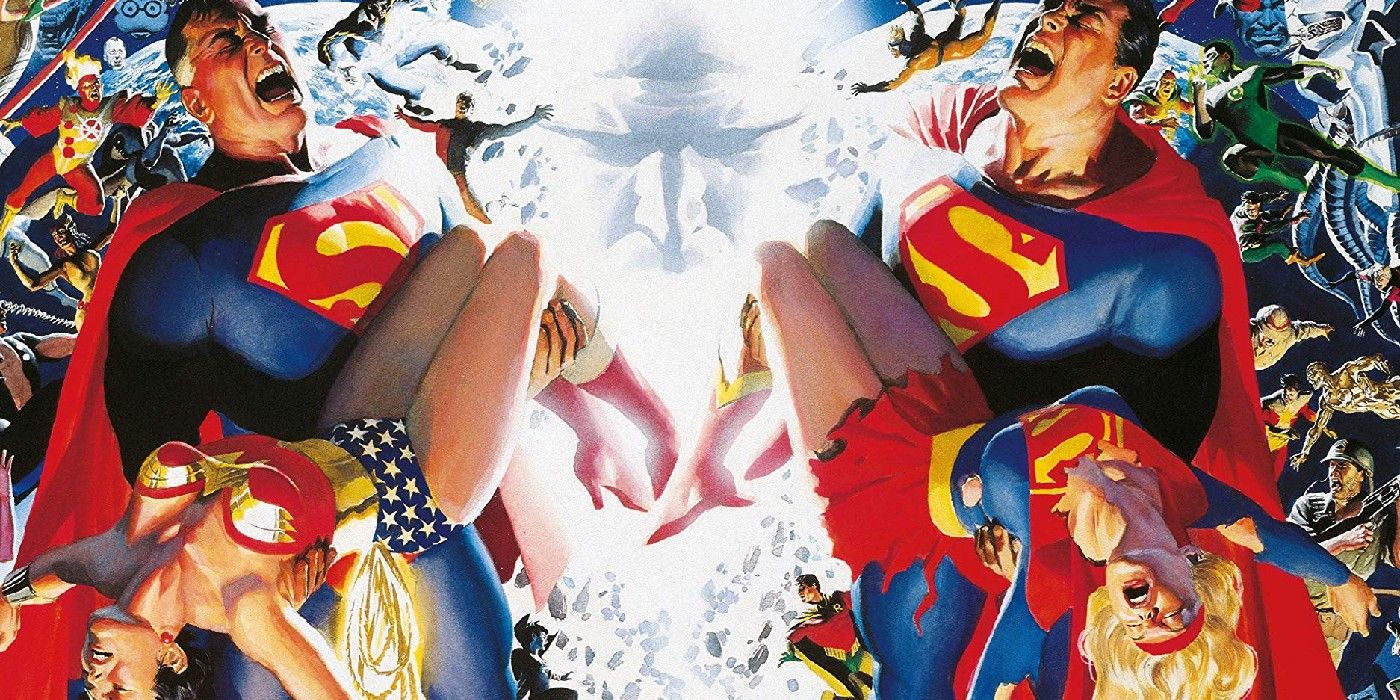
Crisis on Infinite Earths, by writer Marv Wolfman and artist George Perez, is a DC legend. The twelve-issue maxi-series dropped in 1985, one of the biggest years in comics, and changed the game for DC forever. Pitting the publisher’s greatest heroes against the Anti-Monitor with the fate of the Multiverse at stake, CoIE created moments that DC has gone back to many times over the years.
Even all these decades later, Crisis on Infinite Earths is still considered one of the best event books of all time. It does so many things that other event books wish they could do half as well.
10 It Featured The Greatest Writer/Artist Team Of Any Event Book
Marv Wolfman and George Perez are one of the greatest writer/artist tandems in the history of the comic industry. They are great apart but are even better together, creating New Teen Titans and telling stories that have stood the test of time. They were a complete team, working together like few others, and DC trusted them enough to tell their biggest story.
Event books live and die by their creative team, but it’s rare they have the level of comradery that Wolfman and Perez have. The two had worked together for years and were at the top of their game, bouncing ideas off each other and creating work that is still unrivaled.
9 It Pioneered The All-Powerful Big Bad Event Villain Trope
In 1985, event books still were kind of nebulous, with the pieces that readers are familiar with not exactly there yet. Crisis on Infinite Earths went a long way towards codifying what event books would become, and the Anti-Monitor was a huge part of that. CoIE‘s event book competition was Secret Wars, and even that mostly just pitted the heroes against the villains; Crisis on Infinite Earths made a villain that matched the stakes of its story.
The Anti-Monitor made a huge splash right off the bat, destroying universes and smacking around the most powerful heroes. The Anti-Monitor created the trope of the all-powerful big bad, one that many event books would use afterwards and is still one of the best, only rivaled by Thanos.
8 It Remembered The Villains Exist
One of the problems with a lot of modern event books is that while the heroes are all battling the big threat, the villains are usually an afterthought. Sometimes, creators remember they exist, but the villains are a nonfactor in event books most of the time. Crisis on Infinite Earths not only remembered the villains exist but showed them doing what villains would do — taking advantage of the chaos.
Crisis On Infinite Earths #9 was titled “Villains War” and it saw the villains strike against the heroes as they tried to battle with the Anti-Monitor. Wolfman and Perez did something that no other event creative team did, showing the villains acting like villains and doing what they did best.
7 It Ended An Era Of Comics Unlike Any Other Event Book
The modern-day event cycle works on a short-term basis, with the previous event setting up a new status quo and the next event ending it. Crisis On Infinite Earths pioneered this approach, as with nearly every other event trope, but it did it in a much larger fashion. CoIE was responsible for ending the Silver Age, one of DC’s most creatively fertile and beloved periods.
The Silver Age wasn’t a year or two of status quo; it lasted for over a decade and while it’s usually credited with ending in the ’70s, its effects were felt throughout the DC publishing line until Crisis On Infinite Earths ended. The series finally closed the door on the era, propelling DC into the modern age.
6 Its Deaths Mattered
Deaths in event books are a dime a dozen, but they usually have no impact. Fans know that they’re short-term, so unless the moments in the events themselves are amazing, they don’t matter. Crisis On Infinite Earths was the first event book to showcase big deaths, killing off Silver Age poster children Barry Allen and Supergirl.
Beyond being some of the most unexpected DC deaths, each one served a purpose both in the story and the future of DC. Barry’s death redeemed a character that fans stopped caring about years ago, made him a legend, and led to Wally West taking over for him. Supergirl’s death sold the power of the Anti-Monitor and also served as the death knell for the various Kryptonians that had been a huge part of the Superman mythos in the preceding years.
5 It Succeeded Despite Destroying Something DC Fans Loved
Leading into Crisis On Infinite Earths, DC wanted to streamline their universe, and the various Earths were thought to muddy the waters for new readers. The story was meant to destroy all of that and remake it, but most DC readers — the people buying the books month in and month out — loved the Multiverse. Selling them a story that took away something they loved was going to be difficult.
Crisis On Infinite Earths succeeded in this masterfully, becoming one of the most beloved crossovers of all time. Modern events rarely have to deal with the kind of baggage that CoIE did, and even they often fail pretty hard with the fans. Crisis On Infinite Earths was able to take away something beloved and make the fans love it.
4 It Was A Love Letter To The DC Multiverse It Was About To Replace
DC’s Multiverse is one of its most iconic features, and fans loved it. It made DC different than its marvelous competition and had a unique, fruitful history, one that extended across time on each Earth. Wolfman and Perez knew how much fans loved all of this, so they made Crisis On Infinite Earths into an epic that touched on all of it.
Most event books don’t have the scope of Crisis On Infinite Earths, but even the ones that come close don’t do as good a job as it when it comes to laying out why the thing it’s replacing is so great. Even fans who know nothing about the old Multiverse and its history will get a feel for it and appreciate it in ways that other events have never engendered.
3 It Made Lasting Changes
Crisis On Infinite Earths had the perfect tag line — “Worlds will live, worlds will die, and nothing will be the same.” It delivered on this premise perfectly, changing the DC Universe for decades to come. The post-Crisis DC Universe was very different from the pre-Crisis Multiverse, even if it did borrow some of the history from that time. DC wanted something new, and they got it from CoIE.
Event books since have often tried to sell themselves as game changers but rarely come through. Crisis On Infinite Earths did, making sweeping changes that held up for decades. In fact, even when some things are undone, others stay around, keeping the book’s impact vital in a way other events aren’t.
2 It Created The Modern Event Comics In Every Way
As intimated many times above, Crisis On Infinite Earths pioneered just about everything that modern events try to do and did those things better than all of them. In 1985, there were two roads that event books could go down — the safe one that Secret Wars trod or the revolutionary one that CoIE set down. Crisis won that race and became one of the best DC event books of all time.
Modern event comics have their drawbacks, but they followed CoIE to a tee, taking the book’s formula and running with it. It created a genre and remains one of the best examples of it.
1 It Created Multiple Amazing Sequels
Event book sequels are a pretty mixed bag. Secret Wars was great, but Secret Wars II wasn’t and ended event books at Marvel until 1991’s Infinity Gauntlet. IG had a good sequel in Infinity War, but Infinity Crusade was bad. Civil War was iconic, and Civil War II was panned and forgotten. Crisis On Infinite Earths, on the other hand, has had multiple great sequels.
Some are better than others, of course, but the quality of the various Crisis events vastly outstrips any other event book sequel. Fans actually look forward to Crisis sequels and re-read the previous ones, something that rarely happens with other event sequels.
About The Author
