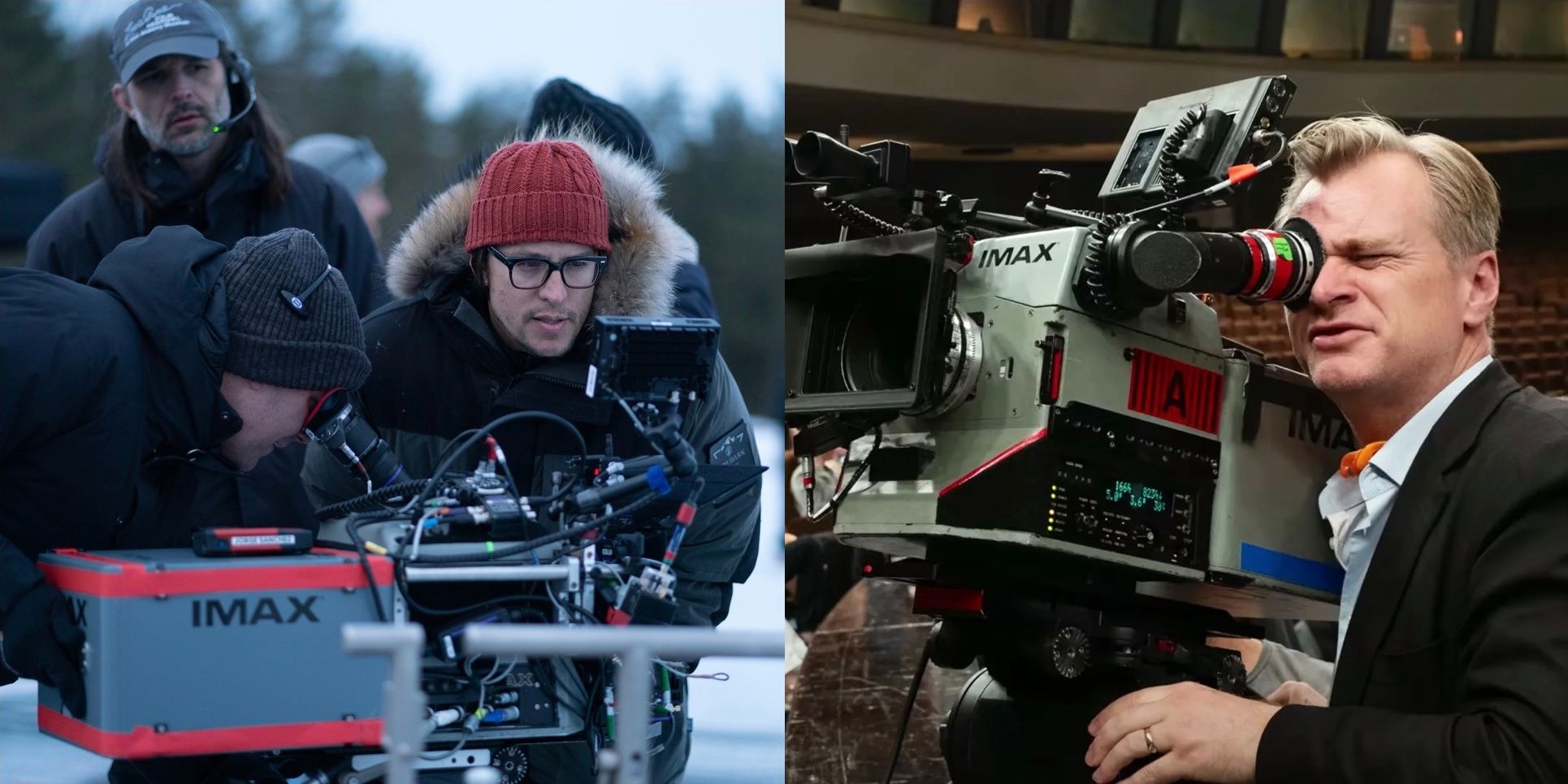
IMAX is arguably the most immersive way to watch a movie. Boasting unmatched audio-visual qualities, larger-than-life cinema screens, and sound systems of the highest possible standard, IMAX draws the audience into something as close to reality as possible, producing a virtually flawless execution of the filmmaker’s original vision.
Prior to its advent in Hollywood, IMAX was relegated to its own stand-alone auditoriums in museums and institutions of art as a ‘specialty film format.’ Now it’s made its way to multiplexes all around the globe. As a result, IMAX has emerged as the gold standard for what any other film format has to match up to, with every element planned under exacting measures to create the most immersive movie-going experience for audiences possible.
5 James Gunn Made An Entire Movie With IMAX Cameras
The Suicide Squad (2021) was shot entirely with IMAX-certified digital cameras on the RED ecosystem, with the Ranger Monstro 8K VV, Red Ranger 8K VV, and Red Weapon 8K VV. “The Red cameras give the film the intense look we needed & they’re small enough to utilize some new rigs invented for the movie,” James Gunn tweeted. “[We’re] excited about where the look landed.“
Previously, Gunn had partially utilized IMAX cameras for Guardians of the Galaxy and Guardians of the Galaxy Vol. 2 with select scenes expanding to fill the 1.90:1 IMAX ratio—which is roughly 26% larger than standard 2.39:1 widescreens. Approximately 40 minutes of Vol. 2 (or one-third of the film) are presented in the IMAX aspect ratio, and there’s no doubt Gunn will choose to shoot some of (if not all of) Vol. 3 with IMAX cameras.
4 Michael Bay Pioneered ‘Smaller’ IMAX Camera Technology
Director of the first five Transformers movies, Michael Bay partnered with IMAX back in 2007. Since then, he’s shot a total of three films with IMAX cameras, including Transformers: Revenge of the Fallen, Age of Extinction, and The Last Knight.
Inspired by The Dark Knight, Bay shot three of Revenge of the Fallen‘s action sequences with IMAX cameras. Age of Extinction was the first Hollywood feature film to be shot on smaller digital IMAX cameras. Bay would later use the Alexa IMAX 3-D rig and IMAX 3-D Phantom 65 to film select sequences in The Last Knight which, infamously, switched between four different aspect ratios, including 2.28:1 and 2.39:1 (Panavision), 2.00:1 (Univisium), and 1.90:1 (IMAX).
3 Denis Villeneuve Promises To Use Even More IMAX In The Future
Denis Villeneuve shot Dune specifically for the IMAX format. Using a combination of cameras, including the IMAX-certified Arri Alexa LF and Alexa Mini LF prototype, equipped with Panavision’s large-format lenses in the Ultra Vista and H-series lineup, select sequences in Dune opened up to the 1.90:1 ratio in IMAX theaters, and to 1.43:1 on select IMAX screens fitted with dual-laser projection technology.
Previously, Villeneuve shot Blade Runner 2049 for the IMAX format with select sequences opening the aspect ratio up to 1.90:1 ratio. The director also confirmed in an interview with Collider that the screenplay for his anticipated Dune sequel—Dune: Part Two—is “mostly” finished. Villeneuve and cinematographer Greig Fraser have plans to shoot the sequel in the IMAX format to an even larger degree. “We fell in love with this format, and definitely there will be—even probably more—IMAX footage in this movie. Definitely.”
2 J.J. Abrams Has Released Five Films In IMAX
J.J. Abrams partnered with IMAX back in 2009 with the release of Star Trek—a reboot that features the main characters of the original television series. Since then, Abrams has directed an additional four films (Super 8, Star Trek Into Darkness, Star Wars: The Force Awakens, and The Rise of Skywalker) that have been released in IMAX, with two of those films shot partially with IMAX cameras.
Into Darkness used a combination of anamorphic 35mm film, 8 perforation 65mm, and 15 perforation IMAX cameras with approximately 30 minutes of the final film opening up to the IMAX format. The Force Awakens was shot partially with 65mm IMAX cameras in addition to 35mm film and was projected in 70mm IMAX with 5 minutes of the final film opening up to 1.43:1.
1 Christopher Nolan Loves IMAX & IMAX Loves Christopher Nolan Back
The undisputed king of IMAX—Christopher Nolan—has released seven of his movies in the format, choosing to shoot only on celluloid film rather than digital alternatives to preserve the spectacle of the IMAX format. The Dark Knight was the very first mainstream Hollywood feature to utilize 70mm IMAX cameras with 28 minutes of the final film opening up to 1.43:1 in theaters.
Nolan’s latest film Tenet has more IMAX footage than any other feature film in history, with 50%—or roughly 75 minutes—of the final film opening up to 1.43:1, filmed with the Arriflex 765, IMAX MKIII, IMAX MKIV, IMAX MSM 9802, Panavision Panaflex System 65 Studio, and Logmar Magellan. His upcoming film Oppenheimer will be the first movie in history to utilize black and white analog IMAX photography, making for some of the highest-resolution film celluloid to ever exist.
About The Author
