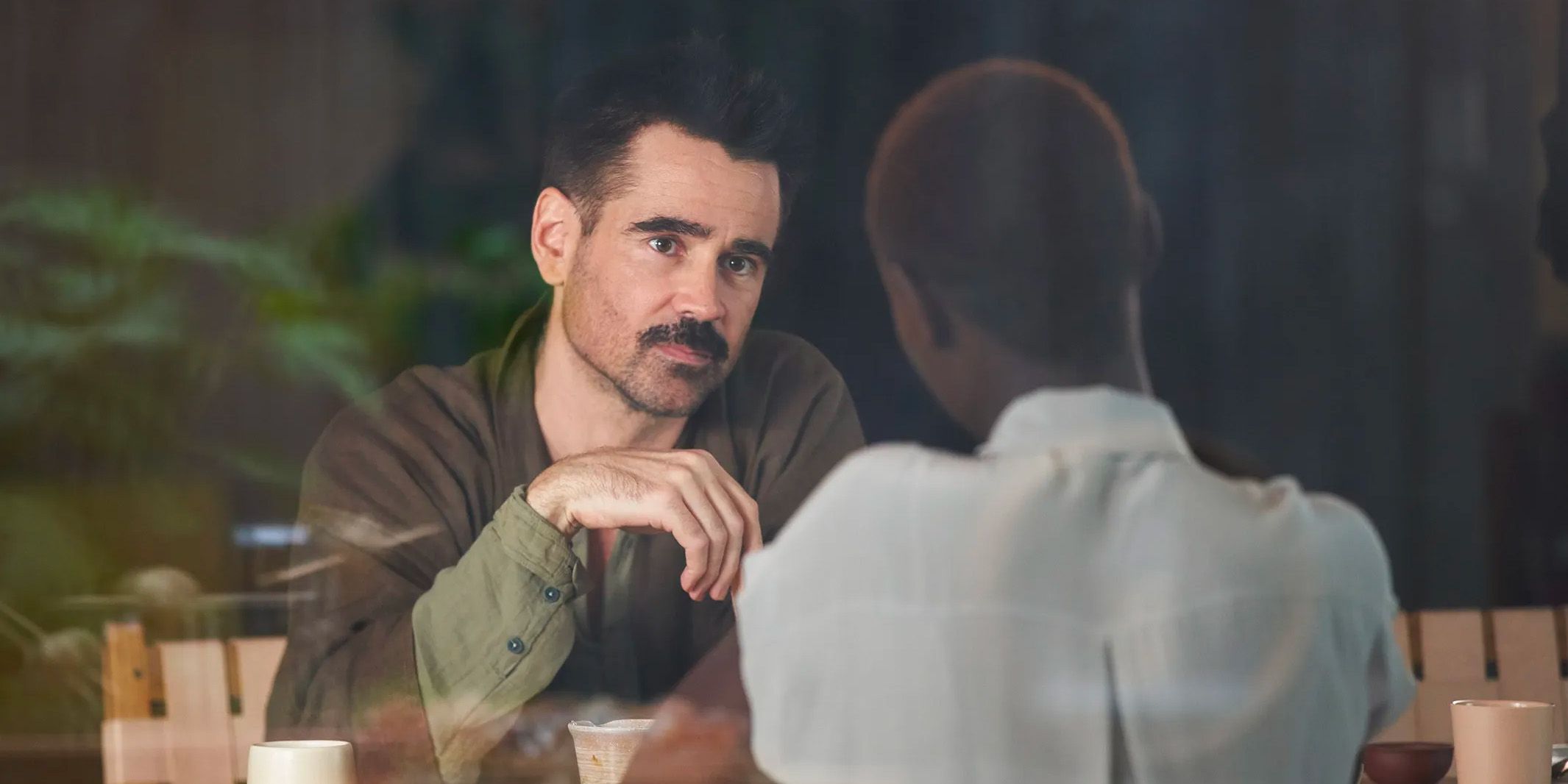
Science fiction is typically the realm of the future, filled with unmade technologies, alien life and faraway worlds that act as exaggerated mirrors to the present day. Kogonada’s latest A24 sci-fi drama After Yang does belong to this genre, as robots and clones are typical ways to have children at this unspecified time in the future, yet one of the most powerful scenes in the film is not about the usual sci-fi fare, but instead harkens back to the ancient tradition of making tea.
Colin Farrell stars as Jake, a tea shop owner who bought Yang, a robot child, as a sibling to his adopted daughter Mika. When Yang malfunctions one morning, Jake brings him to repair shops to try to get him fixed, but after he’s told his robot son cannot be repaired Jake is allowed access to Yang’s memories, which brings him on a journey through their past. One such memory is when Yang asks Jake why he likes tea.
This scene is immediately captivating with the way it shows Jake in his element, simply brewing a pot of tea. His silent gestures — tapping excess water from a wooden spoon or the twirl of his wrist after he takes a sip — combined with long shots of tea leaves floating in glass jars are enough to convert any coffee drinker to a new life of drinking tea. But tea also acts as an important thematic device, just as important as the more typical sci-fi tropes, that explores the topics of human existence and mortality.
“There’s not just flavor in the aroma, there’s history, too.”
As Jake and Yang’s conversation moves from the taste of tea to the way tea shops were handed down generationally, each element is linked to the past. Tea isn’t just a drink, but a teleportation device or a time machine, as the unique flavors in each cup is a world unto itself, bringing the drinker to a different time and place.
This concept is at the very heart of After Yang, a film dedicated to the delicate briefness of life and the vast times before birth and after death. As a robot, Yang technically has no direct link to any specific moment in history, yet as Jake learns more about Yang’s past he finds memories from two previous lives, where Yang had carried out the same function decades earlier for different families. Through a single cup of tea, After Yang beautifully muses on this relationship to time and what, if any, is the connection between the present, past and future.
“It’s all in this tea.”
During this moment of After Yang, Jake describes a scene from the 2007 documentary All In This Tea, where tea connoisseur David Lee Hoffman has a similar conversation with film director Werner Herzog about the taste of tea. Farrell pulls off an incredible Herzog impression — a moment that’s worth the price of admission all on its own — as he describes the taste of tea taking on a full sensory experience: walking through a forest, leaves on the ground, everything damp from a recent rainfall.
This inability to describe what tea tastes like other than through experiential language is extrapolated to existence as a whole. Especially by including a human and a robot sharing the same drink, After Yang forces viewers to contemplate what this same moment means for each of them.
“There are no words to adequately express the mysterious nature of tea.”
The genre of science fiction is, at its heart, about creating false realities to better understand our own. And, as After Yang suggests, if there is no adequate language to describe tea, then any discussion of human existence must too fall short. In a film about sentient robot children and cloned relatives, a pot of tea is strangely the most sci-fi element in the film, with a single cup holding so much turmoil about what it means to be alive.
It is only fitting that, as the scene closes and Yang asks Jake about what he tasted, there’s nothing concrete that Jake can disclose. He pauses, for a long, long time, as though noticing the tea trail along every taste bud, yearning to unlock some discovery of this sip, then merely stating “I’m not sure I can taste the forest.”
About The Author
