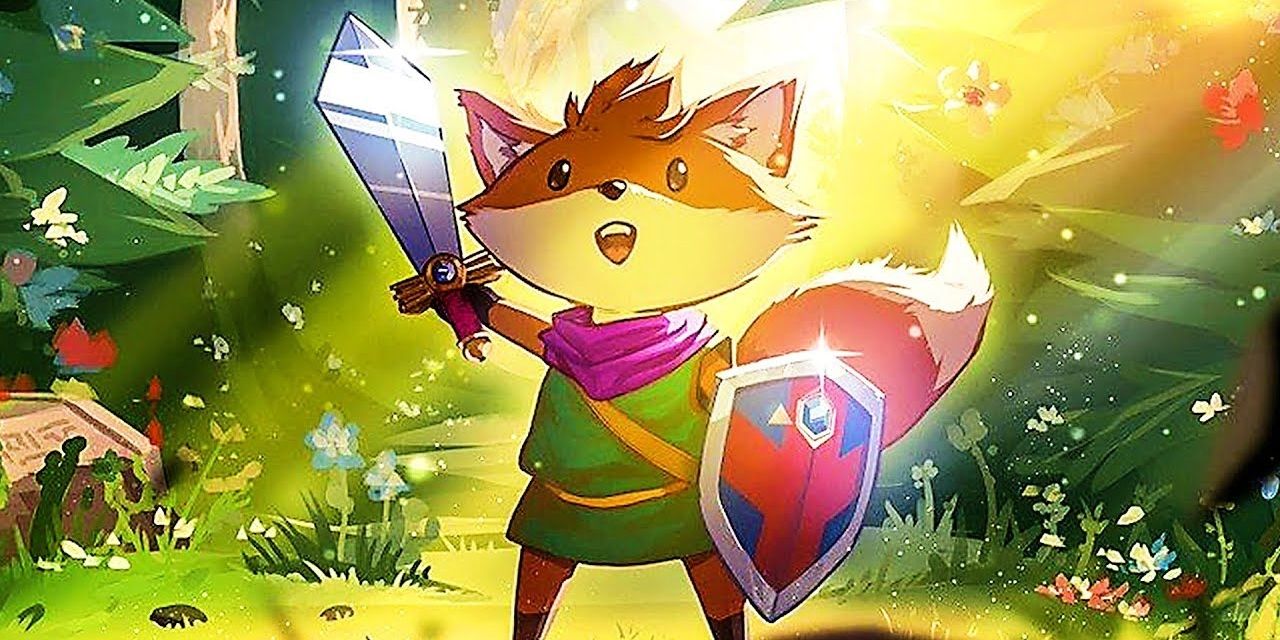
The indie game Tunic is set in a fantasy world where the player controls an unnamed fox hero who wears a green tunic, not unlike Nintendo’s iconic Hylian hero from the The Legend of Zelda series. Utilizing an isometric overhead view, Tunic also possesses a very cute and toyetic art style not unlike Link’s Awakening, although the disarming cuteness belies an incredibly challenging experience, very much like that found in Dark Souls and games like it. Players will battle many harrowing foes and bosses while exploring a sprawling overworld, learning more about how to move forward and how to survive little by little.
The brutal difficulty and heavy reliance on patterns and trial-and-error gameplay, while also carefully observing the surroundings through thorough exploration is by intentional design in games like Dark Souls. However, this all hearkens back to classical methods of gaming as seen in the original Legend of Zelda. Studio Finji seems to understand the relationship between the two games, as Tunic evokes classic Zelda imagery while adopting Soulslike gameplay elements.
Much like Dark Souls, very little of the game’s world and story is told outright to the player, leaving much of the surrounding lore and objectives to player discovery. Tunic takes inspiration from a very similar Zelda/Dark Souls hybrid, Hyper Light Drifter, in that much of the existing dialogue is in a fictional language that the player has to decipher from context clues. Tunic also has collectable pages throughout the adventure that actually form the game’s manual, making reference to how reading the manual was essential to understanding how to navigate the original Legend of Zelda.
Players in Tunic are also required to memorize enemy behaviors and attack patterns to survive, utilizing every possible advantage from their inventory or the surrounding area in the face of impending doom, as even the weakest enemy can easily kill an experienced player. While this idea of frantic problem-solving in the heat of battle has been a thing in classic Zelda, the emphasis on honing combative skills is very much indicative of influence from FromSoftware’s iconic series. Another very obvious reference to the Soulsborne games is the need to save games at fire-lit shrines, which not only heals the player but also revives any slain enemies. Death is similarly very costly, since the player loses coins upon their second death if they cannot recollect them from the spot at which they died.
A standout feature of Tunic is something that both Dark Souls and Zelda have shared for decades: a series of challenging and creative boss fights. From memorizing attack patterns of hard-hitting strikes to creatively utilizing inventory items, Tunic‘s bosses combine the best of both worlds. They encourage players to play on their own terms, from brute-force tactics to thinking outside the box. Learning the many methods to beating bosses in Tunic is just as thrilling and satisfying as it is in either a Zelda or a Dark Souls title.
Tunic‘s release is indicative of Studio Finji’s very clear love of old-school gaming and the modern revival of challenging games. It also shows reverence to influential games like Zelda and Dark Souls. The success of Tunic will hopefully inspire indie studios like Finji to constantly innovate upon their predecessors and never forget the legacy of why people were drawn to gaming in the first place.
About The Author
