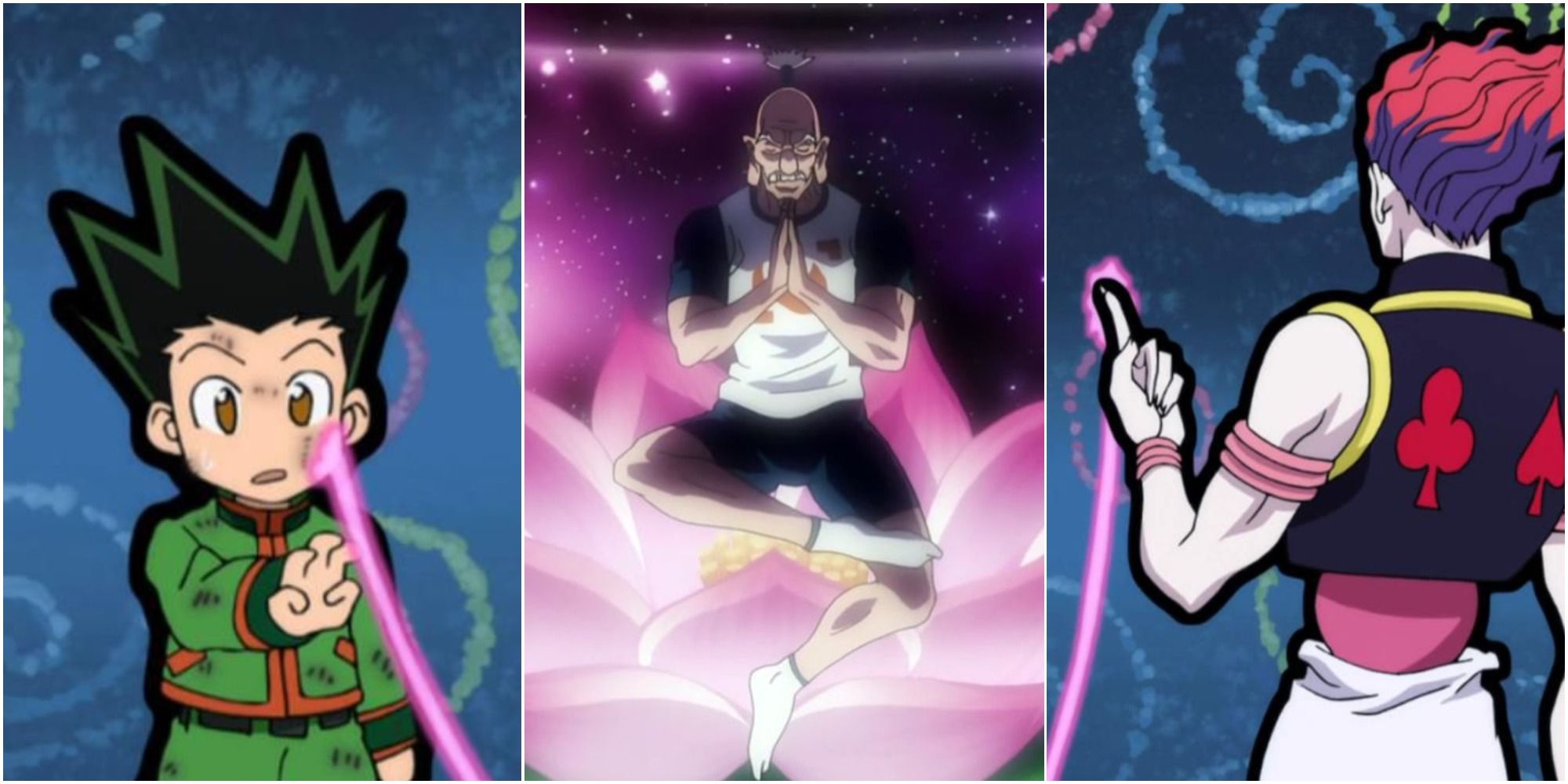
Despite its faltering pace, Yoshihiro Togashi’s Hunter x Hunter remains one of the most popular anime series ever made. Both the manga and the anime have been commercially prosperous, in part due to their unorthodox pattern of storytelling.
Critics classify Hunter x Hunter as a shonen anime, but insist that the narrative often breaks tradition by delving into alternative genres, including thriller and speculative fiction. Hunter x Hunter has been called “an almost random collection of psych-outs, battles, puzzles, and trickery. However, even this vivid summary fails to apprehend Hunter x Hunter‘s knack for generating a brand-new mythology out of nothing.
10 It Includes A Vast Array Of Interconnected Characters
Characters are frequently treated like expendable pieces on a chessboard. Many anime acquire new characters by a process of force-feeding, introducing them only to add narrative bulk. These individuals are confined to their own subplots, interacting with others within their local groups and nobody else.
Hunter x Hunter doesn’t make this mistake; on the contrary, the rich assortment of characters populating its world are in constant contact, whether direct or indirect. These characters’ collaborations and conflicts give rise to a dynamic storyline.
9 Protagonists Are Sidelined In Favor Of Relatively Minor Characters
Anime like Bleach, Naruto, Demon Slayer, and even Togashi’s first major manga Yu Yu Hakusho, concentrate heavily on their protagonists. Ichigo Kurosaki, Naruto Uzumaki, Tanjiro Kamado, and Yusuke Urameshi are followed everywhere they go.
This protagonist-centric formula works exceptionally well, or it wouldn’t be so commonplace. In comparison, Hunter x Hunter repeatedly shifts the spotlight from Gon and Killua, instead focusing on relatively minor characters. These include Netero in the Chimera Ant arc, Kurapika in the Yorknew City arc, and Hanzo in the manga-only Succession Contest arc.
8 Its Villains Are Believable And, To A Point, Relatable
Villains in anime are generally narcissistic, greedy, and unbelievably overpowered. All For One in My Hero Academia, DIO in JoJo’s Bizarre Adventures, and Frieza in Dragon Ball neatly fit into this recurring trope.
This is not to say that Hunter x Hunter‘s antagonists are any less flawed, but their failings make them relatable to audiences, unlike Father in FMA: Brotherhood. Hisoka flits between guarded neutrality and outright villainy, Illumi’s motivations are rooted in Killua, and Meruem’s emotional evolution is a significant factor in his character development.
7 A Wide Spectrum Of Combat Strategies Keeps Things Fresh
Hunter x Hunter doesn’t waste its potential on pointless power-ups in the midst of battle, a seemingly incurable artifact of the shonen anime genre. Dragon Ball is particularly noted for its repetitive and elongated fight sequences.
Hunter x Hunter avoids this issue altogether by devising a complex power system known as Nen and building a nigh inexhaustible spectrum of strategies and techniques around this core ability. Nen has dozens of applications, each with its own set of flexible rules, allowing characters to manipulate the system to their benefit.
6 It’s Not Easy To Predict The Outcome Of A Hunter X Hunter Battle
Anime attacks and explosions defy the basic rules of scientific logic, but they are almost always extravagant. Unfortunately, these battles sometimes stray too deep into hyperbolic territory, which consequently plays havoc with the viewers’ suspension of disbelief.
Several of Saitama’s fights in One-Punch Man satirize this cliché, indicating its ubiquity. Combat frenzy is essential to the shonen anime narrative — the range of dramatic momentum during Hunter x Hunter battles reveals that multiple outcomes are possible considering the wealth of factors involved.
5 Each Arc Smoothly Flows Into The Next
Anime arcs tend to have distinct plots, but they segue from and into adjacent arcs with a negligible level of consistency. On the other hand, Demon Slayer and Attack on Titan are two examples that remain narratively cohesive until the very end.
Hunter x Hunter falls somewhere between the two extremes. It flows smoothly from the Hunter Exam arc to the Heaven’s Arena arc, connecting the two storylines with the unofficial Zoldyck Family arc. Similarly, the Yorknew City, Greed Island, and Chimera Ant arcs are succinctly linked together.
4 The Narrative Doesn’t Shy Away From Complex Emotions
Shonen media is marketed towards teen and preteen boys, explaining why an overwhelming fraction of anime protagonists are between twelve and eighteen years old. The emotional palette in shonen anime is limited to excitement, curiosity, anger, love, happiness, and other associated feelings.
However, Hunter x Hunter refuses to paint a one-dimensional picture for its audience — it extracts every drop of emotion from its characters, no matter how ominous or macabre it might be. Gon takes an uncharacteristically dark journey in response to Kite’s death, forcing Killua to mediate his uncontrollable rage.
3 Gloomy Moments Are Balanced With Frivolous Humor
Hunter x Hunter has more doom-and-gloom than most shonen anime. People are killed, enslaved, tortured, and subjected to innumerable forms of suffering, none of which are concealed from the audience. At the same the show lightens the mood by incorporating carefree moments into the story.
The art style follows the standard anime trend — Killua develops feline facial features when he’s being mischievous and steam blows out of Gon’s ears when he’s frustrated. Hunter x Hunter extends this comical depiction to some villains, notably Hisoka, proving that no one is immune to the universal power of humor.
2 Its World Is Extremely Diverse And Precisely Detailed
The Known World in Hunter x Hunter is approximately the same surface area as the real-life Earth. This means that the actual planet is incomprehensibly vast, perhaps even larger than Jupiter. As such, the so-called Dark Continent stretches the limits of the imagination to breaking point.
It contains countless undocumented species and beings, many of which are allegedly stronger than the strongest Hunters. Togashi has finally ventured into the Dark Continent in the penultimate manga arc, although there’s still a lot to be explained.
1 The Animation Is Warm, Lavish, And Thoroughly Invigorating
Anime has come a long way since the cost-effective animation style of shows like Captain Tsubasa and Saint Seiya. Even in the modern context, Hunter x Hunter‘s animation has received praise from all quarters, critical or otherwise.
Further, the 2011 adaptation of the manga is far superior to the original 1999 anime: refreshing CGI, intricate character designs, and invigorating action sequences are all mixed together in a vibrant cocktail of light and color. On the aesthetic front, Hunter x Hunter is on par with the best of its contemporaries.
About The Author
