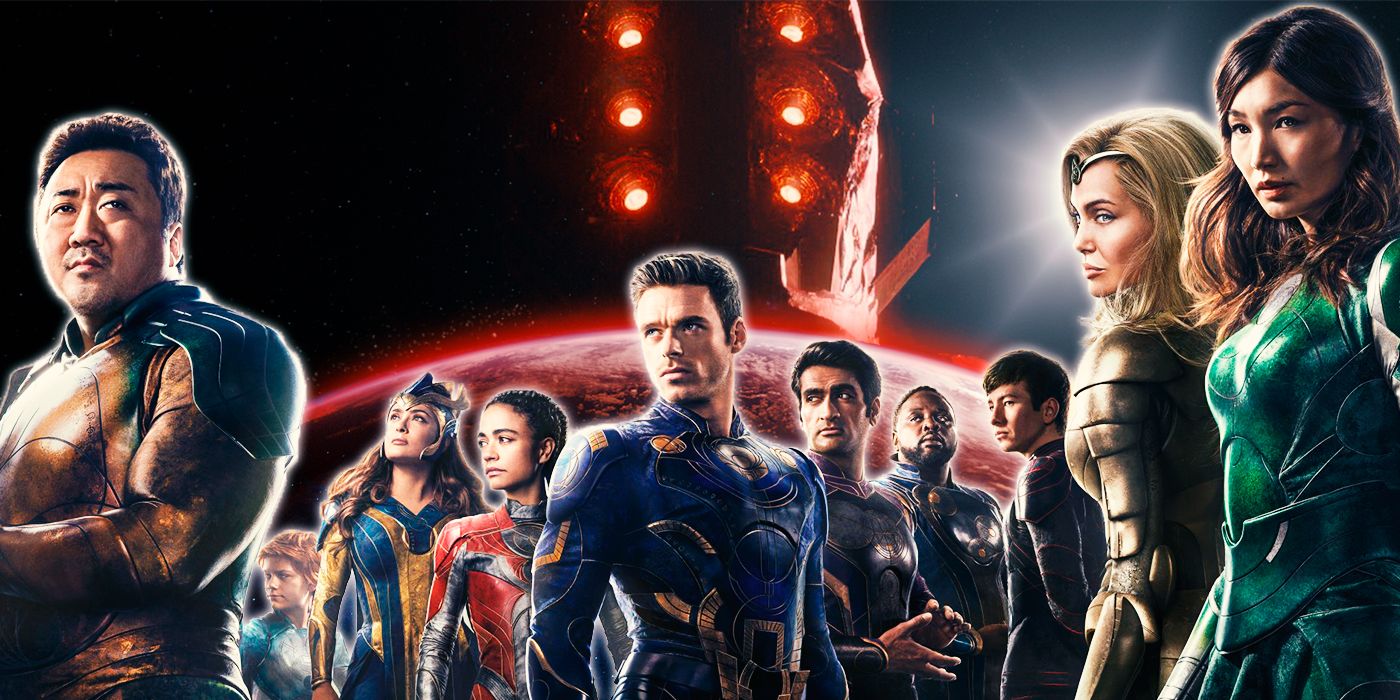
The Marvel Cinematic Universe has evolved from a chronicle of its Earth-based superheroes to a universal epic that charts the beginnings of time itself to its eventual end. Eternals provided an origin for all of existence and Loki, by way of a pair of mischief deity variants, visited The Citadel at the End of Time and its multiversal magistrate, He Who Remains. Along this labyrinthine path of Infinity Stones and multiverses, there are also gods of the realm. Loki’s brother Thor and the even more powerful Odin the All Father are a pair of gods audiences have seen in action, but beyond them lies an entire race of extra stellar entities only hinted at in the past and fully formed in Eternals, who dwarf the power of the Asgardians gods and their remnant.
The space gods known as the Celestials are responsible for creating the stars that make life in the universe possible. Their vast array of powers, outside of their capacity as solar factories, instantaneous travel through space, sophisticated automaton and organic engineering and their telepathic attributes, are still a mystery. Older than the known universe and divinely majestic, they are still vulnerable. Guardians of the Galaxy not only introduced the first Celestial in the MCU but also subtely intimated how one might slay a space god.
Taneleer Tivan, otherwise known as The Collector, tasked Gamora with retrieving an orb from a sacred vault on the planet Morag. Upon receipt of the orb, he regaled the attending Guardians with a tale of the universe and its origins, centered around the Power Stone, which was concealed within the orb and the other five Infinity Stones. During his oral history supplemented with holographic projection visual aids, audiences saw a Celestial unleashing the power of a Stone on a doomed world. Of particular note, this Celestial was more in keeping with their portrayal in the comic books in both stature and purpose, though their use of an Infinity Stone was a departure.
In the universe of Earth-616, the Marvel comics domain, the Celestials are on the physical scale of mountains, not planets. In their work as bio-engineers who seed planets with the ability to produce intelligent life and introduce experimental deviations into these test group populations, they destroy worlds where they feel their genetic experiments have not produced the desired outcomes. Their surveillance can vary from thousands to millions of years and their judgment is final. However, one branch of connective tissue between this dimension and Earth-199999, the setting for the MCU, is Knowhere.
A severed Celestial head from antiquity that serves as an intergalactic hub, Knowhere has roots in both the pages and the reels. In the MCU it serves as a trading outpost similar to a boomtown of the Wild West where the organic material of the dead space god was endlessly harvested for commercial purposes and also served as the home of The Collector’s museum. Knowhere carried a slightly more prestigious pedigree in 616 continuity as a city populated by scientists from across the universe gathered together to study its mysteries. Though there has not been any mention of the headless Celestial in the MCU who donated his skull to cosmic land grabbers and divine fossil fuel miners, the comics do provide a history with some potential immediate synergies.
An elder god who stood in as a metaphysical representation of the void named Knull, once abided in a realm of nothingness that existed in the in-between spaces of the destruction of one reality and the emergence of another. As the Celestials were going about their cosmic reformations they intruded on this space and Knull summoned a malleable aspect of the void, shaped it into a blade, and beheaded the first unlucky cosmic deity to enter the breach. This blade went by many names, including Godslayer, but most referred to it as All-Black the Necrosword. At one point it came into the possession of being named Gorr who used the blade to earn the mantle of the God Butcher.
Dedicated to destroying all deities across reality, Gorr laid waste to entire pantheons for centuries and battled Thor specifically on three different occasions spanning thousands of years, defeating him in every instance. The interesting nexus of these realities is that Gorr the God Butcher is the primary antagonist of the upcoming and unfinished fourth installment of the Asgardian Avenger’s filmography, Thor: Love and Thunder. Given the way the MCU has honored iconic storylines from the comics while adapting them for the screen, Gorr could herald a path toward Celestial murder. The Guardians of the Galaxy, and perhaps other characters from the past as well as other deities, are going to be an integral part of Love and Thunder so Thor’s exploits will likely have cosmic scope.
There is a handful of Eternals who Arishem has collected for judgment and another group trying to rescue them, so the opportunity for paths to intermingle is more than fleeting and the need for leverage against them more than tempting. The Knowhere of the MCU could be absorbed into the comic mythos by essentially combining Knull and Gorr’s origins into one seamless entity. Knowhere could be the tombstone of Gorr’s first kill and perhaps create interesting counterintuitive alliances. Eternals ended with a promise of their return but there hasn’t been any announcement yet for a direct sequel. Love and Thunder could provide a deeper interest in the immortal synthezoids and compelling stakes.
Thena for one would seem to have no love lost for the Celestials given how she may blame them for her Mahd Wy’ry and her proficiency with blades are literally an artifact of legendary proportions. Gorr could present both a danger and an opportunity in the tradition of all of the MCU’s great villains. A being who goes about a destructive cause for well-founded reasons and could create Civil War-like sympathies among the would-be heroes who are arrayed against him. Even if Gorr is not attributed with creating Knowhere through deicide, it would still be the most logical place to go for anyone seeking a way to destroy the Celestials. It has already been established that the organic matter continues to provide mercantile utility but perhaps it could also be deployed in a forensic capacity, providing the basis for a weapon or poison that could ultimately be used against the enigmatic lords of the cosmos.
About The Author
