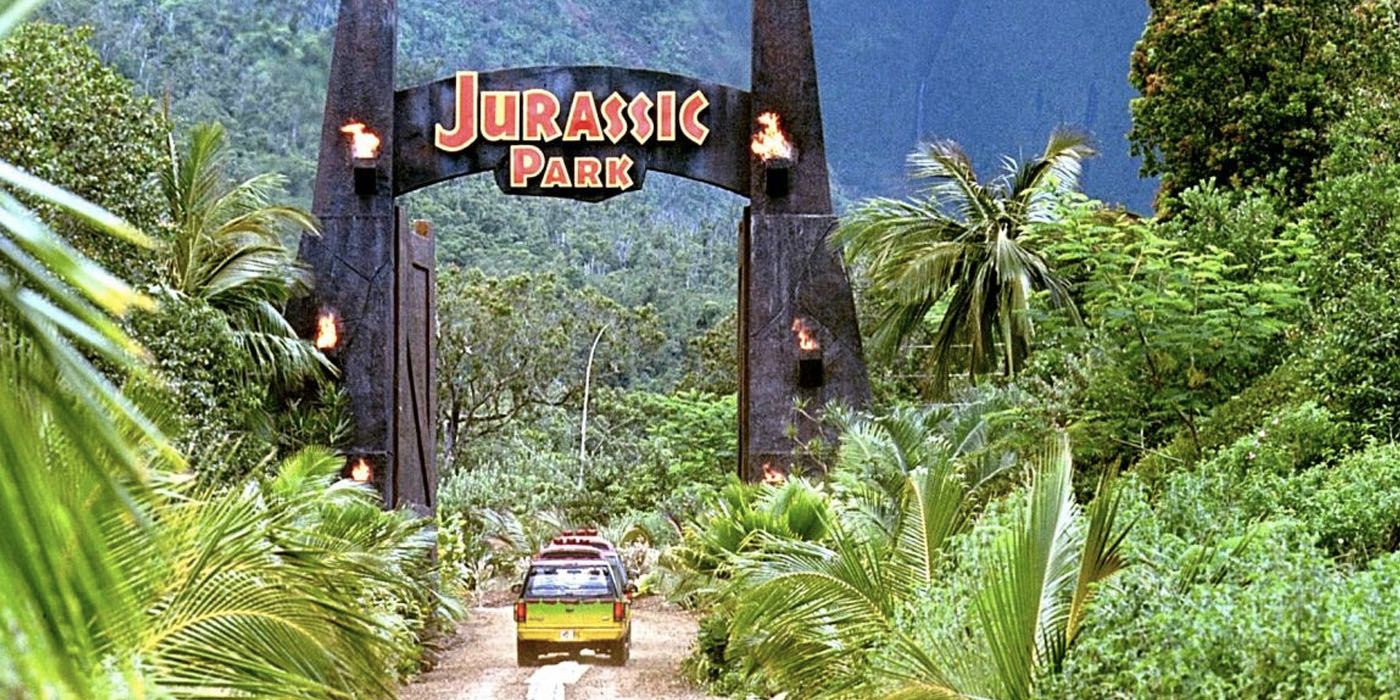
Steven Spielberg is easily counted among the greatest directors of all time. From Jurassic Park to Catch Me if You Can, the director has forged new standards in special effects, storytelling and acting. His contributions to special effects are usually emphasized in career retrospectives, as Indiana Jones alone served to revolutionize certain aspects of visual effects in films, and that franchise continues to excite fans 50 years after the premiere of the first movie.
However, one aspect of Spielberg’s films is often overlooked: the exposition. Especially clear in adapted works, the exposition in Spielberg’s work is truncated without losing important story content. By looking at the properties that have been adapted, moviegoers can gain a greater appreciation for just how intricate Steven Spielberg’s treatments are, especially in how they handle exposition.
Jurassic Park Folds Three Chapters Into A Two Minute Cartoon
Michael Crichton wrote the original Jurassic Park novel, which boasted a rather different story from that of the movie. The so-called “King of the Techno-Thriller” integrated the mathematical concepts of fractals and bell curves in order to convey that relying too heavily upon applied science could be disastrous. Given that charts don’t play as well as dinosaurs on-screen, these were taken out and a large degree of the text was excised to allow for a more linear narrative.
Chief among the factors that were written out of Spielberg’s adaptation was Crichton’s explanation of genetic manipulation, which took multiple chapters at the beginning of the book before introducing the likes of Ellie Satler or Ian Malcolm. The chapters continued with a focus on the science portion of the jobs of those involved, letting Malcolm’s theories take stake over the dinosaur drama in the background. Spielberg took these chapters and fit them into a short animated segment featuring a newly created character: Mr. DNA. By speaking to the audience as though they were children, Spielberg’s sequence conveys both the commercialization of Jurassic Park and simply explains away bringing back the dinosaurs, a complex process. All of this is accomplished with a simple sequence that’s under five minutes long and nestles well into the story.
Ready Player One Cuts to the Chase – Literally
As with Jurassic Park, Ernest Cline’s novel Ready Player One features a series of expository chapters at the beginning to introduce the reader to the world of the story. Different from Jurassic Park, however, these chapters don’t truly introduce readers to the world and the scientific concepts, but instead they show Wade Watts/Parzival’s perception of the world. Many chapters pass before the characters begin to pursue the egg again, relying upon an expository recording at the beginning of the text to keep readers engaged until the chase for the keys begins properly.
Spielberg takes a different approach. The movie opens on The Stacks, much like the book, but follows Wade down them. Within five minutes, the movie’s first major action sequence has begun, a fight on a battle planet. The surreal OASIS is present and gloriously detailed, starting out in a hub rather than Wade’s school.
Within 10 minutes of the movie’s start, just at the end of Wade’s introductory monologue and after introducing Halliday, the creator of the OASIS, and his challenge, the race to find the key begins. Again, Spielberg compresses chapters of worldbuilding and build-up into a tight 10 minutes, introducing the gunters while dropping the religious subtext of Halliday’s journals. Ultimately, where Jurassic Park had an overabundance of mathematics for the screen, Ready Player One was in need of a punch-up for greater action and speed, which Spielberg delivered, even if that couldn’t save the film overall.
Film adaptations tread a narrow line between narrative and visuals. Spielberg has the rare creative ability to balance both and bring about something new and engaging that hews to the original spirit of the text without losing elements of the world in which it was built. Much like Baz Luhrmann’s The Great Gatsby, Spielberg’s Ready Player One shortens the exposition and focuses on the glorious visuals. Jurassic Park, too, manages to fit a complex premise into a moment that plays out as simply as a Saturday morning cartoon. Spielberg is a stellar director, but his ability to compress exposition and get right into the action proves to be one of the elements that give his adapted properties staying power.
About The Author
