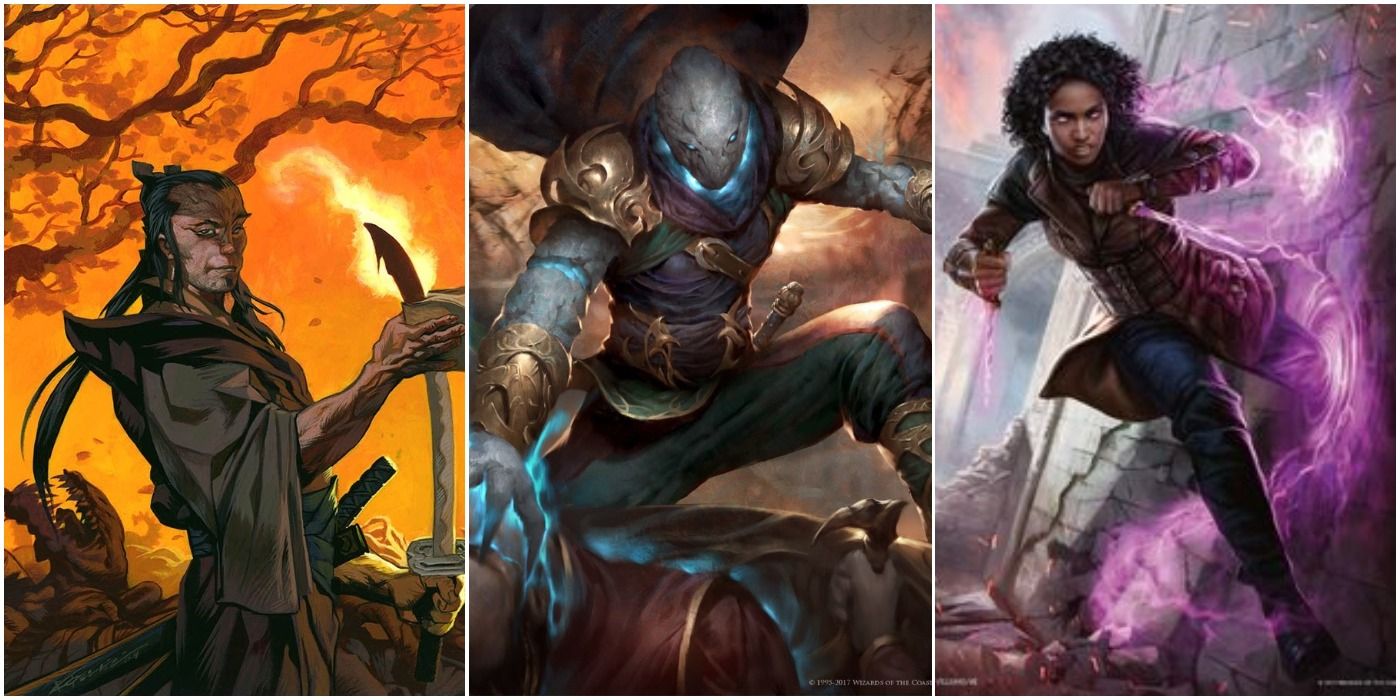
Magic the Gathering’s five colors of mana each have their own outlook and philosophy on life. Black magic is often seen as the most self-serving, but that does not make it inherently evil. Black magic practitioners are ambitious and power-hungry, and this can easily manifest as a driven and dedicated hero.
D&D characters don’t have to be inherently virtuous, though they probably lean more towards heroes than villains. Magic’s many black-mana users can offer some guidance and ideas on how to play a D&D character that may have ulterior motives or higher ambitions.
10 Xantcha Was A Sleeper Agent But Broke Free
From a background as a sleeper agent among one of the worst villains Magic has to offer to travelling with the high artificer Urza, Xantcha was close to some of the largest events in Dominarian history. Created as a Phyrexian sleeper agent, she manifested free will and chose to turn on her masters instead. Starting a D&D character’s story as a sleeper agent gone rogue is a great way to build in a whole host of backstoies and potential enemies.
9 Chevill Hunts Monsters, Like Many D&D Characters
Chevill is a great example of the kind of character that is cast in a negative light in Magic but would actually make a fairly straightforward D&D hero. Chevill is a consummate hunter, no mean feat on the dangerous plane of Ikoria. This put him in conflict with the planeswalker Vivien Reid, as she values the power and majesty of the many creatures of the plane. Chevill would make a great D&D ranger or fighter, and his boastful nature and attitude towards his quarry could lead to some interesting inter-party conflict.
8 Toshiro Umezawa Was Caught Up In A Spirit War
One of the most important figures in the original Kamigawa storyline, Toshiro Umezawa puts a mystical spin on a classic trope. He was once a hitman for the criminal overlord Boss Uramon, but after a failed hit on an ogre shaman, he went independent. From there, Umezawa became embroiled in the Kami War, a large-scale conflict between the forces of mortality and the spirit world.
His story could be a fun blueprint for a mundane D&D character, like a fighter or a rogue, slowly getting more and more involved in the mystic arts, whether by subclass or by multiclassing.
7 Yahenni Was A Freedom Fighter
As an aetherborn from the plane of Kaladesh, Yahenni had the ability to absorb the lifeforce of other beings. Rather than be a selfish vampire, Yahenni was a member of the Renegades. This group of revolutionaries opposed the Consulate’s rule in the city of Ghirapur, stealing goods and resources and redistributing wealth to the people. Yahenni’s status as a revolutionary with exceptional abilities makes them an easy jumping off point for a D&D character, and the aetherborn are a playable race thanks to the Plane Shift: Kaladesh free expansion.
6 Sorin Markov Is A Complicated And Conflicted Figure
When he was first introduced, Sorin Markov appeared to be a rather uncomplicated villainous character. However, as time went on, he became a very complicated and nuanced character. Sorin hails from the plane of Innistrad and is in fact responsible for the creation of that plane’s angelic protector, Avacyn.
Sorin has found himself on various sides of several interplanar conflicts, and this makes him an interesting way to frame a D&D character. He is far more ancient and powerful than a typical PC, but his attitudes and behaviors are applicable to anyone.
5 Vraska Always Fought For Her People
Though she has not always upheld the most heroic of ideals, Vraska is a great example of a black-aligned character doing heroic things for selfish reasons. She entered into an agreement with the villainous Nicol Bolas to secure leadership of Ravnica’s Golgari Swarm, but later pledged the Golgari forces to oppose Bolas’s rise to power. A D&D character modeled after Vraska could be joining the party to enact the will of a powerful being, or simply be fighting for the safety and wellbeing of their people.
4 Kaya Is An Accomplished Assassin
Kaya featured prominently in the later Ravinca storylines, as well as the War of the Spark, and for good reason. After making a name for herself as a prominent and powerful assassin, Kaya was wrapped into Nicol Bolas’s plans to conquer the multiverse. Kaya’s abilities are a great way to describe the abilities of an Arcane Trickster rogue or other spellcaster, and her status as a magical assassin offers great plot hooks as the DM sends the party after more and more powerful creatures.
3 Anafenza Was As Driven As They Come
Black-mana users are famous for their ambition, and this manifests in Anafenza as an unceasing drive towards her goals. Her family was betrayed, leading to her childhood being a long and harsh struggle.
She slowly clawed her way to the top of the Abzan Houses, eventually being elected Khan. A D&D character starting at level one probably starts at the first part of that storyline, but Anafenza’s ultimate destiny makes a great goal to shoot for.
2 Arvad Has A Dual Nature
Once a knight of Benalia, Arvad was turned into a vampire by the Sengir descendant Kazarov. He joined the crew of the Skyship Weatherlight, a powerful and prominent group in the most recent Dominaria storyline. Arvad functioned as the crew’s security chief and was constantly trying to keep his vampiric hunger in check, which is a fascinating concept for a D&D character. There are several ways to create a vampiric-themed character in D&D, any number of which could be brought to bear for this idea.
1 Liliana Embarked On A Quest For Freedom
Though she was once a straight-out villain, Liliana Vess eventually finds that her goals line up with the more heroic of Magic’s characters. After making a pact with four demons, Vess worked as an interplanar enforcer and agent. However, she eventually grew tired of this restriction and embarked on a quest to kill these demons and break the pact. Liliana is an archetypical D&D warlock, and her path to actually kill her patrons is a great way to kick off an entire campaign.
About The Author
