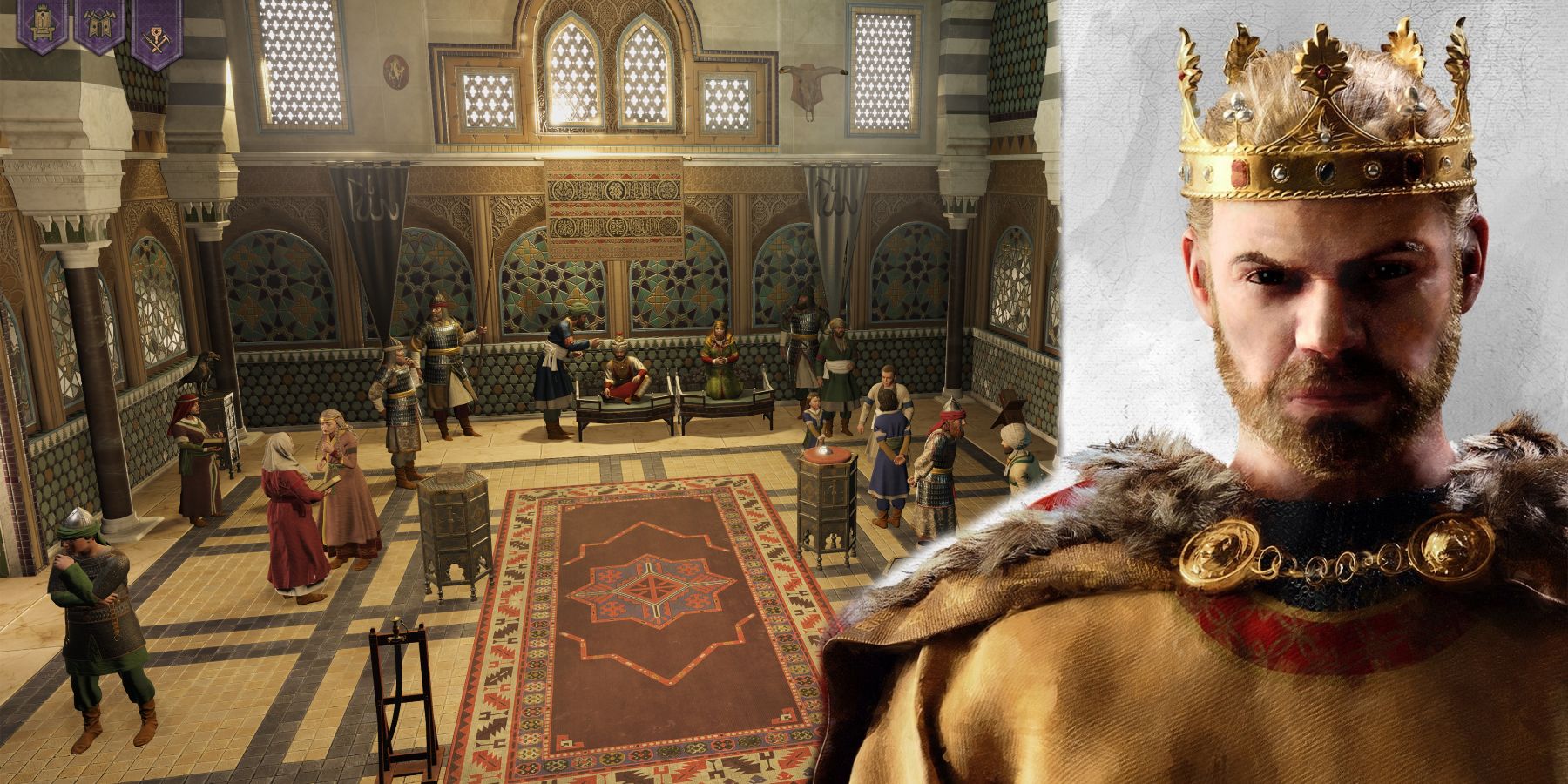
Players can expect plenty of new experiences from the Royal Court expansion for Crusader Kings III, from brand new artifacts to the titular court. The DLC brings with it new systems that thoughtfully deepen the Crusader Kings III experience while never straying too far from the fast-paced grand strategy fans have grown to expect from the franchise.
The first true expansion for the title, following the Northern Lords Flavor Pack, Royal Court allows players to take a seat on the throne and listen to the realm’s problems — deciding how and if they’ll respond to situations of varying importance. Alongside listening to court attendees, the expansion also permits players to customize cultures and even introduces the construction of awe-inspiring relics for both clout and functionality.
Holding Court Lets Players Feel Like Rulers
Of course, the court itself is the most important new feature. Players can enter their court via an icon on the right toolbar, and that’s where most new features introduced in the expansion reside. During play, individuals will make their way to a player’s court — either to pay respects or to bring attention to an issue they have. These issues can be as simple as a disagreement between vassals over who holds claim to a piece of land or as intense as a combat challenge for a court artifact.
It will be up to the player to decide how to get involved or if involvement is even the right choice. In this way, Royal Court does a much better job of making players feel like their at the head of a kingdom than the base game had before. Now, players will periodically sit on their thrones as their leader, beckoning in courtiers and those who’d ask a favor of the ruler. Though every decision won’t benefit the player, holding court allows for a much more intimate relationship between the ruler and the ruled — who knows, holding court might even result in uncovering valuable secrets or preventing hostile plots.
The Court is a Ruler’s Bridge to Their People
The court itself will play a part in how the rest of the world — and other leaders — view a kingdom. Of course, players can control this significantly, but it comes with a cost. The fashion, food quality, number of servants and lodgings can all be upgraded in a menu called “Court Grandeur” for more prestige and happier courtiers, but each luxury adds to the monthly costs of the kingdom. This creates a delicate balancing act between what’s expected of an empire and what’s financially possible. That said, players need to heed the court, as it’ll open up opportunities they might not have otherwise.
The expansion also fleshes out court positions, adding a wealth of optional roles and jobs that can be granted for additional benefits. These court positions can range from the all-important Court Physician to England’s ceremonious Keeper of the Swans. While each one will cost players a monthly salary, some include generous bonuses to offset the monetary cost of employment. These court positions can act as a double-edged sword in many cases, so players should carefully weigh each one’s worth. For example, hiring a Food Taster will add Court Grandeur and reduce the success chance of hostile schemes against the player, but if a disgruntled compatriot is the one employed and then turned, players will find they’ve placed someone working against them in a powerful position.
Artifacts Make Crusader Kings III More Personal
Underscoring the expansion are artifacts. Artifacts can be found, won or commissioned, but each will either hold a prized place on display at court — like the taxidermy Mittens — or offer more direct power as an equipable item. To that effect, players can now equip their rulers with gear in Crusader Kings III, adding bonuses based on the quality and type of artifact. Opening up player characters to equipment has made a subtle-yet-powerful impact on the title, allowing players to turn what might have been a throwaway ruler into something playable after finding the right gear to augment their stats.
Artifacts hold almost as much allure as a territory in Royal Court, and players ought to be prepared to defend their possession or claim to an artifact against other empires. Over time, there’s a chance artifacts will increase in quality or gain new effects if they’re maintained. Alternatively, players can reforge some items into a court artifact if they no longer serve a purpose as equipment. In any case, players will find that maintaining and pursuing claims for powerful artifacts becomes as essential as any other pursuit in the game.
Custom Cultures Open New Doors
As is usually the case with Paradox Interactive titles, like Stellaris before it, a free update accompanies the expansion and adds a slew of improvements and quality of life features. While the court, artifacts and the new court positions aren’t a part of the free update, Crusader Kings III is still adding substantial new features. Chief among these is the ability for players to create their own custom culture.
Initially, cultures were determined by a combination of different variables but ultimately out of a player’s direct control. Now, players can reform, diverge and even create entirely new cultures at any point during a campaign. Naturally, it’ll cost players depending on the size of their current empire and the diversity of cultures, but this small change puts a ton of control into players’ hands.
Royal Court does wonders to rekindle the fire in players’ hearts, offering more depth and content than the base Crusader Kings III ever had without muddying what initially made the title so addicting. With the addition of a kingdom’s court, artifacts, new court positions and quality of life improvements abound, Crusader Kings III has never been better to play. While the game is still a churning sea of menus and pop-up windows, with Royal Court‘s added content, it’s just as worth taking a little time to learn the systems as it was when players discovered the impressive Vampire: The Masquerade fan-made overhaul.
About The Author
