Dungeons & Dragons has been through many iterations across several game lines. Currently in its Fifth Edition, the rules are almost unrecognizable from what they were years ago, barring things like hit points, d20s, and leveling up. These changes have happened gradually over time, but often in the form of sudden changes between editions.
While Second Edition was very similar to Advanced Dungeons & Dragons‘ First Edition, every edition has since has changed some rules in a major way, making each version of the game distinct. Some of these changes have been far more important than others, heavily altering the play experience.
10 The Removal Of Attack Matrices And THAC0
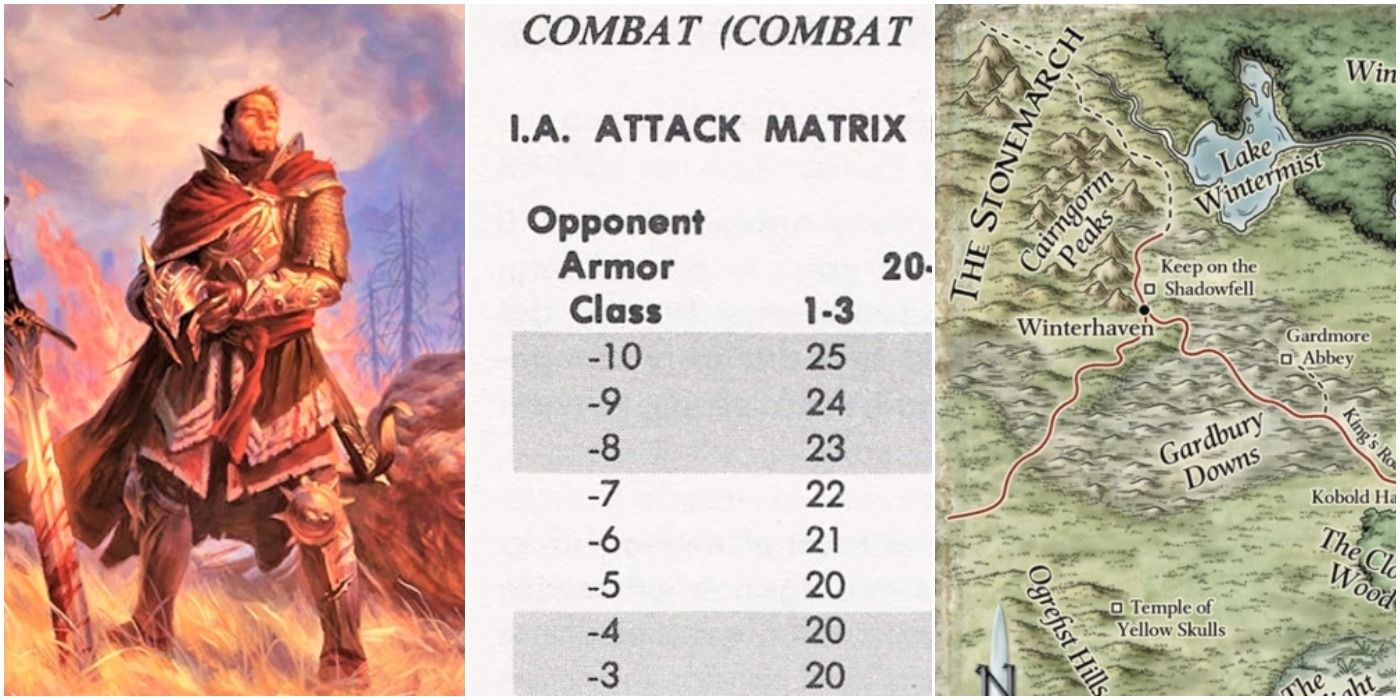
The most notorious cases of confusing older mechanics from Dungeons & Dragons are the ways to hit in older editions, including ‘THAC0’ (standing for ‘To Hit Armor Class 0’) and attack matrices. Each involved a player rolling a d20, but the similarities to modern mechanics largely stopped there.
Each involved cross-referencing several numbers with the d20 roll, including the enemy’s AC (when lower AC made a creature harder to hit) before the attack could be resolved. The result was a confusing mechanic that many were glad to see changed in Third Edition.
9 The Default Setting Changed Several Times
The core rules of Dungeons & Dragons often have a ‘default’ setting, given some information in the Player’s Handbook and Dungeon Master’s Guide to help introduce the players to a fantasy world. In 5e, this is the Forgotten Realms, the setting created and made famous by Ed Greenwood, and home to characters like Elminster and Drizzt Do’Urden.
However, the Forgotten Realms being a default setting is new to Fifth Edition. Although the Realms were always popular, earlier versions used settings as obscure as Blackmoor, whilst Third Edition made use of Greyhawk, and Fourth Edition used the Nentir Vale.
8 Introducing Subclasses To Provide New Options
In many ways, 5e was more of an evolution of the game than a revolution, largely bringing together the most successful mechanics from previous editions into a cohesive whole. However, one of its innovations, inspired by similar systems, is the ‘subclass’ mechanic, used to provide variation between characters.
Previous editions had dozens of classes, with more released in each supplement, many of which were very similar. Instead, subclasses provide new abilities to the classes in ways to make them distinct from one another, allowing a fighter to be things as diverse as a Cavalier and an Eldritch Knight.
7 Removing Racial And Ability Requirements For Classes
Third Edition was a major changing point as the first edition that was created by Wizards of the Coast, making sweeping changes to the game. A seemingly-minor change with a large impact was the removal of requirements for a character to be made as a particular class.
In earlier editions, certain races were forbidden or discouraged from being certain classes, and many classes like Paladin and Bard had steep ability score requirements before they could be taken. Third Edition did away with this, allowing any race to be any class with any stats — although many races were still poorly-suited to many roles.
6 The AEDU Power System
Fourth Edition remains the most controversial edition of D&D. Despite many good qualities, fans of earlier editions believed it to be too far removed from the game and too reminiscent of video games, alongside a host of other mechanical concerns. One of the most controversial changes was the ‘AEDU’ system of organizing powers.
Standing for ‘At-Will,’ ‘Encounter,’ ‘Daily,’ and ‘Utility,’ every class received a number of powers that fit each description, letting them be always used, once per encounter, or once per day. Detractors claimed that this system made classes too similar, while supporters view it as balancing the playing field between classes.
5 The Introduction Of The d20 Mechanic
Third Edition is viewed in hindsight as a vastly complicated system. Still, at the time, it was applauded for simplifying a great number of older D&D mechanics into a single, coherent system. 1e and 2e, among other versions of the game, had a whole host of systems and subsystems for attacking, casting spells, pickpocketing people, and things as simple as climbing walls.
By contrast, one of the selling points of 3e and 3.5 was that a player could simply declare they were doing anything, roll a d20, add a modifier, and be told if they succeeded or not. This changed the game’s entire learning and playing experience, and it remains one of the most significant changes ever made to the rules.
4 The Introduction Of Bounded Accuracy
One of 5e‘s most significant changes wasn’t in explicit mechanics, but in design philosophy. In both 3e and 4e, bonuses would outstrip dice rolls before long, resulting in huge bonuses to rolls like +40, which made the game slightly absurd to follow with very fast-scaling.
The result was that player characters could fall behind each other, monsters very quickly became unable to threaten players above their level, and the d20 could become irrelevant. In Fifth Edition, the game is designed for bonuses that don’t reach much above +11, allowing things to progress at a slower pace while always making the d20 matter.
3 The Removal Of Racial Penalties
One of the changes to 4e that continued into Fifth Edition was the removal of negative racial traits. In previous editions, races didn’t give just stat bonuses, but stat penalties as well. As such, races tended to fit more into a certain role, struggling to fit outside of relatively narrow boxes and reinforcing some of the game’s uncomfortable racial subtext.
In Fourth Edition, most races simply got bonuses to two abilities, continuing into 5e. This encouraged certain roles but didn’t actively punish characters for doing other things. Things would change even more midway through 5e, removing fixed racial stat bonuses as well.
2 Saving Throws Change Constantly
The saving throw system has always been present in D&D, but nearly everything about it has changed. In early editions, characters had a set array of saving throws by class against specific threats, such as ‘poison,’ ‘magic wand,’ and ‘death.’ In Third Edition, they were grouped into three, ‘Fortitude,’ ‘Reflex,’ and ‘Will,’ making use of the Constitution, Dexterity, and Wisdom stats.
In 4e, they changed further, becoming a series of static defenses like Armor Class that certain effects targeted instead of AC, whereas 5e changed them back to a system similar to 3e, but making use of all six stats. Of all the mechanics in D&D, saving throws have seen some of the largest changes between editions.
1 How Extra Attacks Work
Dungeons & Dragons has typically given martial classes the ability to strike more often with a weapon than their fellows. This is to make them directly more capable in combat compared to the more versatile abilities used by spellcasters or Rogues. This has always been consistent, but the way it’s operated has often changed.
In early editions, the complex system could result in the fighter making attacks outside of their turn to represent their speed. In 3e, all characters make an increasing number of less-accurate attacks as they go up in level, eventually letting even wizards make two attacks per turn at higher levels. In Fifth Edition, things took a simpler turn, letting martial classes just make extra attacks at the same efficiency as they increased in level and helping to increase their power.
About The Author
