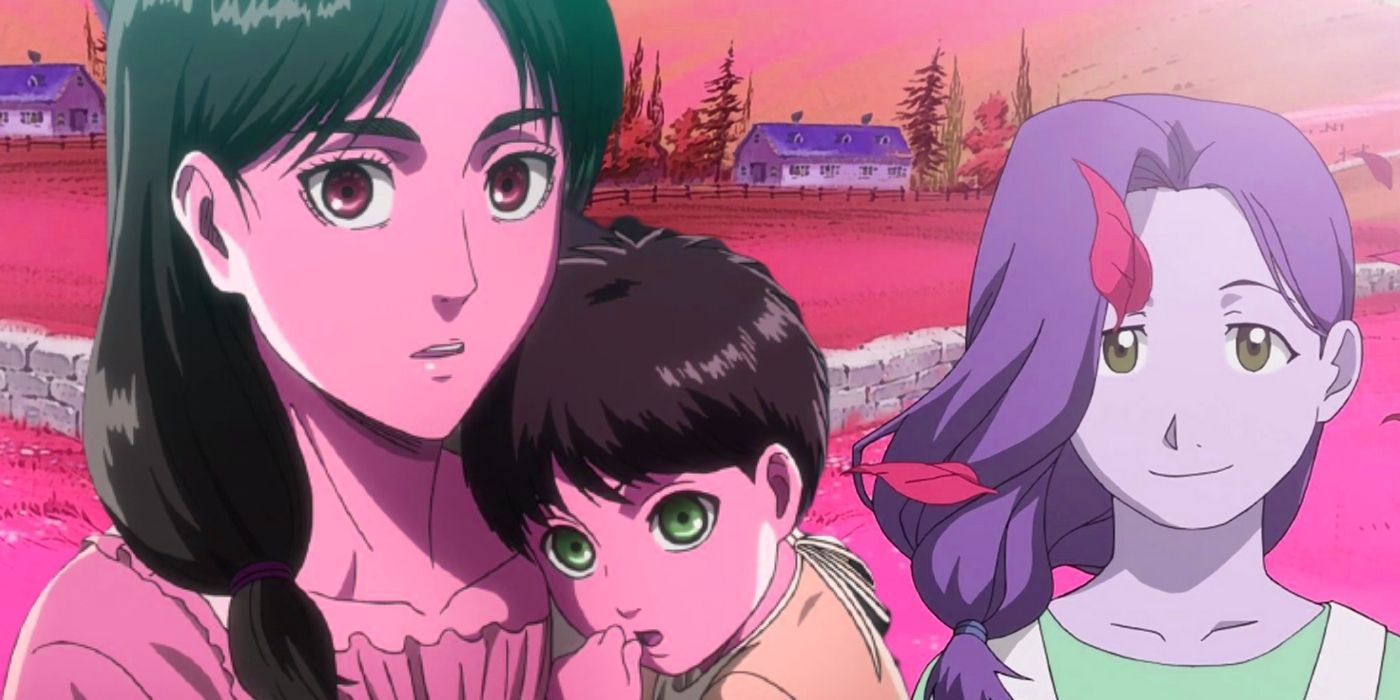
There’s no denying that anime protagonists often have it rough. After all, challenging a character is the essence of good storytelling, and seeing a character rise to meet those challenges is what makes a series worth watching. Anime heroes and heroines are, naturally, the central focus of their stories, and secondary characters rarely receive as much attention in the development department.
And what about anime moms, who often fail to reach even secondary character status? These tertiary beings rarely factor into the teen protagonist’s life in a meaningful way, underwritten and over-archetyped as they often are. The life of an anime mom is rarely nuanced and often entirely unfair, and even the most three-dimensional anime moms tend to get the short end of the stick.
10 You’re Limited To Just A Few Unflattering Hairstyles, & You Will Probably Wear An Apron
Dead Mom hair has long since been a meme. Too many anime homemakers wear a cardigan and a suspiciously loose side ponytail, symbols of domesticity that seem to foreshadow the character’s untimely death. This cursed hairstyle is often paired with an apron, tied around the waist, and the character’s omnipresence in the family kitchen. Why have so many anime embraced this limiting and doomed take on motherhood?
In mid-2oth century Japan, traditional housewives cooked, cleaned, and looked after the kids while a husband earned a salary. This expectation has sometimes been romanticized in Japan just as it has in the West: the housewife is a wholesome specter in her own home, beautiful but domestic, hair long but restrained, clothing demure and practical. But writing a character in accordance with these outdated standards ensures many anime moms become deadweight to a story, and authors like to solve this problem by granting her an untimely death. Not much of a thank you, is it?
9 More Than Likely, Your Partner Is Out of the Picture
While anime moms are often resigned to the home, anime fathers are usually MIA. Though they’ve sometimes passed away, as in Wolf Children or Naruto, often enough they’re simply classic deadbeats or working abroad, abandoning their families to deal with the fallout of their actions and absence.
Hohenheim may have his reasons for ditching his family in Fullmetal Alchemist, but either way, Trisha Elric is left with the burden of raising two errant children despite her ill health. Anime moms rarely have the support of a loving partner, and when they do, the work is still unevenly divided or the father is a downright poor influence. These couples are almost always heteronormative, exacerbating the cliché tenfold.
8 You Exist Only To Nurture The Protagonist
What does Inko Midoriya do all day, while her son is off galavanting with the rest of UA? As an audience, fans love Inko because she’s the perfectly imperfect, supportive mother. At times she questions Deku and the dangers he faces, but she never permanently forbids him from challenging villains or endangering himself.
Her husband is abroad and her son is at school, but all of Inko’s identity is based on her desire to support her son. She sews him a superhero costume, encourages him when he’s upset, and cooks meals for him. Beyond that, who is Inko, and why is it that few anime moms get to be people beyond who they are to their children? Too many anime fail to define mothers as individuals in their own right.
7 You May Be Written As Abusive
Occasionally, anime moms are given more than a nurturing personality, but this isn’t necessarily a good thing. While parents in comedy series like Saiki K are written as lovable idiots, more “serious” anime sometimes cast mothers as abusive. Todoroki’s mother pours boiling water on his face because she resents his resemblance to her abusive husband. In Erased, Akemi Hinazuki ruthlessly abuses her daughter. The central struggle for the protagonist of Your Lie In April is processing years of abuse at the hands of his terminally ill mother.
If the two anime mom options are domestic prop or traumatic presence, how can these characters hope to grow?
6 With A Few Notable Exceptions, You Are Rarely The Main Character
Wolf Children received significant acclaim for multiple reasons, but perhaps the film’s true power was its characterization of its lead. The Mamoru Hosoda film documents the life of a normal woman, Hana, who falls in love with a werewolf and raises his children after his untimely, violent demise. The film chronicles her life as a single mother, the challenges of parenting made even harder because her children are fundamentally unusual.
While the children eventually become strong characters in their own right, Hana remains the film’s heroine. Hana’s refreshing success as a character highlights the overarching stigma in anime as a whole: very few anime moms are as fortunate as Hana, who gets to be the primary agent in her own story.
5 Your Child Is Probably Ungrateful (& Will Regret It After It’s Too Late)
“Leave me alone, Mom!” cries every kid ever at some point, and anime is no exception. Unfortunately, in anime, this statement is usually succeeded by the child going off on a dangerous adventure or the mom facing deadly harm after his harsh words. Anime moms rarely know the true extent of their child’s exploits. This would be normal, to an extent, but half the time their kids are off killing demons or fighting monsters while Mom’s at home wondering why he won’t talk to her.
Few anime moms are written as aware of their surroundings, and often harm comes to their loved ones as a result. Basically, the kids are alright, but the parents can’t do anything right, and may as well not exist.
4 Chronic, Undefined Illness Is A Likelihood
Even excellent anime harbor the time-tested sickly mom cliché. In My Neighbor Totoro, the sisters’ mother remains bedridden with a chronic illness for the entirety of the film, although at least her sister’s adventures culminate in visiting her in the sick ward.
Princess Jellyfish is a heartfelt story about identity whose primary heroine, Tsukimi, uses a jellyfish infatuation to cope with her mother’s death. Ciel Phantomhive of Black Butler inherited an illness from his mother. While sometimes this trope is gloriously subverted (Izumi of Fullmetal Alchemist comes to mind), leaving Mom in a hospital is a good way to incur sympathy without requiring the mom to be an active part of the story.
3 Actually, You’re Probably Not Long For This World, Sorry
Most anime moms aren’t long for this world, dead mom hair or not. In fact, it’s hard to think of shonen hits that don’t feature an orphan, and moms often die onscreen for additional drama.
Eren watches his mother get eaten. Guts of Berserk loses not just one, but two mothers in his youth, and Inosuke actually wears the head of his deceased boar stepmom. Too many anime moms die over the course of a story that’s about someone else.
2 In Fact, You May Be Dead Already
While dramatic demise seems par for the course for anime moms, some moms don’t even make it into the series before passing. Tohru’s Mom is dead from the get-go in Fruits Basket, and Ichigo’s Mom dies when he’s nine and Bleach‘s story doesn’t begin until he’s fifteen.
In many cases, Mom is a memory that motivates or torments a protagonist, and little more. Inuyasha’s mother played no part in his life, apart from giving him half-demon angst. Even when loving flashbacks are incorporated into a series, too many moms exist as a symbol of loss rather than a character themselves.
1 Even When You’re Exceptionally Well-Written, Things Aren’t Going To Be Easy For You
Certainly, not all anime moms fall victim to these tropes and clichés. But even those that don’t, such as Queen Hiling from Ranking of Kings, are still likely to go through more hardships than happiness. Torn between her stepson and her own son, Hiling struggles to do what’s right.
Similarly, Tohru’s mom, Kyoko, was fantastically written but died regardless. When Nagisa, Clannad’s female protagonist, grows up and has a kid, her death follows swiftly. While some of these trials are fundamentally human and rewarding, is it too much to ask that anime moms be given their own spotlight to live and grow? With a few notable exceptions, anime has a lot of growing up to do when it comes to characterizing motherhood.
About The Author
