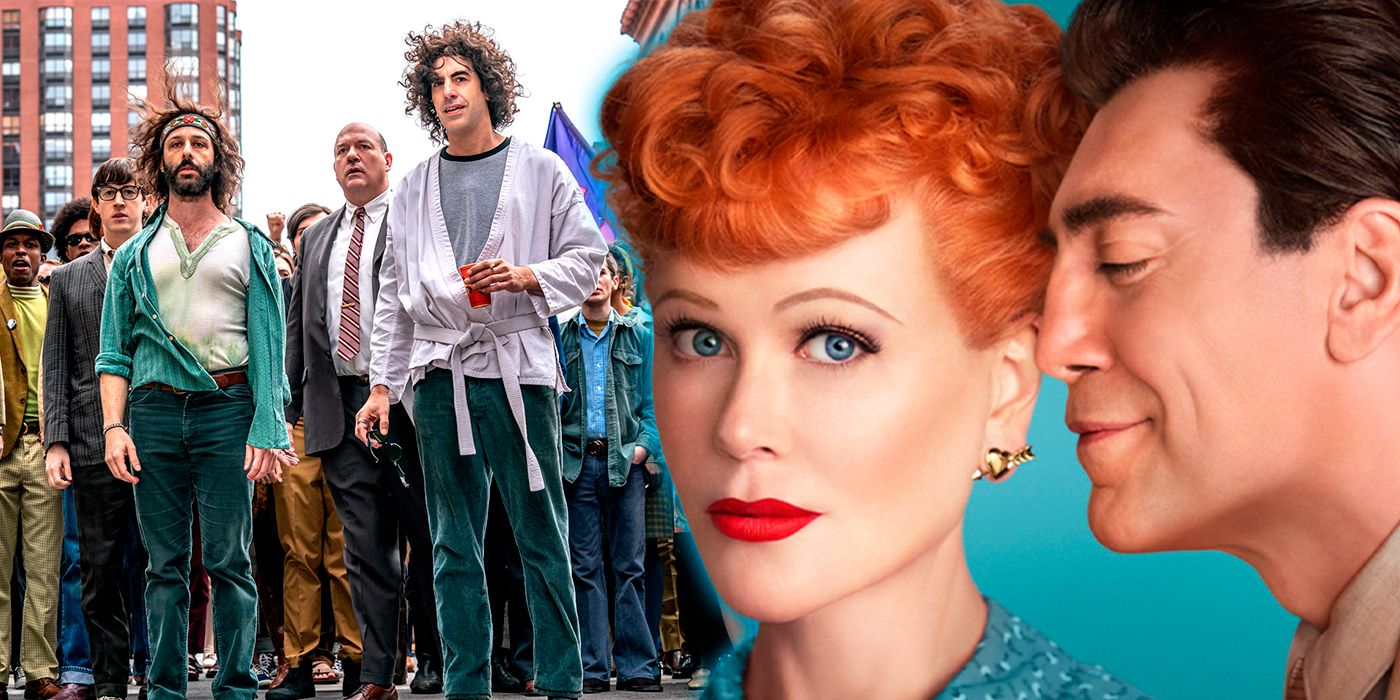
On a surface-level glance, it may not seem that Being the Ricardos shares much in common with The Trial of the Chicago 7. While the former follows the marriage and professional partnership of I Love Lucy’s Lucille Ball and Dezi Arnas, the latter delves into the infamous Chicago courtroom drama that became a political battlefield during the days of the Vietnam War. Yet, writer/director Aaron Sorkin crafted both tales in similar ways, and the more each is compared to the other, the more their similarities stand out. Perhaps what stands out most is a common flaw that perpetually afflicts Sorkin’s projects: a little bit of dramatization can enhance a story, but overdoing it dilutes the reality.
In terms of picking moments from history ripe with their own natural drama, Sorkin’s choices in settings leave nothing wanting. Being the Ricardos focuses on a fraught week of production on I Love Lucy where journalists prepare to publish a story that could ruin Ball’s career, Ball reveals her pregnancy to the show’s overseers, and she struggles with whether or not to believe the reportage of her husband Anaz’s infidelity. Chicago 7 also picks a potent placing for its story, featuring the Chicago Seven on trial after the riots of the 1968 Democratic National Convention turned the anti-Vietnam War protestors into figureheads for an entire movement.
But neither story proves satisfied with merely telling the tale of its place and time. Both feature parallel plotlines which pick and choose events from the past to intersperse in the present of the films’ events. For Being the Ricardos, that means watching Ball and Arnaz’s relationship grow into the professional partnership that defined their relationship. For Chicago 7, that means watching the buildup to and the unfolding of the riots that spurred on the trial in the first place. However, in neither film is the Frankensteinian assemblage of dramatically-potent events enough as Sorkin hypercharges both with characters and dialogue and scoring to electrify everything with an even greater sense of consequence. But does either monster really come alive, or are they fried to a crisp?
Lucille Ball was doubtless a comedic genius in her own right and deserved her unparalleled place in TV history. But Being the Ricardos portrays her as an inhuman savant, struck by epiphanic inspiration where the best way to do a scene erupted into her mind’s eye fully-formed. The same sorts of epiphanies and ingenious inspirations recur throughout the legal defense of Chicago 7, and in neither film are they particularly true to the hard work and tireless practice that defines the careers of comedians and lawyers alike. But perhaps most egregious of all is the climactic endings to each film.
In Being the Ricardos, Dazi Arnaz confronts a live studio audience with a defense of the Red Scare allegations against Ball, which ultimately culminates him his projecting FBI Director J. Edgar Hoover over a microphone in order to clear Ball’s name to a cheering crowd. In Chicago 7, the antagonistic Judge Hoffman ineffectually bangs his gavel in an impotent effort to silence the triumphant recitation of Vietnam casualties that earns everyone else in the courtrooms’ respect. Neither moment in either film is historically accurate, and both represent perfectly just how overwrought the drama becomes which ultimately undermines their value.
It’s just too much. The reality of either story would be more than enough to prove engaging, entertaining and deeply resonant with audiences even with minimum dramatization. Such stories should be all the more meaningful because they really occurred. Viewers should not be able to guard their own relation to the story through the consciousness of the events being fictive. In different films, the personal tragedies of comedians or the cultural significance of political extremes clashing violently could both be enhanced with the knowledge that they are real stories.
But neither Being the Ricardos nor The Trial of the Chicago 7 feels real. Sometimes a sweeping orchestra does not exalt a moving speech so much as undermine it, but Sorkin consistently opts for the grandiose over the intimate and familiar to the detriment of the events he brings to film. There is certainly no dearth of talent where Sorkin is concerned, with The West Wing, The Social Network and Moneyball standing out as tremendous displays of craftsmanship. But where his latest projects are concerned, it’s hard to feel like he could accomplish much more with so much less.
To see the interplay between reality and drama in Aaron Sorkin’s styling, watch Being the Ricardos now on Prime Video.
About The Author