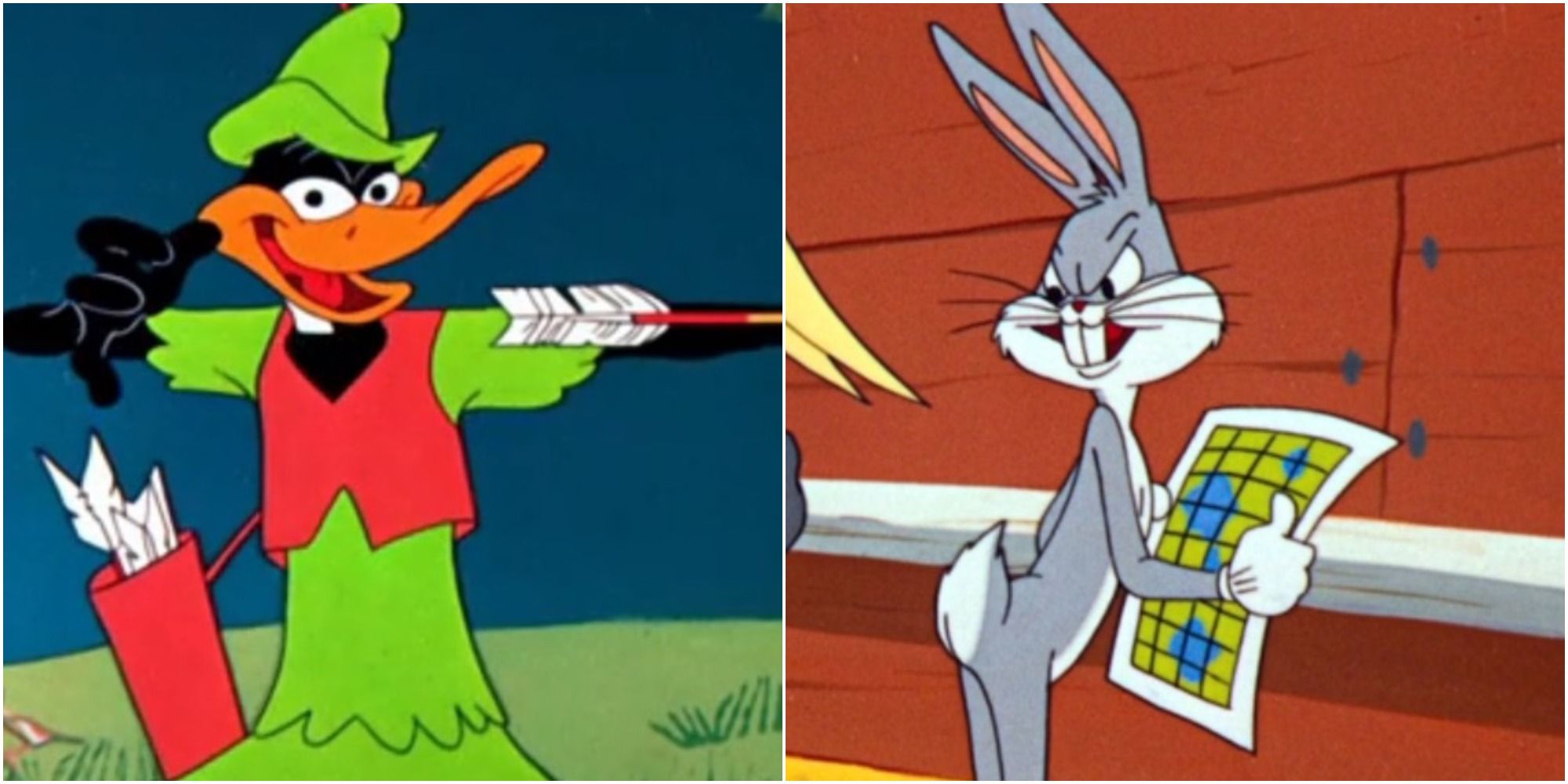
Looney Tunes is nothing less than era-defining. It captured the attention of global audiences with the help of iconic characters, like Bugs Bunny, Daffy Duck, and everyone in between. The Warner Bros. cartoon series was most prominent during its Golden Age (1944-1964), but its cultural impact can be felt to this day. Looney Tunes has since evolved into a massive franchise which incorporates TV series, feature films, video games, special episodes, and comic books.
There are over a thousand Looney Tunes shorts in total. Unfortunately, many have been lost to the fog of history. However, a sizable number of shorts have maintained their freshness despite the animation medium’s exponential growth over the past few decades.
10 Walky Talky Hawky Made Foghorn Leghorn The Antiheroic Star He Was Destined To Become (1946)
Foghorn Leghorn is known for two things: his weighty Southern drawl and pompous personality. This histrionic rooster first appeared in Walky Talky Hawky, where he tricks Henery Hawk into attacking his on-again-off-again nemesis, Barnyard Dawg.
Walky Talky Hawky lasts for a mere seven minutes. Its narrative is dense with a flurry of activity and excitement, eventually culminating in Henery’s temporary victory. Walky Talky Hawky made Foghorn Leghorn the antiheroic star he was destined to become.
9 Rabbit Of Seville Parodies Several Pieces Of Classical Music (1950)
Rabbit Of Seville is a backhanded parody of Rossini’s famous opera, The Barber Of Seville. Bugs is the titular barber, and Elmer is forced to play his unwilling client for a packed audience.
Rabbit Of Seville makes several witty references to classical pieces of music, like Mozart’s The Marriage Of Figaro and Mendelssohn’s Wedding March. Critics consider Rabbit Of Seville to be on par with What’s Opera, Doc?, a 1947 short that’s generally acknowledged to be one of Looney Tunes’ greatest offerings.
8 The Scarlet Pumpernickel Provides A Sharp Contrast (1950)
The Scarlet Pumpernickel borrows from Baroness Orczy’s historical novel, The Scarlet Pimpernel, except the protagonist is Daffy Duck. The Scarlet Pumpernickel involves a deft meta-narrative in which Daffy tries to pitch a nonsensical script to Warner Bros.
The Scarlet Pumpernickel is particularly hilarious because it provides a sharp contrast between Daffy’s frivolous attitude and his would-be vision of himself as a legendary playwright. Several other Looney Tunes characters make an appearance, including Sylvester, Porky, Elmer, and Melissa Duck.
7 Robin Hood Daffy Extracts As Many Hijinks As Possible (1958)
Robin Hood Daffy contains only two characters, Daffy Duck as the titular outlaw and Porky Pig as his portly frenemy, Friar Tuck. As per his character, Daffy tries to portray himself as a remarkable hero and fails miserably, much to Porky’s delight.
By the end of Robin Hood Daffy, Daffy acknowledges his shortcomings and announces that he would rather be “Friar Duck.” Robin Hood Daffy manages to extract as many hijinks as possible over its 3.5-minute runtime.
6 High Note Is A Masterpiece Of Classically Adult Booze Humor (1960)
High Note is unique among Looney Tunes’ shorts in that it lacks recognizable characters and dialogue. This music-themed short earned an Oscar nomination for its surreal narrative. Every character is a musical note, even the “conductor” of the orchestra.
The notes mutate into innumerable items, such as hangers, horses, slides, dogs, lassos, and so on. In the words of Jerry Beck, author of The 50 Greatest Cartoons, High Note is a masterpiece of “classically adult booze humor.”
5 Bully For Bugs Is A Highlight Of Animator Chuck Jones’ Glittering Career (1953)
In Bully For Bugs, Bugs Bunny accidentally finds himself in a bullring while on the hunt for a “big carrot festival.” Toro attempts to defeat Bugs, but Toro’s incredible strength is no match for Bugs’ wacky attack style.
Toro is inevitably brought down by his own hubris (and a TNT barrel). Apparently, Bully For Bugs was created by Chuck Jones as a response to producer Eddie Selzer, who declared that the bullfighting concept wasn’t cartoon-worthy. Bully For Bugs ended up being one of the highlights of Jones’ career.
4 Devil May Hare Introduces The Relentless Tasmanian Devil (1954)
Devil May Hare is the debut performance of the relentless Tasmanian Devil, who is unfairly pitted against the incomparable might of Bugs Bunny. Taz uses every ability at his disposal, but neither his tornado spin nor his jaw strength is enough.
Devil May Hare concludes with Taz getting “married” off to a Tasmanian She-Devil. Bugs is the minister for the ceremony. Tasmanian Devil would later go on to star in Taz-Mania, a four-season sitcom dedicated to his comical exploits.
3 Little Red Riding Rabbit Ends With Bugs Teaming Up With The Big Bad Wolf (1944)
Little Red Riding Hood, the popular children’s fairytale, has different endings depending on the writer. Charles Perrault has the wolf eat Red Riding Hood and her grandma. The Brothers’ Grimm version ends with the wolf drowning.
Little Red Riding Rabbit, on the other hand, twists the protagonist into a villainous caricature who wants to cook and eat Bugs Bunny. However, the Big Bad Wolf and Bugs team up and punish Red Riding Hood for her tiresome behavior.
2 The Great Piggy Bank Robbery Remains One Of Looney Tunes Silliest Offerings (1946)
The Great Piggy Bank Robbery stars Daffy Duck as his alter ego, Duck Twacy. This is an obvious play on the comic-strip detective, Dick Tracy, whose rogues gallery is comprehensively referenced in The Great Piggy Bank Robbery. Daffy arrogantly declares war on the so-called criminals, only to find himself outnumbered.
Although his harrowing experiences turn out to be a dream, Daffy finishes the story with egg on his face as usual. The Great Piggy Bank Robbery remains one of the best and silliest Looney Tunes shorts to date.
1 Elmer Loses To Sylvester’s Musical Racket In Back Alley Oproar (1948)
Sylvester never succeeds in eating Tweety Bird, but he has the last laugh in Back Alley Oproar. Sylvester’s nocturnal melodies irritate Elmer Fudd, who wants nothing more than a good night’s sleep. Elmer is simply unable to stop Sylvester’s racket until he lights a box of dynamite, killing himself and Sylvester.
Unfortunately for Elmer’s spirit, he doesn’t get the “west and wewaxation,” he desires because the ghosts of Sylvester’s nine lives continue their musical performances on the way to heaven. Back Alley Oproar is uproarious from start to finish.
About The Author
