SPOILER WARNING: This article contains minor spoilers for “Deus Ex Latrina,” the latest episode of DC’s Legends of Tomorrow Season 7.
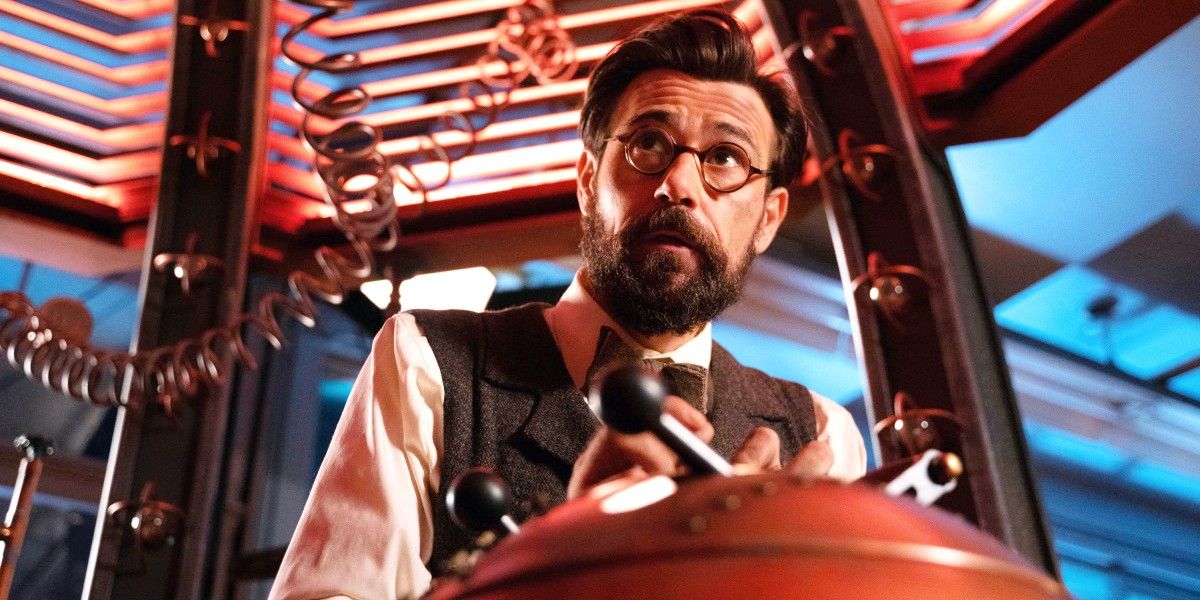
Meet Gwyn Davies, who is nothing like Matt Ryan’s previous character John Constantine. In “Dues Ex Latrina,” the latest DC’s Legends of Tomorrow episode, the team got to know Gwyn a little better after his time machine accidentally ported them to 1986 Chernobyl. Stranded there by his own miscalculation, Gwyn had an episode wherein he revealed the source of his trauma: the death of his friend and paramour during a particularly brutal battle in World War I. According to Ryan, Gwyn may just have a chance to open up and heal a little with some help from the Legends.
Speaking to CBR, Ryan introduced Gwyn and explained just what makes the character so delightfully different than John Constantine, who he played from Season 3 through Season 6. He compared Gwyn to Sherlock Holmes and detailed the extensive research he did in order to accurately portray Gwyn’s trauma. He also addressed whether or not he would ever return as Constantine, revealed the moment that made him feel like Doctor Who, teased a scene between Gwyn and Ava and more.
CBR: You are in such a unique position, where you were able to switch to a completely new character for this season. What kind of input did you have in the creation of Gwyn Davies? What was most important to you when it came to defining who he is?
Matt Ryan: It initially started, as you know, when we knew that John wasn’t gonna be on the show anymore, and then it’s like, “Okay, time for the next job. Move on. Maybe I’ll go and do some theater, because I haven’t done that for a while…” And then they were like, “We’d love to have you back!”
The initial thing we talked about is, “Well, what does the show need, in terms of a dynamic or a character that comes in? What kind of energy?” John was someone who was on the back foot, who comes from a world where he’s got lots of experience; he’s kind of all knowing and he’s arrogant. We wanted someone that kind of brings in a fresh perspective, someone who has been bound to his time, in his period, in terms of his sensibilities and the way the world was, and then his eyes are opened in this crazy new world.
So we talked initially about the dynamic and the energy and some of the themes we wanted to tackle, and then he just kind of happened, you know? He just kind of happened! To change character on the same show, for me, it had to be something completely different physically, vocally and in terms of his inner workings and machinations as well. It had to be something that felt, to me completely different, and it does. Yeah, it’s a unique thing, creating a character like that as well.
I did a lot of research into World War I, because that was where his trauma comes from and part of his huge experience. I did all this thematic work around the society, and then you just kind of let him loose and he’s become his own his own character in a way. Yeah, it’s a really interesting process and really unique to be able to do that in front of an audience — and also in front of the crew and the actors. They knew me as John and they like John and then suddenly, I’m saying I’m this other person. You have to kind of force them to look at you differently.
Now, after playing him for however many episodes we’ve done so far, it feels like he’s always been in the room. It’s almost like, “Wait, did I play John Constantine on this show before?” And that’s a good indicator to me to know that we’re hopefully on the right track.
For years, you were kind of attached to this portrayal of John Constantine, who has this long history in the comics and, now, on TV. Since Gwyn is free of all that continuity, what did that allow you do with his character that perhaps you couldn’t with Constantine?
Yeah, it’s the discovery, like in the moment — in the moment of who he’s going to become. In the playing of him, you find something, and then you can say, “Oh, this can be a part of him too,” rather than him being canon and having all of those things in place. He’s someone also who can develop in real time in front of the audience.
I love the idea of him coming from a place where he’s socially bound and emotionally bound, in this very kind of put-together world in the early 1900s, and that he’s someone now that can discover himself in front of the audience’s eyes. He’s someone who, physically, he’s got all this trauma, but how does he work through that? And remembering he was a soldier; he was a warrior in World War I, and who was that person before? Then you look at the physicality to him now, and it’s not that he’s going to go back to that warrior, but who’s he going to become? To be able to play that out in front of an audience as we’re kind of discovering it as well, I think it’s quite unique.
It’s a wonderful thing for me, because I can find something in the moment, and then throw it to the writers or Phil [Klemmer], the producer, and go, “Oh, maybe this could be a part of him too!” and we can implement that in real time. That’s a completely different and unique challenge to what it was with John.
Clearly, the trauma of Gwyn’s past viscerally affects him. How did you set out to approach that part of him, particularly in such a silly show as Legends of Tomorrow?
The fact that we all have our inner traumas, no matter how big they are, and everything’s relative, right? It was important to me to play the part of him that comes from that socially-bound world, and then his whole world is opened up to these people who think and look and feel differently. To portray his dilemma that he’s in, he’s someone who has faith and is religious, but also he has a love for someone in a way that wasn’t allowed in that time legally, as well as spiritually, and to play that dynamic out in real time on the screen, that’s something that that transcends time.
It’s good to tell that story, because we can tell it from someone who is bound by those societal rules and structures. He’s someone who can work through that, but that’s also parallel to today, as well, in a very different way. It’s just framed and looked at in a different lens. That was really important to me, is to get underneath the skin of the struggle that he has between his faith and his love and this world that has been blown open to him.
The hard thing is, as well, as you say, Legends is a style of show which it’s hard to explore those things in certain ways, but hopefully, we can do that. Also, he still has some of the qualities that we love about Legends, and whoever he’s going to become, as he works through this trauma, is also something — the comedy element of it, in a way, comes from a very different place, of kind of the slapstick funny; it comes from his physicality and his mind, the way he looks at things. It’s just a really interesting thing to play on the show.
It feels so completely different to John, in a wonderful way. I hope that it works, because it’s one of those things you have to give yourself boldly to, jump into it and see how it goes. I’ve just fallen in love with him the more and more I play him because he has this huge heart, this huge openness and vulnerability, which — a lot of the time — we don’t like to see such characters on these kinds of TV shows; we want our heroes to be strong and lead, and this is someone who is showing you he’s open. We see what’s going on underneath, and he’s vulnerable, and then the journey towards who he becomes is gonna be an interesting one.
Which other character do you think Gwyn has the most interesting dynamic with and why?
Well, the interesting thing is there’s dynamics playing out with Gwyn that I, as John, the relationships were different. Behrad, for instance, the relationship that he has with Behrad is a wonderful one. Me, as an actor playing that, me and Shayan [Sobhian] hadn’t really had the chance to do that, and that’s a really interesting one, and the way that Zari kind of opens him up.
The interesting thing is each character that he — not gets paired with, but as he gets to know the Legends, there’s something unique about each individual relationship that he that he has with them. I would say there’s this great moment coming up — or I really enjoyed playing it, anyway; I don’t want to say it’s great — but where Ava and him bond, and there’s these very open vulnerable moments, but also at the same time, there’s this strength in the both of them. I love the way that Jes [Macallan] plays Ava, and she is and can be an emotional person, but she has this drive as well. There’s something that Gwyn got from that relationship, which is upcoming in however many episodes to come, that I found was really interesting.
What I’m finding is each relationship that develops, Gwyn is learning something about himself that he never knew. That’s the interesting thing. So I’m discovering these things as we go on, and they’re always surprising and unique.
Which do you find more challenging to portray: the magic or the science?
Ah, interesting! Well, do you know what? I don’t know about the magic, because it’s been seven years since I started playing John Constantine, that kind of became like second nature, and me getting into the new rule sets of this guy, I almost feel like he’s a little bit like Sherlock [Holmes] in a way that his mind looks at a million miles an hour.
Now at the moment, he’s surrounded by all this trauma and this physicality that he’s bound by, but actually, he is a genius. There’s something about the quickness of his thought that I really, really love and that energy that he has.
But in terms of the challenge, I would say this, because I don’t remember what it was like to start learning about the magics! I’ve got to say that when I started playing John, I read all the comics, and then I started reading all the grimoires and all the magic books. That was tough, because I was learning symbols and things like this and looking at spells in a way, and I’m going, “Wow, I’m going into this potentially dark, supernatural world!” So I would say that that was more challenging in a way for me than Gywn, because the science thing isn’t as — it doesn’t have the potential of — you look at magic and you’re going like, “Shit! These spells are real!” Words used to mean things back in the day! If you say something and you curse someone, that can stick to them. So getting my head into that was probably more difficult than getting the science and the shit out of Gwyn, but that was a long time ago, and the magic stuff became second nature. So it’s really good to jump into this challenge, too.
You mentioned Sherlock Holmes and, when I chatted with Phil Klemmer at the start of the season, he compared Gwyn to J.R.R. Tolkien. I’d love to hear a little about the influences and inspirations you turned to as you developed this character.
Well, the first thing was, “Where does he come from? What time was he living?” and then looking at World War I. I love this part about being an actor. I played Fluellen in Henry V years ago, and I went and I read everything about the Hundred Years’ War. Then I had a little bit more time, so I went back to 1066, and I just love that shit, that there’s something real I can base this character on.
So I basically went through all the World War I documentaries and the history of how we got there and all of that. I would put images up on the wall. The trauma that he has comes from the loss that he’s had from someone he loves, but also the trauma of that war, which was absolutely ravishing on people’s souls as well as physically. Even now, I can feel a little lump in my heart and my throat, because it was crazily traumatic and diving into that stuff…
As Phil said, the Tolkien elements of it as well, that he went through that, and then his trauma was worked through his writing and all that stuff. This guy has a trauma; how can he work though it? Through the Legends, and through these different sensibilities and ways of living that can open him to a new way of living as a human being. I think that that development is huge. Its massive! Thematically, that’s crazy. That’s a whole TV show in itself, do you know what I mean? To get into that stuff!
But to be able to get into that and research it, and then have it, and then discover where he is in this world and how he moves forward as well is really the the interesting thing, and for me, not to linger on it too long as well, in terms of the style of the show is — it’s Legends! You don’t want to be too heavy, but at the same time, you want it to resonate, and you want it to be that trauma to be real, I think.
Then there’s comedy that comes from that, this guy in 1925 going like, “Oh my god, what are these things that are in this world?!” and someone who’s looking onto a world with fresh eyes and is discovering for the first time. There’s almost a childlike quality to that, that I really enjoy playing. Then with all the stuff underneath as well, it’s really becoming a joy to play, really. The physical comedy of it is really cool, as well. I’m enjoying that stuff.
I feel like I saw a little Doctor Who in there, especially with that last part you mentioned.
Yeah! The interesting thing is, all of the influences in your life, they all seep in in certain ways, even if you don’t want them to! When I saw that time machine for the first time and I looked in the mirror, I was like, “Oh shit! There’s a bit of Doctor Who in there!” But obviously, he’s completely different.
Where he comes from and who he is as a person is completely different to that Doctor, but it’s interesting how those things kind of creep in even without you wanting them, and how — in our psyches — there’s all these things and experiences that we’ve been through that are present and they manifest themselves in your work in different ways. But there was a moment I looked at the mirror and I was like, “Oh! Okay! That’s interesting.” But the good thing about it is who he is is very different.
When it comes to Legends, I feel like the only rule that ever applies is never say never, so I have to ask: what are the odds we could see Constantine again somehow, maybe sometime down the line?
I think that’s a question for the gods. [laughs] The funny thing is, being on the show, that thing I was talking about you having to kind of force the audience or force the other actors and the crew to look at you different, and then we’re in a place now where it feels that Gwyn has always been there. There’s this moment when I turn around and go like, “What the — I was John Constantine on the show a minute ago, but it feels like a completely different world!”
The one thing I say about John is this: at every point on my journey with John, there were all these stops. One thing I’ve learned from playing him over the years: you never say never in this business. But who knows? At the moment, John Constantine, he’s not in the room. It’s Gwyn Davies, and I’ll leave it at that, basically, and say, “Who knows?” That’s a question for the other realms!
Legends of Tomorrow airs Wednesdays at 8 pm ET/PT on The CW.
About The Author
