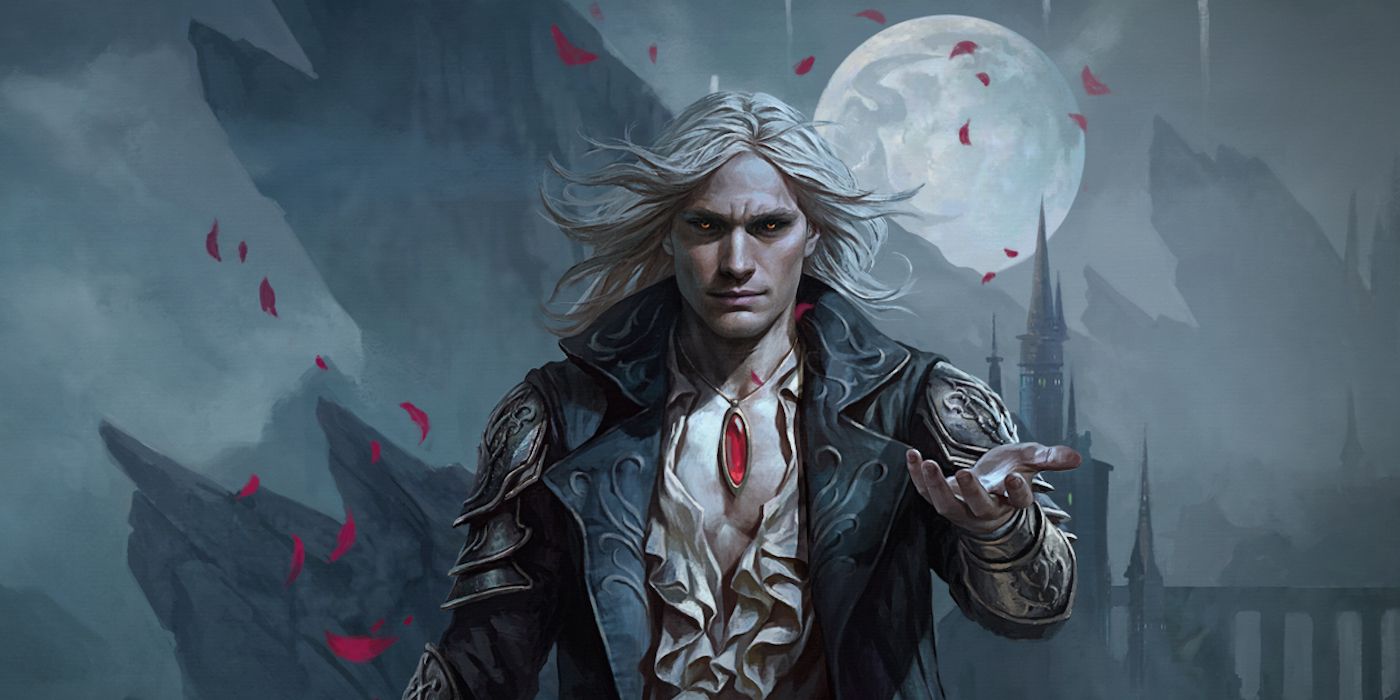
Magic: The Gathering‘s newest adventure takes place on the dark plane of Innistrad, and the game’s latest journey to this Gothic horror plane began with Innistrad: Midnight Hunt. That set, released earlier this year, starred the savage Werewolf tribe. Now, Innistrad: Crimson Vow puts the Vampire tribe in the spotlight — and this set is looking even better than its predecessor.
Together, Midnight Hunt and Crimson Vow form an unofficial two-set block, sharing both a setting and similar mechanical identities and gameplay strategies. Still, Crimson Vow found room to innovate, and players familiar with Midnight Hunt will still want to carefully review Crimson Vow to see what it has to offer.
The New Mechanics Of Crimson Vow: Cleave, Blood Tokens & Training
As earlier Crimson Vow spoilers showed, this set has some brand-new mechanics that expand upon Midnight Hunt. These mechanics neatly fit into the two-color draft archetypes and tribes established by Midnight Hunt. The Vampire tribe is still a black-red aggro archetype, but now, Vampires can do more than attack early and use spot removal to push damage. These creatures can also create all-new Blood artifact tokens, which join the same “family” as Clue, Treasure and Food tokens from earlier sets. A Blood artifact token can be tapped and sacrificed after {1} is paid to discard a card, then draw a card.
Blood tokens do more than refresh the hand — they can also enable graveyard-based effects by discarding certain types of cards. Plus, Blood tokens synergize with cards that benefit from the player discarding cards or having enough creatures in the graveyard. Although it is usually Vampires that make Blood tokens, a deck of any color can activate them. A deck could splash the right colors to play a few Vampire-themed cards and make Blood tokens. Cards with disturb, for example, should benefit greatly from Blood tokens.
Another new mechanic in Crimson Vow is the training ability, a triggered ability that appears most often on Human creatures of white mana. A creature with training gets a +1/+1 counter when it attacks with an allied creature that has greater power. Training also allows a player to rapidly change the power of their creatures to enable the coven ability, which appears in white and green and is heavily based on humans and their allies. Training also encourages players to use Auras and Equipment cards to bolster their biggest creature, so smaller creatures with training can keep getting +1/+1 counters and not catch up too soon.
Cleave is a new ability in Crimson Vow that isn’t tied too closely to any particular tribe, color combination or draft archetype. Cleave is an alternate cost effect, similar to kicker or overload, that allows the player to eliminate all text in brackets to alter how the card works. Most often, a cleave card will have words in the brackets that limit the card’s effects, so removing that text makes the card more flexible. When paid with 1BB, Path of Peril only destroys all creatures with a mana value/CMC of 2 or lower, but if paid with 4WB, this spell destroys all creatures.
Returning & Altered Mechanics of Crimson Vow: Transform, Disturb, Mill & Exploit
Crimson Vow also includes several mechanics and themes carried over from Midnight Hunt or earlier sets, and they synergize well with Crimson Vow‘s new mechanics. Mill returns as a means of fueling the graveyard quickly, and it’s usually blue, black and green cards that can mill the player’s own library and reap the benefits. The legendary Old Rutstein can mill one card with every upkeep and reward the playerwith Blood tokens, Treasure tokens or 1/ green Insect creature tokens. Self-mill also works well with cards that have disturb or those that benefit from a well-stocked graveyard.
Exploit returns from Dragons of Tarkir, mainly appearing on blue and black Zombie cards. A creature with exploit can sacrifice any creature, even itself, when it enters the battlefield. Then, each exploit creature will reward the player in a different way when and if a creature is sacrificed that way. This can be an effective way to use up weak and otherwise irrelevant creatures.
A trademark of all Innistrad sets, Transform unsurprisingly is returning. Crimson Vow includes a few new Werewolf creatures with transform, as well as a collection of other cards that can transform in different ways. The disturb effect also returns, appearing on transform creatures that can return from the graveyard once the disturb cost is paid. However, Crimson Vow handles disturb differently than Midnight Hunt did.
This time, all disturb creatures begin as white or blue creatures, and once they return transformed, they will become Auras that can be attached to a friendly creature. Flavor-wise, this represents fallen spirits that can be used as protective barriers or weapons by the living, especially Humans. The Aura side often reflects the Spirit side mechanic-wise, such as Distracting Geist and Clever Distraction both being white cards that can tap the opponent’s creatures.
The Tribes Of Innistrad: Crimson Vow
For the most part, Crimson Vow has the same tribes as Midnight Hunt, expanding upon these well-established tribes while adding a few new tricks to them. These tribes should feel familiar and fresh when players draft with them here. The Vampire tribe adds two more colors to its color identity — blue and white. Markov Waltzer is the first multicolor Vampire without black, and it can attack quickly and augment fellow attackers. Runo Stromkirk, meanwhile, is a legendary blue-black Vampire that can transform into a Kraken Horror.
The blue-black Zombie tribe returns, and instead of making 2/2 Decayed tokens, this tribe uses exploit in Crimson Vow, and exploit meshes well with those 2/2 decayed Zombies if they are found together in a deck. That should be easy for players during games of Standard or Pioneer.
The green-white Human tribe is largely the same as before, though it swaps the coven ability for training. This continues the tribe’s theme of +1/+1 counters and building up a large board state. In fact, the 1/1 tokens made by Torens, Fist of the Angels have training, which represents how green-white decks can go wide and go tall equally well.
The Werewolf tribe returns in red and green, but it has few remarkable new cards. Still, Child of the Pack can make 2/2 Wolf tokens to generate value without actually casting a spell, then transform into a 5/5 and grant +1/+0 to all friendly creatures. It’s a powerhouse uncommon for this tribe.
Finally, the Spirit tribe is also returning. This time, Spirits can return as Auras via transform, and augment each other or their Human allies to generate even more value. This gives any Spirit deck a lot of grindy value in games, as well as traditional white and blue effects such as tapping enemy creatures, bouncing permanents and countering spells.
About The Author