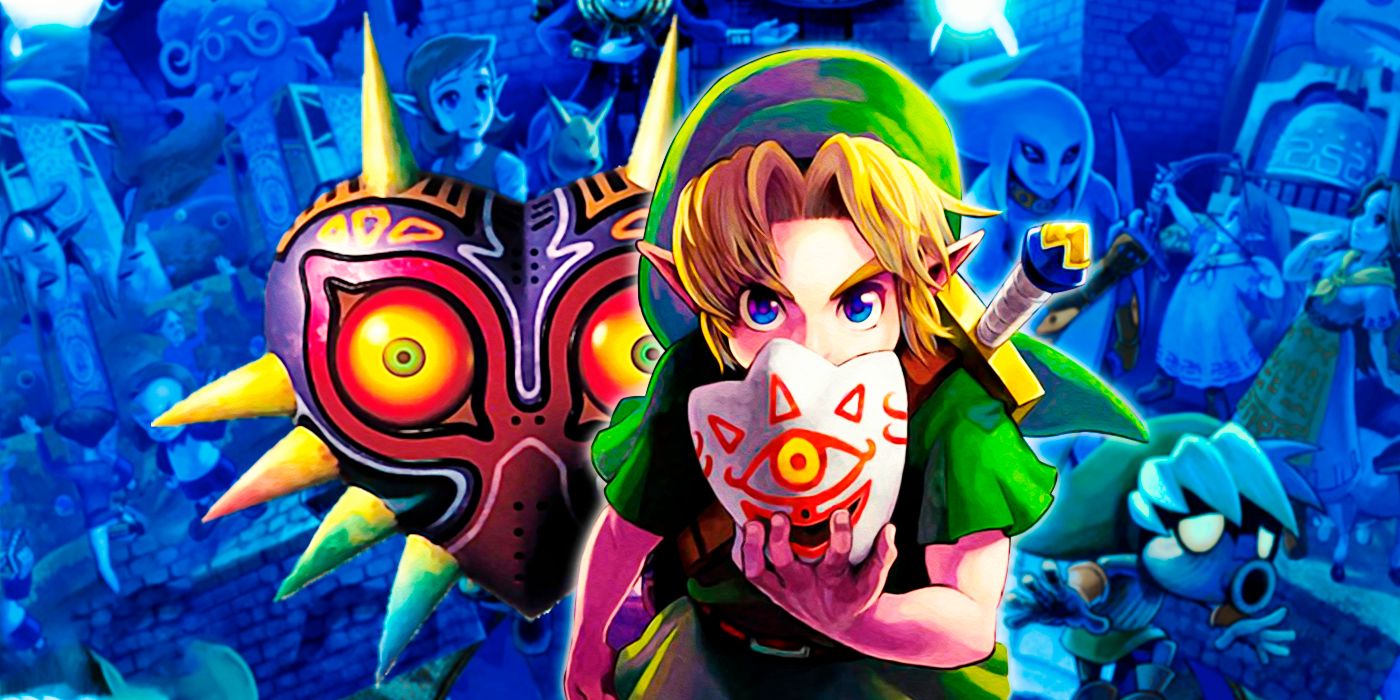
Of all the acclaimed title’s in Nintendo’s long-running fantasy video game franchise The Legend of Zelda, the darkest and saddest of them all is 2000’s Majora’s Mask. Originally released for the Nintendo 64, Majora’s Mask served as a direct sequel to Ocarina of Time, with Link exploring a strange, parallel world to Hyrule known as Termina. With the sinister mask Majora possessing a Skull Kid to help bring about a lunar apocalypse, the eponymous mask is one of the most memorably terrifying primary antagonists in any Zelda game. However, one fan theory makes Majora’s Mask an even darker story.
The number five shows up a few times over the course of Majora’s Mask, from the transformation masks that Link faces over the course of the game — including the Fierce Deity Mask and Majora’s Mask itself — to the guardian giants freed by Link at each of Termina’s temples to stop the moon from colliding with Clock Town, with the moon itself counting as the fifth colossal entity. When Link is transported onto the moon’s surface for a final showdown with the evil mask, he finds a dream-like world where four masked children play around a fifth child wearing Majora’s Mask and keeping to himself. This suggests the game could be an exploration of the five stages of grief with a twist that each of the transformation masks are the trapped soul of a recently deceased figure within Termina.
While exploring Termina, Link encounters the ghost of Darmani, the Goron chieftain who recently fell to his death in a chasm outside of Snowhead Temple. He passes on the Goron Mask, allowing Link to take his physical form while wearing it. Later, Link finds a dying Zora musician Mikau, who was mortally wounded trying to rescue his singer Lulu’s eggs after they were stolen by Gerudo pirates. After Mikau passes on, Link gains the Zora Mask that allows him to assume Mikau’s form while wearing it.
In the prologue and epilogue, a lone Deku scrub is seen transformed into tree, suggesting the Deku Mask the possessed Skull Kid cursed Link to wear (transforming him into a Deku scrub) was also from a deceased character. This revelation hints that each of the transformation masks is the calcified soul of each of the figures Link transforms into, literally transforming into a dead character.
In regards to the five stages of grief, the Deku scrub would represent denial, as the scrub is revealed in the epilogue as the son of the Deku butler who refuses to believe his son is dead until he finds his body. Darmani represents anger, with the Goron unable to find peace as a ghost and frustrated he couldn’t find a way to save his people.
Mikau represents bargaining, with the Zora pleading with Link to recover the stolen eggs from the Gerudo. Majora itself represents depression, exemplified when the boy wearing Majora’s Mask on the moon refuses to play with the other children. Finally, the Fierce Deity Mask represents acceptance, with Link channeling its immense, divine power as the ultimate weapon against Majora.
Fan of Majora’s Mask have long praised the game for going deeper with its narrative than other Zelda games. A prime example of this is the dark truth behind the first three transformation masks and what each symbolizes in a game that serves as a meditation on the end of the world and how different people react to their own mortality. More than the sweeping fantasy epic that endeared Ocarina of Time to gamers worldwide, Majora’s Mask shows a more vulnerable, introspective side to The Legend of Zelda — one that has players comparing notes on its themes over 20 years later.
About The Author
