Aside from their tactical gameplay and wide cast of characters, the Fire Emblem games are known and loved for their stories. While the implementation is often somewhat trope-y, and on occasion reliant on cliches, the stories nonetheless help certain games stand out from one another, and make the games more than just a series of skirmish battles across a continent.
For the most part, the stories are non-interactive. Certain games, especially Awakening, Fates, and Three Houses, have given the player control of choices at certain critical junctures, but even in those games, the story is something to be watched, not influenced. As a result, some choices made by Lords during these plots have left players in a state of utter confusion and frustration.
10 Micaiah Letting Herself Be Ambushed Before A Major Battle
In Fire Emblem: Radiant Dawn, Micaiah is the protagonist of the game’s first act, the ‘Silver-Haired Maiden’ who inspires a rebellion in the nation of Daein against the Begnion Army, who occupy their territory after Path of Radiance.
Even as she fights to put somebody else on the throne, Micaiah becomes the symbol of the entire rebellion and its popular face. She is the single person most crucial to its success. Despite this, the night before the final battle to put Pelleas on the throne, Micaiah becomes overwhelmed and leaves her heavily fortified camp without a single bodyguard. As a result, she is ambushed, and it is only the appearance of the Black Knight that stops the rebellion from ending there.
9 Eirika And Ephraim Letting Their Sacred Stones Be Destroyed
Fire Emblem: The Sacred Stones follows a continent where the Lords of each of the major powers owns one of the titular stones, powerful artifacts that keep the apocalyptic Demon King at bay. The best friend of protagonists Eirika and Ephraim, Prince Lyon, becomes possessed when he willingly destroys his own to save his father, and seeks to return the Demon King, starting a war.
Throughout the war, Ephraim and Eirika have protected their own Sacred Stones by carrying decoys and having theirs hidden away. Despite this working, they both retrieve theirs, and then, within minutes of each other, let Lyon acquire and destroy them. As a result, the Demon King is ultimately summoned at the cost of Lyon’s life and is stopped in the nick of time.
8 Chrom Arguing Against The Avatar’s Sacrifice
At the climax of Fire Emblem: Awakening, it is revealed that there are two options for dealing with the Dragon Grima once he is defeated. If merely the power of the Falchion and Fire Emblem are used, Grima can be put to slumber for a thousand years, and will then awaken to resume his conquest. Otherwise, the Avatar can be sacrificed, and use their bond to kill Grima permanently.
The Avatar is willing to make the sacrifice (and unexplainedly survives), but Chrom is staunchly opposed. While it is understandable that he wants his friend and possible love interest to survive, all putting Grima to sleep ensures is that the Dragon will get another chance to inflict misery on countless people later.
7 Byleth Allying With Dimitri In Three Houses
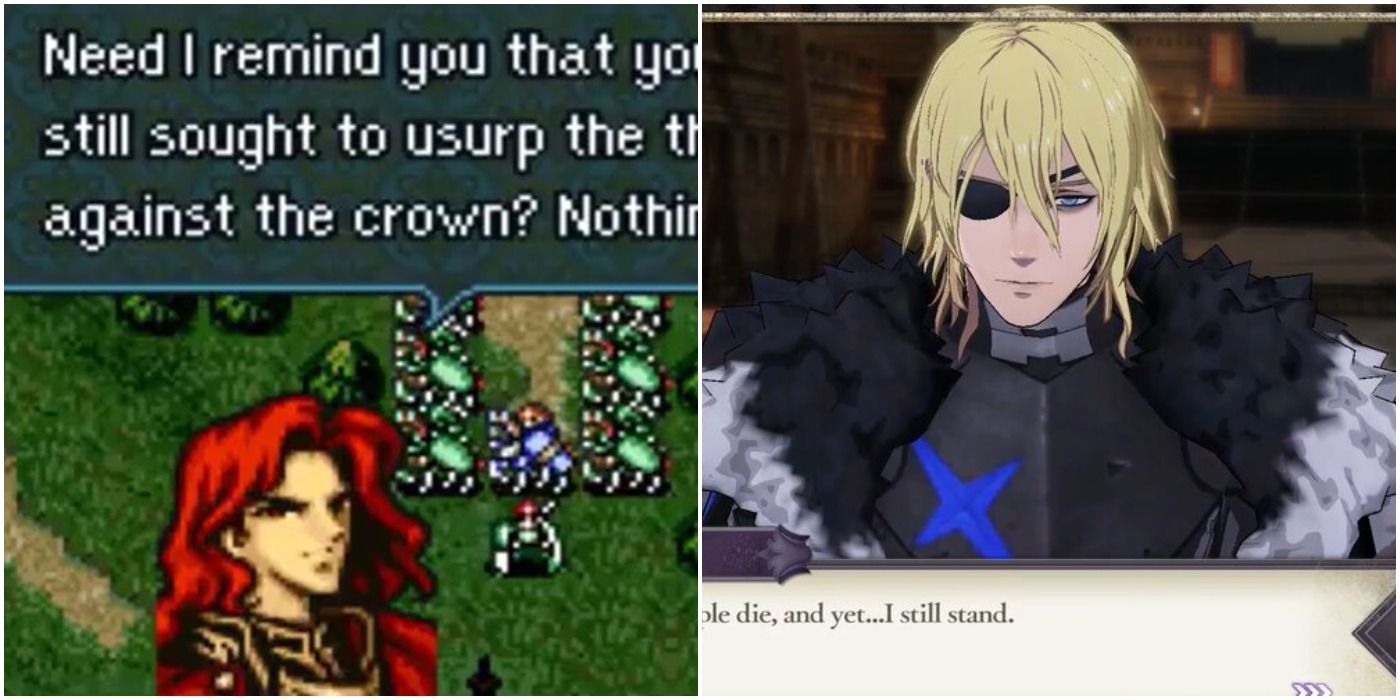
Dimitri is not an evil person in Fire Emblem: Three Houses and the ending that sees him become King has him ultimately let go of what is troubling him, but for much of the Blue Lions route of the game, which sees Byleth ally with him, he is visibly unstable.
Byleth even comments on Dimitri’s erratic behavior, able to see he is struggling but continues to support him. The result is one of the bloodiest battles of the entire series when Dimitri forces a fight with both the Empire and the Alliance, with massive casualties on all sides. Even this doesn’t break Dimitri out of his vengeful obsession.
6 Sigurd Trusting Arvis As An Ally
The first act of Genealogy of the Holy War sees Lord Sigurd returning after a year in exile to take his revenge on the Lords who framed him for attempting to usurp the throne of his nation, Grannvale. He fights a bloody war across the continent and returns to his home, where he is told that Lord Arvis knows of his innocence, and has all along.
Despite Arvis offering minimal aid prior to this point, Sigurd believes him to be an ally and lets his guard down at a seeming celebration of his return. As a result, Arvis betrays him and his army, Sigurd, and deals with one of the worst defeats in any Fire Emblem story.
5 Ike Not Counselling The Laguz Against War With Begnion
There is no denying the morality of the war the Laguz Alliance declares against the Begnion Senate in Fire Emblem: Radiant Dawn. They start the war to avenge the near-genocide of the pacifistic Heron Laguz in a callous power play.
However, Begnion is the strongest power on the entire continent, and Ike, who is hired by the Laguz Alliance, knows it. Whilst Ike does have experience in fighting against a superior force, the last time, he did so by successfully acquiring the aid of Begnion, who handily tipped the war in his favor. Instead, Ike resolves himself to war, with far worse consequences than merely a Laguz defeat.
4 Corrin Not Openly Confronting The False Garon
The ‘Conquest’ route of Fire Emblem: Fates sees protagonist Corrin and their siblings attempting to reform their nation of Nohr from the inside, while also not losing their war with the Kingdom of Hoshido. Part of this is curbing the influence of King Garon, their father, who has become twisted and cruel.
Corrin trusts Garon despite several open attempts to have them killed, and even when it is revealed that ‘Garon’ is an imposter demon pretending to be their father, they still go along with his plan in an attempt to have him revealed to be an imposter, rather than openly confronting him. As a result, his scheme nearly succeeds, and thousands die in the war.
3 Chrom Preparing To Give Up The Fire Emblem
Many of Chrom’s more questionable decisions ultimately come from a lack of ruthlessness and care for his loved ones. In Fire Emblem: Awakening, Mad King Gangrel holds Emmeryn, Chrom’s older sister, prisoner, and threatens her life unless Chrom gives up the Fire Emblem, an immensely powerful artifact needed for his plans.
Despite the very real threat of Gangrel having the Emblem, Chrom still prepares to give it up until Emmeryn intervenes, throwing herself to her seeming death to stop Chrom from making the wrong choice.
2 Letting The Second Generation Grow Up In An Alternate Dimension
A poorly-justified gameplay mechanic leads to one of the most morally questionable decisions in the entire series, if not logically questionable. Due to the popularity of the second generation in Awakening, thanks to their interesting backstory and in-game power, the mechanic was re-used in Fates.
However, Fates lacks the time travel plot of the previous game. So instead, to justify the inclusion of children, your party members marry and fall pregnant during the game. Once they give birth, their children are raised in an alternate dimension where time moves faster, allowing them to age and join the army quickly. The moral implications are uncomfortable for many.
1 Micaiah Killing Pelleas To Try And End The Blood Pact
Radiant Dawn takes the unusual gameplay approach of having the player control two different armies in opposition to one another in its third act. Ike is hired by the Laguz Alliance to wage war on Begnion, whilst Micaiah fights to protect Daein when Pelleas sides with Begnion, despite the enmity between the two nations and Begnion being on the less moral side of the war.
It is revealed that Pelleas has only done so because he is compelled by a Blood Pact, which will kill the people of Daein one by one if he refuses to aid Begnion. Based on incomplete information, he believes his death will end the Pact and asks Micaiah to kill him. She can do so, despite the Pact being powerful magic neither understands, and the decision backfires greatly.
About The Author
