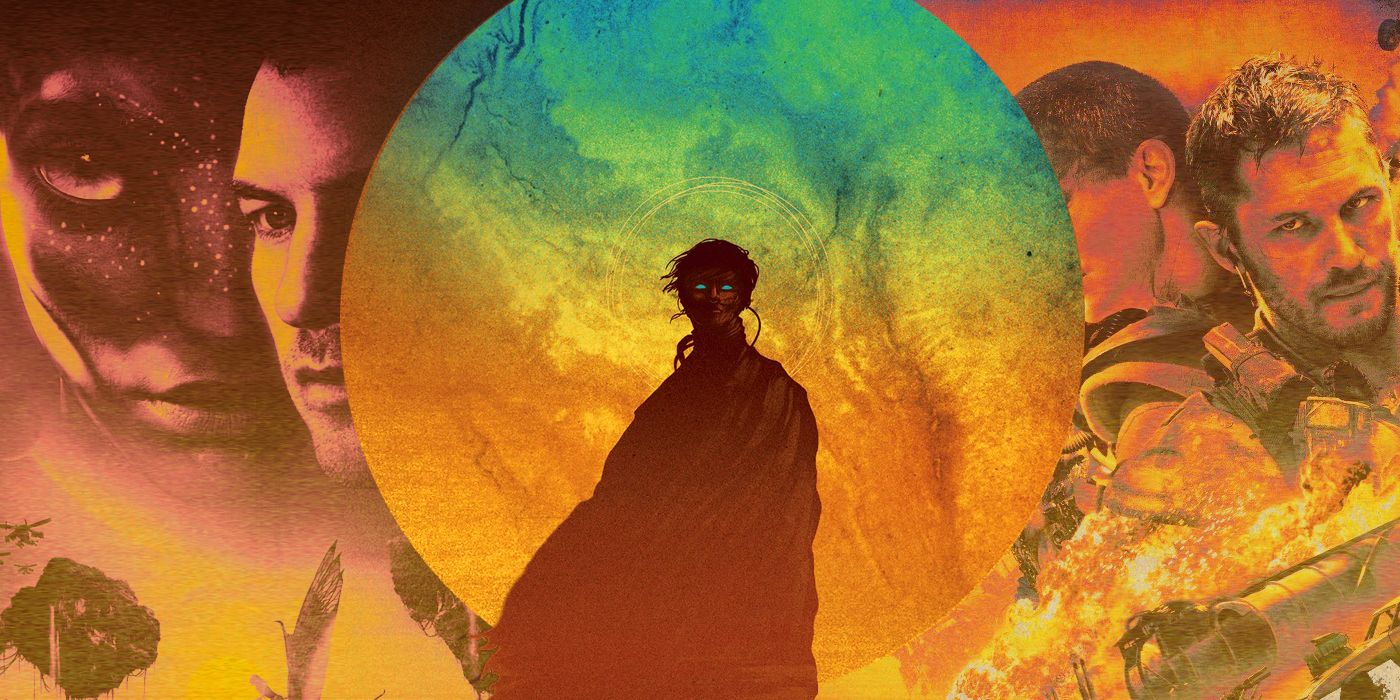
WARNING: The following contains spoilers for Dune, now playing in theaters and on HBO Max.
The millions of people who’ve seen Dune, either in theaters or on HBO Max, without having read Frank Herbert’s book beforehand, probably noticed an overwhelming number of similarities to other storied franchises. That’s not a coincidence. The 1965 novel isn’t the origin point of sci-fi or fantasy literature, but it’s arguably the most successful and influential in its category.
Dune represented a huge step up in terms of epic worldbuilding and episodic storytelling, and it introduced plot arcs, character archetypes and genre elements that are so common today, Herbert’s originality can easily be taken for granted. Countless books, TV series and films have been inspired by Dune, including Star Trek, The Chronicles of Riddick, Miyazaki’s Nausicaä of the Valley of the Wind and even Futurama. The following five franchises, however, did more than riff on Herbert’s ideas or parody the tropes he created. Each one has such strong parallels to Dune that without it, they may never have existed.
Star Wars Is Basically a Dune Remix
Star Wars borrows from Dune so thoroughly that it feels like a remix. Single ecosystem planets? Check. A young, white male savior imbued with mystical powers? Check. Desert homeworld with two celestial bodies on the horizon where moisture is scarce, patrolled by hostile, nomadic natives and giant, ravenous sand creatures? That’s all here, too. A scheming Emperor with a terrifying underlord whose body is compromised and who spends time in curative vats of liquid? Yep and yep. A mostly faceless army of Imperial troopers? A self-righteous, mind-controlling religious order that’s worked its way into intergalactic politics? A princess? A trade guild? A shocking revelation of a main character’s actual parentage? Check, check, check, check, check — though some of that won’t happen until Part Two.
To be fair to George Lucas, Star Wars goes on to tell a very different story than Dune, one that’s more simplistically about good and evil, often more fun and accessible, and definitely more appropriate for children. Lucas also drew inspiration from World War II, Vietnam, Samurai movies and spaghetti westerns, while Herbert was inspired by Middle Eastern cultures and environmentalism, and used his book series to interrogate the ethics of power. Fans are surely happy to have both franchises, but the fact that Dune paved the way for Star Wars is undeniable.
Game of Thrones’ Ned Stark Is Essentially Duke Leto Atreides
George RR Martin’s A Song of Ice and Fire series — and its TV adaptation, Game of Thrones — is a product of the author’s interest in the War of the Roses and classic fantasy literature. But Herbert’s Dune was clearly of interest, too. Though they take place in different worlds, both revolve around great houses — each with their own crest, colors and forces — making political and militaristic plays for the throne. Both authors created long histories and vast settings, with generations of religious lore and prophecies that may or may not turn out to be reliable. A modest amount of mythical creatures and magical realism show up in both Dune and Game of Thrones, as opposed to franchises like Lord of the Rings and Star Wars, where fantastical elements are more prevalent. Most of the people are just people, even if they’ve learned some cool tricks.
Westeros has Dune’s loyal sword trainers, mystic advisors, eunuchs, witchy women and yes, more misunderstood nomadic desert people and another young, white male ‘chosen one.’ In Dune Messiah, the ability to reanimate the dead is introduced, as happens with GoT‘s Gregor Clegane. But what it copies and pastes most obviously is the character of Ned Stark. Ned’s personality and his plot arc are almost exactly the same as that of Duke Leto Atreides. Lastly, Dune set the standard for the surprising frequency of main character deaths that Game of Thrones came to be known for.
Avatar Has Undeniably Similar Themes to Dune
James Cameron’s Avatar is, theoretically, a franchise, though only the first film has actually been released. Part Two has finished filming and is scheduled to come out in December of 2o22, with a Part Three currently in production. Anyone who’s seen the 2009 blockbuster will have picked up on its not-so-subtle themes. Another young, white male protagonist goes to an exotic, foreign planet to help harvest its resources. Then, he meets the locals, learns their ways, falls in love with one of them, and becomes something of a ‘chosen one.’
The specifics aren’t a one-for-one. Like Arrakis, Pandora is beautiful and dangerous, but in the exact opposite way. It’s lush, with flying banshees instead of subterranean sandworms and unobtainium instead of spice. But thematically, it’s perhaps the closest match for what Herbert was interested in exploring. Whether the Avatar films will subvert those themes, as Herbert does in subsequent volumes of Dune, remains to be seen until the long-awaited sequels finally come to theaters.
Mad Max and Dune Have Similarly Bleak Worldviews
George Miller’s Mad Max movies are dystopian more than they’re science fiction or fantasy, but there’s a post-apocalyptic sense to Herbert’s work, too. Dune takes place thousands of years in the future, after humanity has relied too heavily on technology, squandered its resources and all but collapsed. Minus the timescale, that’s the setup for Mad Max, in which Max Rockatansky tries to survive and figure out his own personal ethics in a world that might be beyond saving, and eventually becomes — you guessed it — another messianic figure.
Dune and Mad Max share some superficial elements, like their harsh, sandy locales and their grotesque, resource-hoarding villains. The franchise starts to mirror Paul and Jessica’s Dune escape from the Harkonnens into the desert with Mad Max: Fury Road, as it becomes more overtly about environmentalism and powerful women. But it’s the bleak worldviews of these two stories that make them virtually interchangeable. Both are unsentimental examinations of how humans organize themselves into societies, and both come to the conclusion that there’s no perfectly altruistic way to go about it.
Tremors Turned Dune’s Sandworms Into an Iconic ’90s Horror Staple
Inspiration doesn’t have to be layers deep with meaning. Tremors took Dune’s most iconic visual and spun seven movies out of it. Herbert’s sandworms are a reverent presence on Arrakis; the Fremen call them Shai-Hulud, which in their fictional language means “old man of the desert” and in Arabic closely translates to “thing of immortality.” But they aren’t actually in the books or the movie that much, despite their looming threat and importance to spice production.
Tremors solves that problem by making its version of the creature, called a Graboid, the monster in a comedy-horror franchise that’s been going strong since 1990. Tremors isn’t the only property to plagiarism the sandworm, either. Beetlejuice famously has them, which just goes to show how universal Dune’s influence has been over the last 55 years.
About The Author
