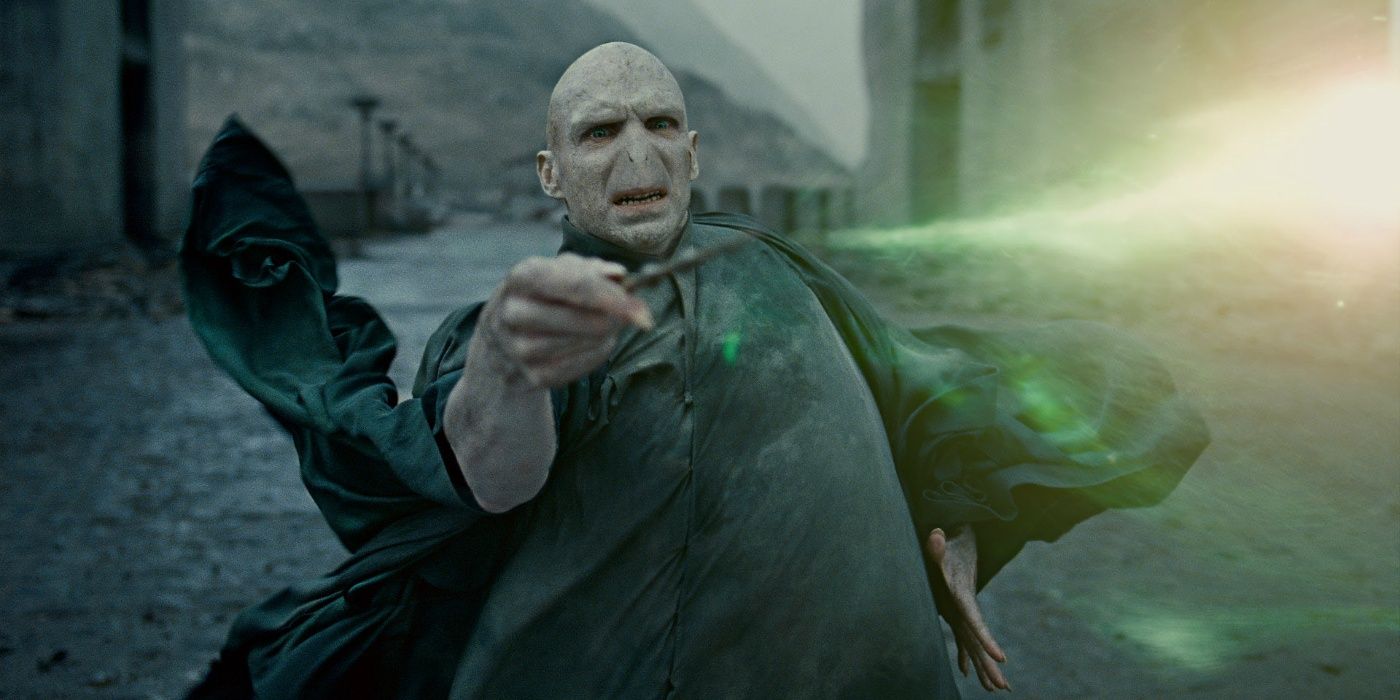
The Harry Potter series is full of interesting antagonists. From the crazy antics of Bellatrix Lestrange to the unbearably unpleasant presence of Dolores Umbridge, there is an abundance of characters that fans love to hate. Of course, none are quite as synonymous with evil as that of Lord Voldemort, though. His looming presence in the franchise is not understated, and nearly every problem that Harry faces in the series is either directly or indirectly caused by the one known as He-Who-Must-Not-Be-Named.
This is probably why it is no surprise that, by the seventh and final installment of Harry Potter, Voldemort seems like an unstoppable force. And in a way, he is. As fans learn over the course of the series, Voldemort found a way to make himself virtually immortal. And he did so by creating six Horcruxes, objects that possessed a fragment of the creator’s soul so that, if they are ever killed, they are able to bring themselves back from the dead. When Harry learns about these Horcruxes, he, Ron and Hermione spend the final story traveling across Britain to find and destroy them. Here is a list of the Horcruxes, and how each met its end.
Tom Marvolo Riddle’s Diary
In Harry Potter and the Chamber of Secrets, Tom Riddle’s diary is a major focal point of the story, as its original owner turns out to have far more significance than originally realized. Towards the end of the story, when Harry goes to save Ginny from the Chamber of Secrets, he meets a young Tom Riddle. And it is there that Riddle reveals himself to be Lord Voldemort and explains that he was the one that opened the chamber and released the basilisk.
At the time, the extent of the diary’s true nature was not revealed, as Harry was led to believe that Riddle was a memory strengthened by Ginny feeding her emotions to him. In reality, the matter was more complicated, as Dumbledore would reveal to Harry in Harry Potter and the Half-Blood Prince that the diary was just one of seven Horcruxes. This Horcrux, of course, was destroyed by Harry with the basilisk fang during that final confrontation with Riddle.
Marvolo Gaunt’s Ring
This object first appears in Harry Potter and the Half-Blood Prince and is Riddle’s grandfather’s ring (although, in the films, it is attributed to his mother.) It not only served as a Horcrux but also contained the resurrection stone. Albus Dumbledore found this ring and even attempted to use it as a means of bringing back his dead sister once he recognized the stone. What resulted from this act, however, was a curse that nearly killed him. He ultimately destroyed the ring with the sword of Godric Gryffindor but not without suffering the consequences.
The curse weakened Dumbledore to a noticeable degree. At the start of Half-Blood Prince, Harry, along with the viewers and readers, sees the damage the curse had done to Dumbledore’s arm, although it is not revealed why until later. While the ring was destroyed before the events of Harry Potter and the Deathly Hallows, the resurrection stone survived, and Harry would later find it inside the golden snitch.
Salazar Slytherin’s Locket
This locket was a source of many problems for the trio in the final moments of Half-Blood Prince and the first half of Deathly Hallows. It is an heirloom of the Slytherin family, having been owned by Salazar Slytherin, himself, of whom Voldemort is a direct descendant. This fact, along with most of Voldemort’s family history, is not explored in the films, but it is a major talking point in the books. Toward the end of Half-Blood Prince, Dumbledore and Harry go after the locket, only for Harry to discover the locket they found is a fake. Then, in Deathly Hallows, Harry, Ron and Hermione eventually go on a search to find the real locket.
They soon learn that the locket was in the possession of Dolores Umbridge, and after sneaking into the Ministry of Magic, they manage to procure it and escape. They then remain in possession of it as they attempt to find a way to destroy it. This affects them greatly, but none more so than Ron, who briefly abandons his friends after an argument with Harry. The locket is eventually destroyed by Ron, who uses the sword of Godric Gryffindor to do so.
Helga Hufflepuff’s Cup
Like the locket, Helga Hufflepuff’s cup is also the family heirloom of a founding member of Hogwarts. Helga Hufflepuff’s cup fell into the possession of Tom Riddle after he murdered a woman named Hepzibah Smith to claim Salazar Slytherin’s locket. This particular detail is left out of the films, but it is a pretty crucial element in understanding how it came into his possession in the first place. After it is eventually turned into a Horcrux, it is given to Bellatrix Lestrange, who keeps it in her vault at Gringotts Bank.
Harry, Ron and Hermione retrieve it from the vault and remain in possession of it until the Battle of Hogwarts. During the battle, Ron and Hermione make their way back to the Chamber of Secrets, where Hermione destroys it with a Basilisk fang. While the book only recounts the events through dialogue, due to the viewpoint being limited to Harry’s, the film, Deathly Hallows Part 2, wisely shows Ron and Hermione destroy the cup.
Rowena Ravenclaw’s Diadem
The Lost Diadem is another item that belonged to a house founder. Rowena Ravenclaw possessed the item, which could make its wearer smarter, before it was stolen by her own daughter, Helena. While its origins were explored in greater detail in the book, the general idea of how Tom Riddle retrieved the Diadem remains mostly the same in the film. The Grey Lady, who happens to be the ghost of Helena, was tricked by Riddle to reveal the location of the Diadem. And once Riddle gains possession of the item, he turns it into a Horcrux and hides it in the Room of Requirements.
Upon learning this, Harry, Ron, and Hermione explore the room in search of it. But they soon run into Draco Malfoy and his friends, who attempt to fight them. The destruction of the diadem was another element that differed from book to film. In the books, it is unintentionally destroyed by Vincent Crabbe in a “Fiendfyre,” while the film sees Harry stab the Diadem with a basilisk fang before tossing it into the Fiendfyre.
Nagini
According to a controversial plot point in Fantastic Beasts: The Crimes of Grindelwald, Nagini was once a human woman that was born with a curse that allowed her the ability to transform into a snake. Although, as of right now, it is unclear how it happened, by the time of the Harry Potter series, the change was permanent. Whatever the circumstances were behind this, she eventually becomes Lord Voldemort’s “pet,” and she is the only other living creature, besides Harry, that Voldemort made into a Horcrux.
While the events surrounding her demise differ from the source material, mostly in the sense of when it happens, the way in which she dies is largely the same. She is beheaded by Neville Longbottom with the Sword of Gryffindor in both the book and the film. However, while the book has it occur just before Harry revealed himself to be alive, the film chooses to have it happen at the climax of Harry and Voldemort’s battle.
Harry Potter
This Horcrux has the unique distinction of being the only one that Voldemort didn’t know about. While it is no secret that, throughout the series, Harry is subconsciously linked to Voldemort, the reason for it is not revealed until the last act of Deathly Hallows. As it turns out, the secret behind some of Harry’s abilities, such as his innate skill of speaking Parseltongue, along with his ability to see through the eyes of Voldemort in his dreams, is because he has a piece of Voldemort’s soul attached to him, making him a Horcrux. This happened after Voldemort attempted and failed to use the killing curse on him when he was just a baby.
This Horcrux was destroyed by Lord Voldemort himself. When Harry learned that it was attached to him, he met with Voldemort in the woods and let the villain cast the killing spell on him. This destroyed the Horcrux but gave Harry the chance to return to the physical world, which he accepted.
About The Author