WARNING: The following contains spoilers for Dune, now playing in theaters and on HBO Max
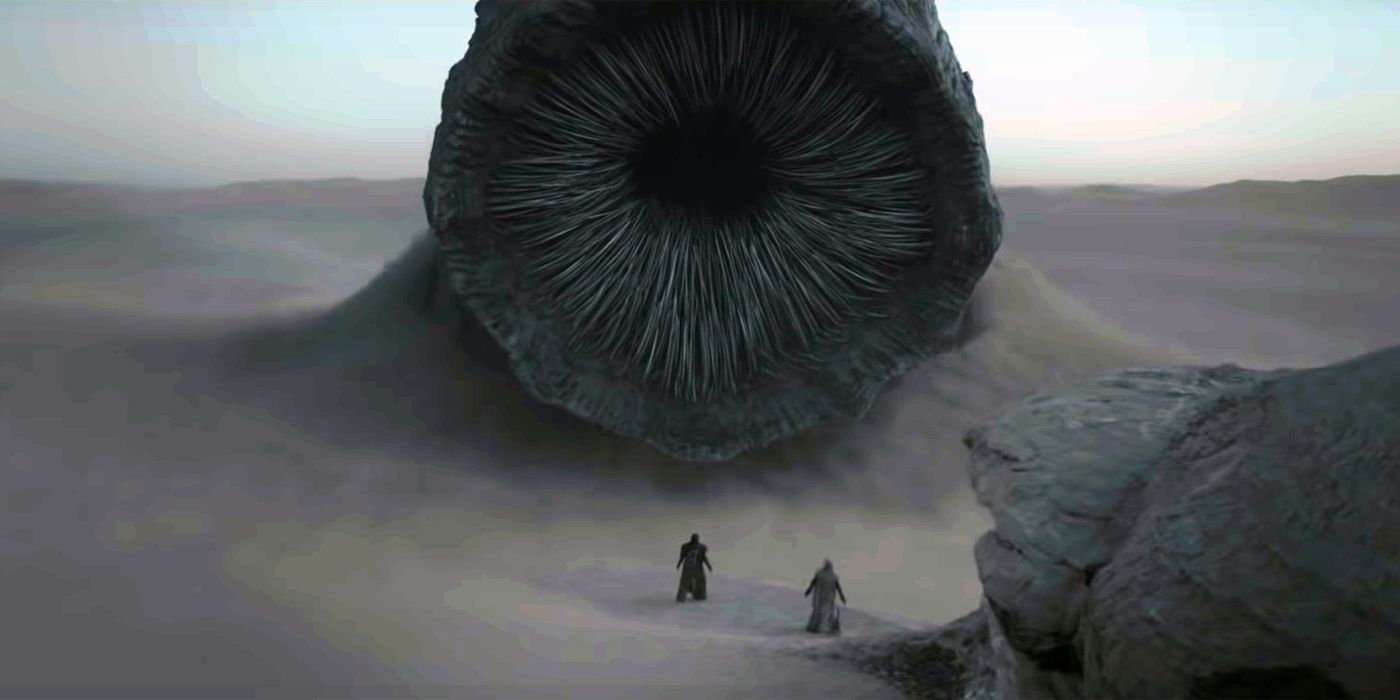
Dune — for better and for worse — is focused on the epic scale of the sci-fi classic above all else. The tale of House Atreides has always carried a massive scope, one that transcends generations and worlds. And there are elements of the story that lend themselves well to this kind of presentation, and the newest adaption of the property accomplishes one particular aspect with gusto. The Sandworms in Denis Villeneuve’s Dune are perfectly realized, giving the impression they’re more forces of nature than regular creatures, which helps broaden the genuine epic feel of the film.
The Sandworms remains one of the most iconic elements of the Dune franchise. Debuting in the first novel in the series, the Sandworms are one of the primary predators of the world Arrakis. A largely desert-covered planet that produces “the spice” that helps make space travel a possibility in this series, these massive beasts that travel beneath the sands of their world have become so massive and tough that it’s largely impossible to stop them. The Sandworms can more or less destroy anything they encounter, with their largest ones often reaching thousands of feet long. In the film, the Sandworms are introduced not as an animal species of the world to be dealt with but a reality of life on Arakkis that one has to adjust to.
It’s a fantastic piece of world-building, with their first true sighting being as Leto (Oscar Isaac) and Paul (Timothée Chalamet) descend near a Spice harvester in the desert. Spotting one from afar while it’s still submerged in the sands, Leto ultimately sets down their ship to help evacuate the crew of the harvester after their vehicle’s attempts to escape the path of the Sandworm fails. They barely load the ship in time before the Sandworm consumes the entire massive vehicle. It does this by appearing beneath it, effectively a Sarlacc Pit that can move and reposition itself underneath its victims. In this way, the film doesn’t focus too hard on the potentially humorous sight of giant worms wriggling around on the surface or overplaying them — keeping the creatures as an almost unknowable and hard to predict force of nature.
It makes them feel epic in the way that Dune’s creator Frank Herbert had envisioned. The only time Sandworms are seen clearly and for an extended period is towards the end of the film. Paul and his mother Jessica (Rebecca Ferguson) have barely escaped into the deserts with their lives and have been moving in the unique Freman style to avoid stirring attention. Rising out of the sands and finally following them, it’s a moment where Paul seems to firmly accept the true scope of the universe around him and sees that he truly has the chance to survive it in a largely wordless sequence.
In a film that values the epic scope of the Dune saga, the Sandworms are a strong indicator of this vision of the source material. While the film may lack smaller character moments, the scope and scale are undeniable, and the Sandworms are a good indicator of that. They’re distinct and dangerous and almost awe-inspiring at times, their sheer strength but lack of direct motivation helping cement how dangerous and almost elemental they — and the world of Arrakis — really are. They’re a perfect representation of the impressive scope Dune loves to embrace.
To see the Sandworms in action, Dune is in theaters now and streaming on HBO Max.
About The Author
