Throughout its multiple incarnations — and there has been a surprising number — King Kong has always faced a dilemma. At heart, it’s a love story, and a very tragic one at that, as the giant ape makes a connection with a woman intended to be his sacrifice and is subdued and taken to New York as a result. His subsequent rampage comes in an effort to find her, and his final, fatal plummet from the Empire State Building entails a heartbreaking farewell as the heroine watches him fall. When done right, it doesn’t leave a dry eye in the house, but when handled poorly, it gets very creepy very quickly.
The 1976 King Kong fell into that trap the hardest, along with a number of other problems that have rendered it more bizarre curiosity than a legitimate giant monster movie. But its handling of that all-important aspect of the plot — in this case, Jessica Lange’s would-be starlet — comes across as all wrong. But while most of the big-budget versions of the story negotiate the problematic sexual undertones quite well, the 1976 King Kong gets skewered on it, making it the creepiest version of the story to date.
The hint of sexuality always lingered around Kong and the heroine — a sense that their connection would go beyond an empathetic-but-platonic bond and into something actively primal. That began with the classic 1933 version in a scene where Kong strips Fay Wray before stopping to sniff his fingers for her scent. Wray’s Ann Darrow is horrified and has little sympathy for Kong, which lets the movie escape the darker implications of bestiality. It left Ann a more traditional damsel in distress, and while the ape’s devotion to her is still played as tragic — marked by the famous final line “it was beauty killed the beast,” her reluctance to engage with Kong steers clear of the ominous implications of that scene. And given the censorship at the time, the movie likely couldn’t risk anything further.
21st Century adaptations of the story have tread with considerable care and reaped the rewards accordingly. Though overstuffed and self-indulgent, Peter Jackson’s 2005 adaptation found the perfect tone between Naomi Watts’ Ann Darrow and Andy Serkis’s Kong. Their bond was deep but overtly platonic and played closer to a pair of siblings than a romance. 2017’s Kong: Skull Island largely also steered clear of the question entirely, save for a brief moment between Brie Larson’s Mason Weaver and Toby Kebbell’s Kong. By doing this, the story conveys their shared compassion without delving further, avoiding the more problematic connotations and getting on with telling its story.
Through a combination of timing and circumstances, the 1976 version had none of those narrative safeguards. Indeed, the production had every reason to push the boundaries as much as it could. Producer Dino De Laurentiis famously hyped the film’s effects and the debut of Lange, then a model with no acting experience. He proved to be right about her, as she went on to win three Emmys, two Oscars and a Tony Award in her legendary career. And the ape suit was designed by Rick Baker, who himself went on to become a trailblazer in his field.
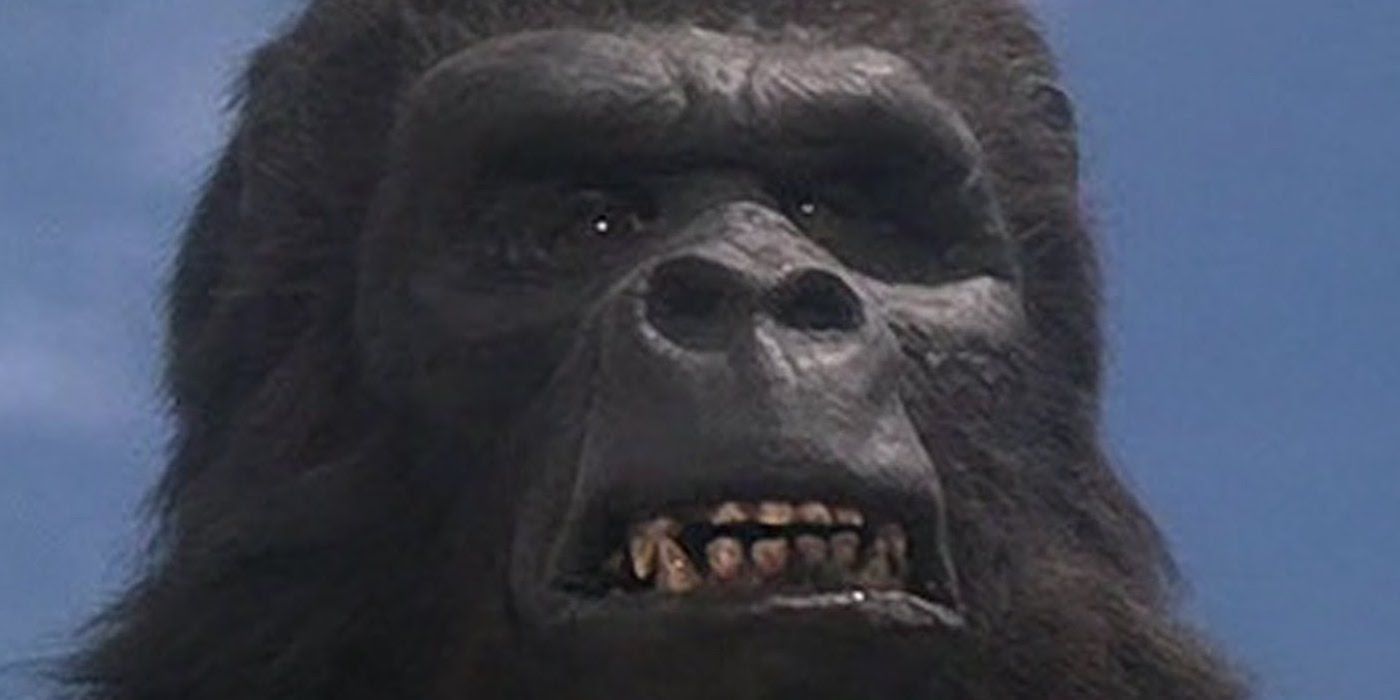
That said, little about their work here spoke to better things. The ape suit was dreadfully unconvincing, and while Lange expressed a certain knowing campiness in her performance, she lacked the material to do much more with the character. To top it all off, the film made overt what the 1933 version only hinted at, presenting a Kong with overtly erotic intentions and a heroine who appeared to respond. It produced not only an uncomfortably straightforward variation of the charged scene from 1933 but even more awkward moments, such as a scene where Lange bathes beneath a waterfall and Kong blows her dry.
It would be challenging enough to pull such moments off with modern special effects, but the combination of an obviously phony Kong and a tone-deaf approach to a delicate moment is cringe-inducing. And the extended sequences between them, constituting a considerable portion of the second act, suggest doubling down on the problem rather than acknowledging the extent of it. These scenes were far from King Kong‘s only shortcoming, but they were certainly the most notable ones.
About The Author
