The Dungeons & Dragons sourcebook Mythic Odysseys of Theros presents a world inspired by Ancient Greece. In addition to new races, subclasses, beasts and backgrounds, the book also introduces an all-new pantheon of gods and goddesses. True to the sourcebook’s inspiration, the Theros pantheon and its 15 gods are very involved in mortal lives — which gives players and Dungeon Masters tons of new material and influences to explore.
Theros’ gods represent a range of moral alignments, Cleric domains and abilities. It’s a large, dysfunctional family which has expanded through divine evolution across four generations. Worshipers can become champions for their chosen god by performing actions that advance the god’s interests or behaving in accordance with their ideals. Each time a champion does something in service to their god, their piety score increases (at the DM’s discretion). The higher their piety, the more likely they are to receive divine blessings. Here’s a breakdown of the gods in Mythic Odysseys of Theros.
Athreos, God of Passage
Athreos is a Lawful Evil god whose symbol is a crescent moon. He is a gaunt, cloaked, veiled figure who does not speak; his robes are ragged, his masks made of gold. The few bits of his body that are visible reveal stretched gray flesh and bones that hardly resemble human ones. Athreos is never without his ancient staff, Katabasis, which he transforms into his ferryboat.
Suggested Cleric domains for Athreos are Death and Grave. Like Charon from Greek and Roman mythology, Athreos ferries the dead across the Tartyx River in order to convey their souls to the Underworld. Mortals honor Athreos through funeral rights that include burying the dead with clay masks to “frame” their identity, as well as a coin to pay for passage to the Underworld.
Ephara, God of the Polis
Ephara is a Lawful Neutral god whose symbol is an urn pouring water. She most often appears as a huge, animated statue wearing a stone crown that resembles the top of a column or pillar. In her human form, she appears as a woman dressed in blue and white, who carries a large urn from her shoulder that pours the dark sky of Nyx onto the ground, where it dissolves into mist.
Similar to Athena, Ephara watches over cities and protects them from outside threats, in addition to helping them reach their full potential with art, industry and scholarship. She sees herself as the founder of civilization itself and she created the first code of law. Mortals honor Ephara by contributing to society or freeing others from tyrannical rule, and suggested Cleric domains are Knowledge and Light.
Erebos, God of the Dead
Erebos is a Neutral Evil god whose symbol is a serene face. He appears as a slender, humanoid figure with gray skin and large horns that curve outward from the sides of his head. He wields an eternally long black whip. In his other forms, Erebos appears as a cloud of choking smoke, a black asp or an animated, golden idol.
Like Hades or Pluto, Erebos is the god of death and the Underworld — as well as riches. He’s a tyrannical ruler whose very presence often leaves people feeling intense despair. Mortals typically pray to Erebos for wealth and security, but some of his more dangerous followers actively glorify and cultivate death. The latter make for especially heinous D&D antagonists, and suggested Cleric domains for Erebos are Death and Trickery.
Heliod, God of the Sun
Heliod is a Lawful Good god whose symbol is a laurel crown. He appears in a variety of forms, but prefers to look like a bronze-skinned, middle-aged human man wearing a flowy, golden tunic. He has a short beard and glossy black hair, upon which he wears a golden wreath. Heliod frequently appears riding a white pegasus or a golden stag.
The best Cleric domain for Heliod is Light, as he is the radiant god of the sun. Myths claim Heliod guarantees the rising of the sun each morning and he is recognized by everyone in Theros as the one responsible for providing their realm with warmth. Heliod Mortals honor Heliod through simple gestures, like bowing to the rising sun each dawn, or even holding days-long festivities.
Iroas, God of Victory
Iroas is a Chaotic Good god whose symbol is a four-winged helmet. Iroas appears primarily as a powerfully-built male centaur, but with a bull’s body rather than a horse’s. He wears gleaming armor and a winged helmet, and wields a shield and spear, which ring with the power of his loud, booming, baritone voice. Sometimes, Iroas also appears a full bull, or a mighty human soldier.
The best Cleric domain for Iroas is War, as he is the steadfast god of victory. He receives prayers from soldiers and common folk alike, asking for victory in battle, as well as courage and fortitude. Mortals honor Iroas through performing great deeds of athleticism or skill.
Karametra, God of Harvests
Karametra is a Neutral Good god whose symbol is a cornucopia. She appears to mortals as a woman with hair braided out of orderly rows of leaves, which shroud her eyes from view. Karametra is usually depicted sitting on her throne, which is comprised of tangled grape vines that sprout from various jugs and amphorae. Above her is an elaborately carved wooden canopy. Her sable companion curls around her feet and she wields a harvester’s scythe in one hand.
The suggested Cleric domains for Karametra are Life and Nature. Similar to Demeter or Ceres, Karametra is widely revered as the mother of the harvest. This fertility goddess is honored in almost every human settlement through modest shrines, in the hopes that she may open her arms and bless the people with bountiful harvests, healthy children and prosperity. Mortals honor Karametra through small shrines and praising her love and generosity on a daily basis. They also gather for full moon feasts each month to celebrate her role not just in harvest, but in parenthood and community-building.
Keranos, God of Storms
Keranos is a Chaotic Neutral god whose symbol is a blue eye. It’s rare for him to appear before mortals, but when he does, he takes the form of a stout, bearded man wearing a purple loincloth and a mithral chain around his waist, which clasps beneath a dragon’s skull. Sometimes, he communicates with mortals through epiphany; other times, he appears to them as a great horned owl with lightning strikes that flash in his eyes.
The suggested Cleric domains for Keranos are Knowledge and Tempest. As the god of storms and wisdom, Keranos is merciless and impatient — and he’s as likely to lash out at mortals with a bolt of lightning as he is to hit them with a bolt of inspiration. Mortals honor Keranos through festivals and offerings of fish or distilled spirits.
Klothys, God of Destiny
Klothys is a Neutral god whose symbol is a drop spindle. According to Mystic Odyssey of Theros, she just emerged from the Underworld for the first time in mortal memory to stop a major upset to the cosmic order. Klothys appears as a woman with six curling horns and an extravagantly long mane of silver hair that curls around every part of her and the various spindles she carries.
Suggested Cleric domains for Klophys are Knowledge and War. She is one of Theros’ original deities and she oversees the order of the cosmos, which she seeks to keep balanced through ensuring that everything remains in its proper place.
Kruphix, God of Horizons
Kruphix is a Neutral god whose symbol is an eight-pointed star. They appear only as the star-filled silhouette of a hooded, four-armed figure with no defining characteristics in regards to species or gender — although sometimes, their silhouette takes the form of a bird or whale. Two of the stars outshine the others, which suggests the placement of eyes.
Suggested Cleric domains for Kruphix are knowledge and trickery. They are a particularly enigmatic god, whose domain is in mysteries, horizons and the passage of time. According to the mythos, they know everything that has ever been known by anyone, from the dawn of time to the present second. Mortals honor Kruphix through rituals performed at temporal or spatial boundaries and they do have a secretive cult following, though the size and scope of this group is unknown.
Mogis, God of Slaughter
Mogis is a Chaotic Evil god whose symbol is a four-horned bull’s head. He appears as a massive, four-horned minotaur clad in spiked armor and wielding a massive, ebon greataxe. He doesn’t bother taking on other forms when he appears to mortals; he cuts a terrifying figure on purpose as the personification of war’s cruelty. Mogis’ goal is to defeat Iroas in combat so he becomes the only war god in the Theros pantheon.
The suggested Cleric domain for Mogis is War. However, unlike his brother Iroas whose war divinity is based in triumph, Mogis represents slaughter and violence, especially in combat. His very presence incites violence, to the point that soldiers fear succumbing to his blood lust and consequently dishonoring themselves and their brothers in arms.
Mogis Mortals worship Mogis through acts of horrible cruelty and violence, which he encourages. Minotaurs are his most ardent worshipers and will hold blood rites in his honor. However, some minotaurs do leave the path laid by Mogis to pursue more peaceful lives. During the blood moon, his followers have a feast of raw or barely cooked meat, followed by intoxicants and then self-mutilation rituals.
Nylea, God of the Hunt
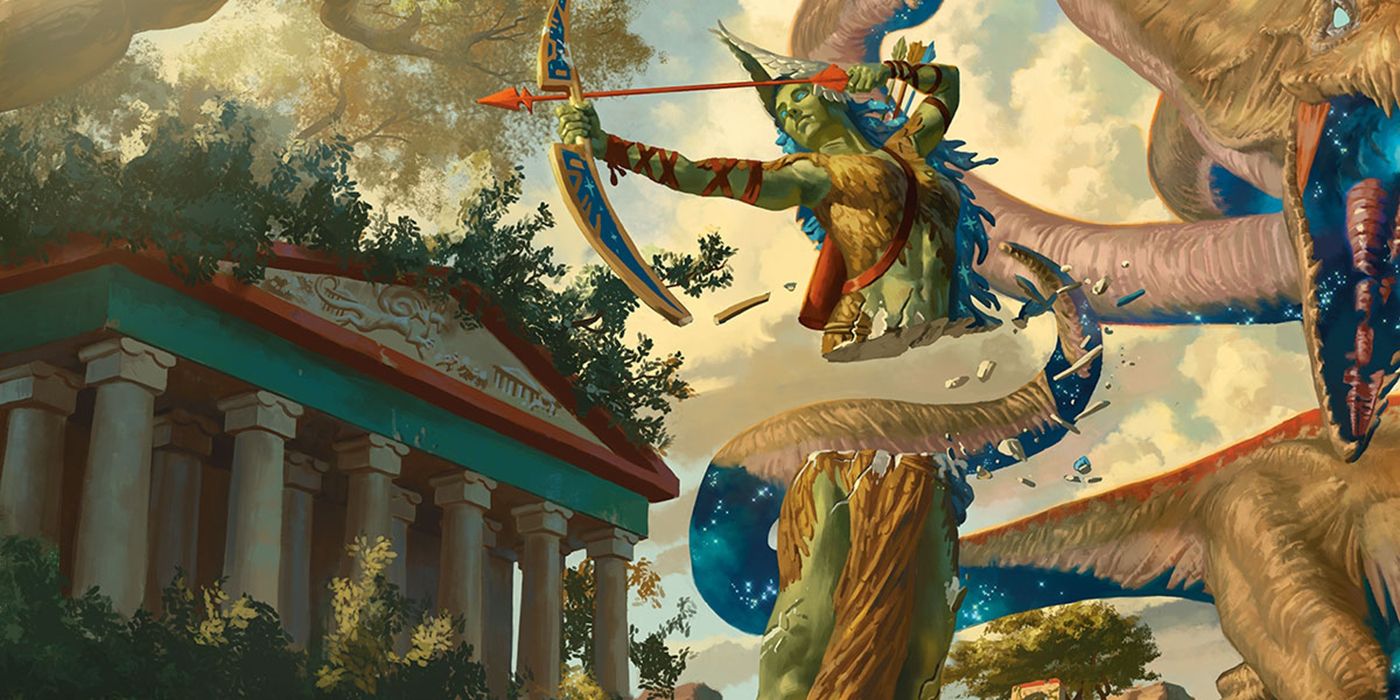
Nylea is a Neutral Good god whose symbol is four arrows. She appears as a green-skinned dryad with wooden extremities, whose hair is made of seasonally-changing vines and leaves. Sometimes, she appears as various animals, though she favors lynxes and wolves. When she wants to be left alone, she’ll transform into a tree — usually oak or olive.
The suggested Bleric domain for Nylea is Nature, because she is the wild and carefree god of the hunt — similar to Artemis or Diana in Greek and Roman mythology. Nylea Centaurs, satyrs, humans and nymphs are her most devoted followers. They pray to her for forgiveness when they hunt a dangerous animal or cut down a tree. As acts of atonement, they will also leave food behind for other animals or plant seeds.
Pharika, God of Affliction
Pharika is a Neutral Evil god whose symbol is snakes. She appears as a green-skinned, human woman with the lower body of a snake and scaled hands. Two bronze vipers emerge from her chest and she always carries a kylix, which is a drinking cup she can use to produce medicines or toxins. If she needs to be subtle, she’ll appear as a serpent, a medusa or an aged human.
Suggested Cleric domains for Pharika are Death, Knowledge and Life. She is the god of affliction, medicine, alchemy and aging. When Theros was first created, Pharika seeded the world with medicinal plants, strange minerals and magical nexuses; she also leaves clues for mortals to find these things, even in the wilds or the Underworld — not out of altruism, but out of a desire to study mortal suffering and innovation.
Nights of the waxing, crescent moon are sacred to Pharika, at which time harvesting medicinal plants is thought to be especially auspicious. The diseased and dying write Pharika prayers for remedy and even the healthy will pray to her before harvesting herbs, handling a venomous animal or receiving a medical procedure. Her most devoted followers often join together in small, mysterious cults — the most infamous is the Cult of Frozen Faith, which is led by a medusa.
Phenax, God of Deception
Phenax is a Chaotic Neutral god whose symbol is a winged golden mask. He appears before mortals as a willowy humanoid with gray skin, wearing elegant robes. He also appears as a variety of animals, including rats, mockingbirds or asps. Phenax was a mortal trapped in the Underworld — until he learned to forsake his identity to prevent Erebos from detecting his actions. He dressed himself in Athreos’ cloak and crossed the Rivers That Ring the World to return to the land of the living.
The suggested Cleric domain for Phenax is Trickery, as he is the masked patron of lies and cheats. He governs the spheres of gambling, deception and betrayal, which puts him at direct odds with Heliod. Every time a mortal lies, they pay homage to Phenax. His most devout followers are thieves and gamblers, but any formal rituals in his name are performed at night — particularly during the new moon.
Purphoros, God of the Forge
Purphoros is a Chaotic Neutral god whose symbol is a double crest. He appears as a muscular man with coal-hued skin, which is mostly covered in mutable, organic bronze. He sometimes appears as a phoenix or a bull made of cooling lava, however, when angry, he can appear as a volcanic eruption, a mass of lava or a blazing fire. If he appears as one of the latter forms, the mortals who see him aren’t likely to survive long enough to tell anyone of the sight.
Suggested Cleric domains for Purphoros are Forge and Knowledge. He is the god of fire, the forge and the restless earth, whose dominion is the raw creativity that can be tapped into by sapient minds. As such, he is also the patron of artisans, obsession and the cycle of creation and destruction. Because Purphoros is the god of the forge, every smithy acts as a temple to him. His worshipers will also light small fires in his name and burn wooden crafts or drawings of their inventions to get his attention — regardless of their professions.
Thassa, God of the Sea
Thassa is a Neutral god whose symbol is a crest of waves. She appears as a towering, triton-like woman with tentacled hair and crab legs who stands in and over the sea. If she gets closer to mortals, she may change her size and form to that of a giant squid, a storm, a school of sharks or a fog bank. Thassa also appears as a crab, which is her favored animal. Occasionally, she’ll speak through the ocean itself.
Suggested Cleric domains for Thassa are Knowledge and Tempest, because she is the god of the sea, aquatic creatures and the unknown depths. Since the seas are associated with more nebulous concepts like change or long voyages, she also holds sway over these less tangible dominions. Tritons worship Thassa because they spend the majority of their lives living under the sea. Meanwhile, land dwellers honor her through the week-long Lyokymion festival (the Feast of the Melting Swell), as well as prayer.
About The Author