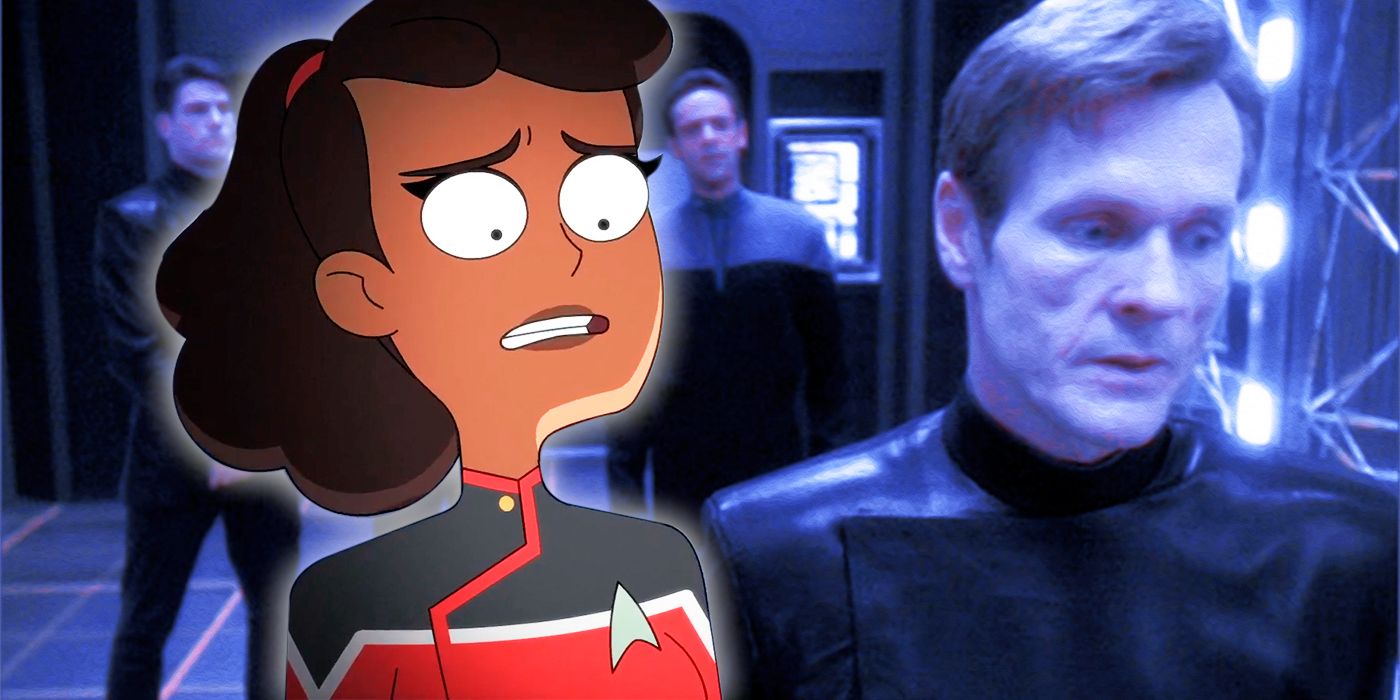
WARNING: The following contains spoilers for Star Trek: Lower Decks Season 2, Episode 4 “Mugato, Gumato,” streaming now on Paramount+.
Star Trek is notable for presenting an idealistic, optimistic vision of humanity’s future, largely overcoming interpersonal differences and divisions to spread this idea of peaceful coexistence across the galaxy. However, Starfleet, the peacekeeping and exploratory branch of the United Federation of Planets, has been depicted throughout the franchise as having a dark side counter to this harmonic vision. This more morally compromised history for Starfleet has been touched on and lightly explored during Star Trek: Lower Decks Season 2.
Brad Boimler and Sam Rutherford ponder the fact that their friend Beckett Mariner has served on a whole myriad of Starfleet vessels and installations, boasts some impressive prior experience as the Cerritos visits strange, new worlds and has a lot of high-ranking contacts throughout Starfleet. The Cerritos’ shifty bartender informs the two junior officers that Mariner is secretly a covert operative assigned to the Cerritos, taking on black ops duties to further Starfleet’s agenda under the cover of the starship’s usual duty of completing menial tasks around the Alpha Quadrant. And though Rutherford and Boimler are initially dismissive of the rumor, they quickly realize that Starfleet does have an extensive track record of such behavior.
Star Trek: Deep Space Nine introduced the military agency Section 31, a clandestine organization within Starfleet that performed intelligence and defense operations outside of the public eye. From daring raids, internal oversight and security and research that ran counter to the Federation’s ideals, Section 31 played a vital role during the Dominion War. The early days of Section 31 were revealed in the prequel series Star Trek: Enterprise, while Star Trek: Discovery Season 2 featured the organization briefly and violently going rogue against Starfleet when the malevolent artificial intelligence Control possessed its personnel through nanotechnology, as part of its plan to destroy all sentient life in the galaxy. Following this incident, Starfleet appointed a new leader to the organization, presumably keeping it on a much tighter leash.
With both Boimler and Rutherford aware of Section 31’s existence and its reputation, in stark contrast to the main characters in DS9, this suggests that the agency has gone public to a degree since the conclusion of the Dominion War. Throughout DS9, Starfleet Command’s official stance was to neither confirm nor deny the existence of Section 31, while the agency’s espionage activities helped turn the tide of the conflict, though this occasionally put them at odds with Captain Benjamin Sisko’s command. And with Boimler previously extolling the principles that led him to enlist in Starfleet standing counter to Section 31’s illicit tactics and penchant for secrecy, the possibility that his best friend is working for something as reputedly sinister as Section 31 places him and Rutherford on edge regarding Mariner’s rumored double life.
Of course, Mariner denies actually being an operative for Section 31 when Boimler and Rutherford confront her with their suspicions and mounting evidence. Instead, she admits to spreading the rumors herself to keep annoying people away from her and build up a cool reputation for herself. This does keep the question of how exactly Mariner learned all of her skills and received all of her prominent, albeit apparently brief, postings throughout Starfleet open, but she appears to be genuine about never being a part of Section 31.
To see the separate missions, Star Trek: Lower Decks Season 2 is now streaming on Paramount+, with new episodes premiering every Thursday.
About The Author
