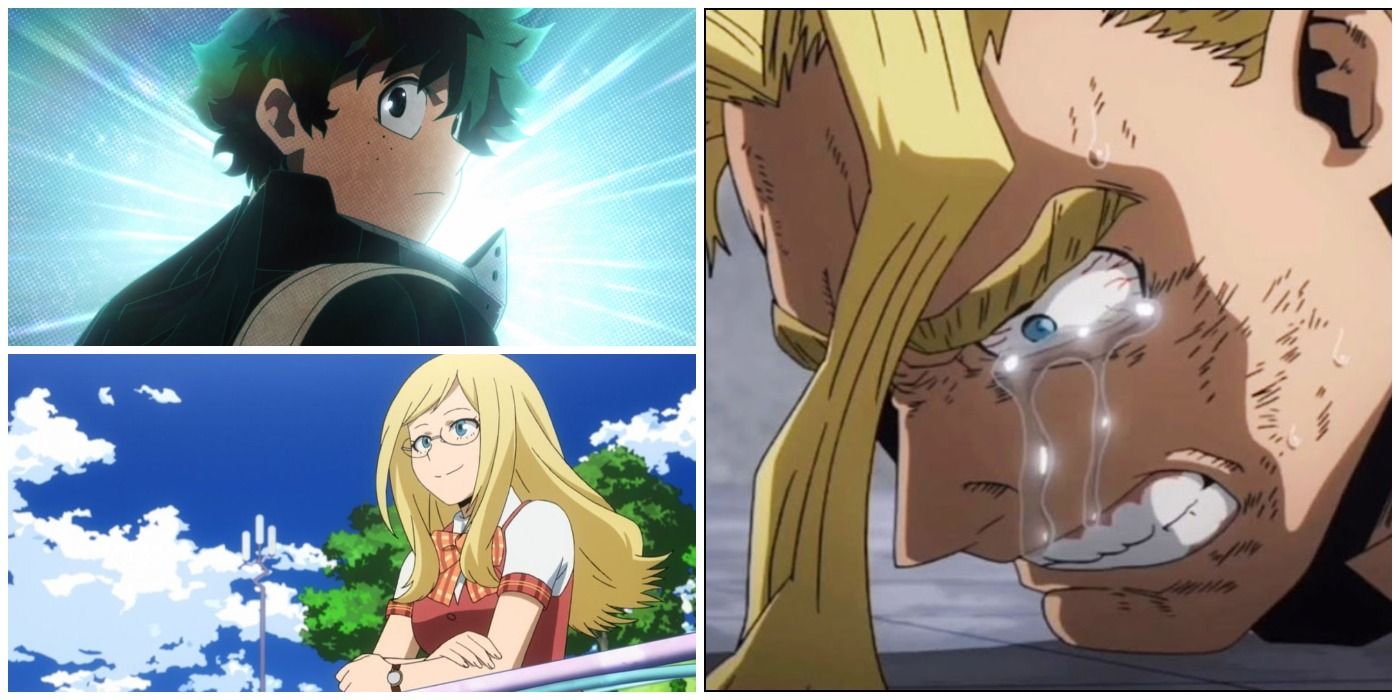
The world of My Hero Academia rotates around Quirks, the unique blend of superpowers that mangaka Kohei Horikoshi uses to create his colorful cast of characters. Each Quirk, from the weakest to the most powerful, is special in some way, from Inko Midoriya’s Attraction of Small Objects to Eri’s Rewind. But there is the occasional unlucky child who doesn’t manifest a Quirk at age four alongside their peers. Quirklessness is a recessive gene and it can be identified by the presence of an extra joint in their pinky toe. All Might himself was Quirkless before he received One For All from Nana Shimura. The protagonist of the series Izuku Midoriya finds himself in the same situation when he inherits One For All from All Might.
Growing up Quirkless is very traumatizing for Izuku, as he was constantly belittled and bullied for being inferior to others. All Might even tells Izuku his dream to become a Pro Hero is doomed to fail until Izuku proves him wrong through his sheer strength of character. But as difficult as it may be, even being Quirkless comes with some unexpected advantages.
8 The Quirkless Can Inherit One For All Without Dying
The most iconic Quirk in My Hero Academia is One For All, which All Might passes on to Izuku after Izuku proves his heroic heart. But One For All is so powerful it burns out its users. If the person inheriting One For All already has a Quirk, their lifespan is severely depleted.
This is why All Might is the only known user of One For All who reached a fairly advanced age while every other user died young. His Quirkless body was able to adjust to One For All, as it didn’t clash with a previously existing Quirk.
7 The Quirkless Are In A Legal Gray Area When It Comes To Acts Of Vigilantism
As hero society focuses so much on Quirks, their laws follow the same pattern. One of the main crimes hero society has to deal with is using one’s Quirk without a license. It’s a rule set in place for a good reason; unlicensed individuals can hinder rescues, as in the case of Gentle Criminal. Still, it’s very frustrating for young heroes who want to help but don’t have permission.
A Quirkless individual doesn’t have that problem. Legally, a Quirkless person could take a stand because the law focuses on the use of a Quirk, not the actual act of vigilantism. For example, Izuku doesn’t get in trouble when he rushes in to help Bakugo during the Sludge Villain incident, but he could have after he stepped in to fight Hero Killer Stain, or if he’d used his Quirk against the League of Villains in Kamino.
6 The Quirkless Don’t Risk Dangerous And Painful Body Modifications
Quirks are a genetic lottery: some people win the big prize while others draw the short straw. It’s not unusual for Quirk users to be seriously inconvenienced by their abilities. Toru Hakagure’s Invisibility is powerful, but it’s impossible to turn off. Pro Hero Thirteen is practically a gigantic black hole. Sir Nighteye’s sidekick, Centipeder, has a centipede for a face.
Even Dabi — previously known as Toya Todoroki — who’s blessed with a powerful Quirk isn’t luckier. Dabi’s Cremation is a stronger version of his father’s Hellflame, but he is born with his mother Rei’s ice resistance instead of Endeavor’s resistance to fire. Most people who have difficult Quirks adjust to it, but there are always those who don’t. The Quirkless don’t have that problem.
5 A Child’s Quirk Can Be Dangerous For Family Members
As a rule, the appearance of a Quirk is welcomed by everyone, including the child’s family members. But that’s not always the case. In fact, sometimes, the uncontrolled Quirks of children can be lethal for loved ones.
Tomura Shigaraki accidentally used his Quirk, Decay, on his family, which made him end up in All For One’s hands. Eri’s quirk Rewind erased her father out of existence and led to her being experimented on by Overhaul. Being Quirkless is far preferable to experiencing this kind of trauma.
4 The Quirkless Have Endless Potential
Having a Quirk means individuality, but it also limits one’s path. Beyond the physical difficulties, there are often mental and societal aspects to consider. Villainous Quirks like Himiko Toga‘s can simply break an individual’s mind.
While powerful, Toga’s Transform fosters a fascination with blood and sets her on the path to villainy. Granted, some people with villainous Quirks do defy the odds, but for people like Toga, their choices are made by their genes. In a way, the Quirkless are the same, as the simple fact that they don’t have a Quirk is a societal burden. But it’s possible to overcome that, particularly if they have the support of friends and family members.
3 The Quirkless Are Seen As Weak And Pitiful, But They Can Use This Misconception To Their Advantage
In a society so heavily skewed in favor of Quirk users, it stands to reason that Quirkless individuals are seen as weak and pathetic. From the very first episode, this is made more than obvious, as Izuku’s fellow students all emphasize how useless he is due to his Quirkless nature. For someone as straightforward as Izuku, it seems like an abyss impossible to cross.
But, like the legal loophole, this too is something that can be exploited. Quirkless people are always underestimated, and that’s exactly why they can be very dangerous opponents. Melissa Shield proves to everyone that she’s remarkable, even though she doesn’t have a Quirk.
2 Weaponry And Fighting Styles Often Address Quirks Alone
The strong focus on Quirks and tendency to overlook the potential dangers of Quirkless individuals manifests in every field. It’s not unusual for weaponry and fighting styles to focus on !uirks. It’s an approach that makes sense, as !uirks are a type of weapon too.
But Overhaul’s Quirk Erasing drug wouldn’t affect a Quirkless individual, and neither would Shota Aizawa‘s Erasure. Eraserhead does point out that no hero is a one-trick pony, but even he would be taken aback if his Quirk had no effect on someone who didn’t have a visible mutation.
1 Discrimination Against Minorities Breeds Solidarity And Dissent
The Quirkless make up less than twenty percent of the world’s population. As is the case of many minorities, they’re discriminated against. History has shown that minorities in this situation tend to band together to fight their oppressors. It seems unlikely that My Hero Academia‘s creator is setting the scene for a Quirkless revolution, but in the real world, that wouldn’t be out of the question.
Had he stayed Quirkless, Deku could have even become the leader of such a movement. While the necessity of a revolution isn’t precisely a good thing, it could have brought hero society into a brighter future in a different way.
About The Author
