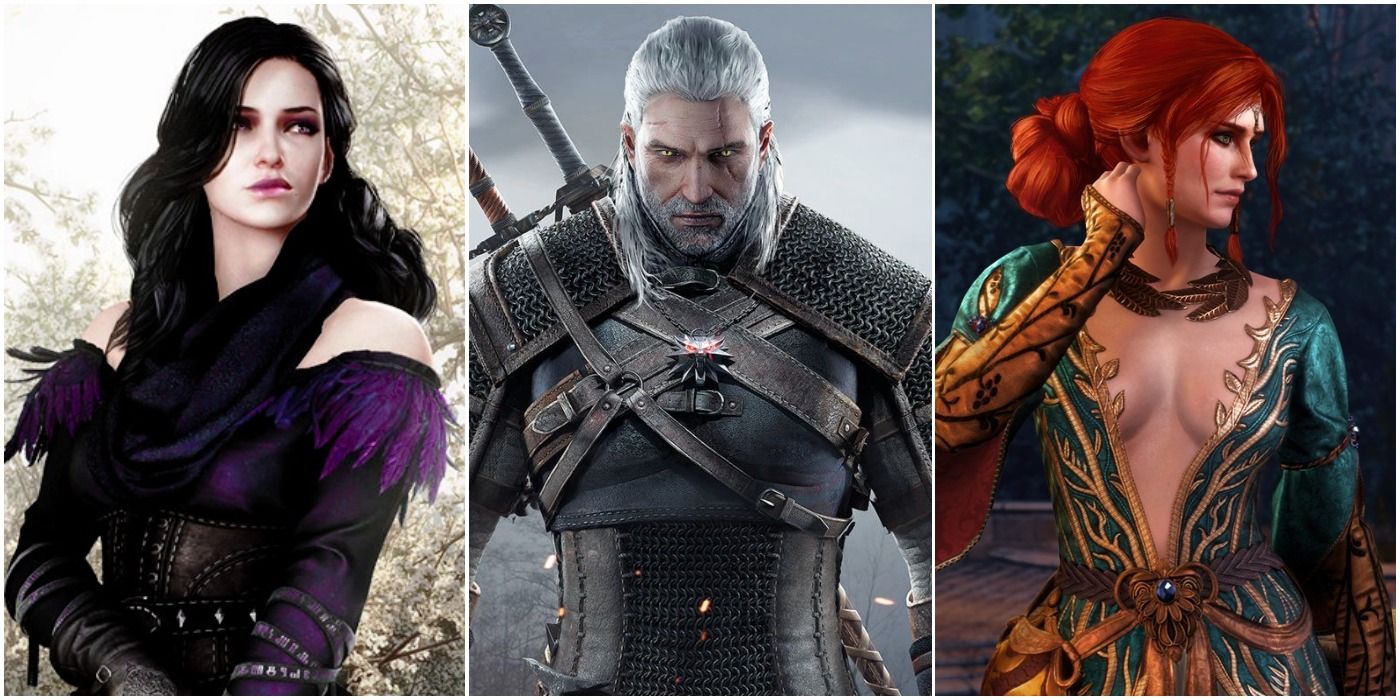
Even six years after release, CD Projekt Red’s Witcher 3:Wild Hunt remains a masterpiece among the ever-changing tides of gaming culture. From slaying monsters to facing down the mythic Wild Hunt, the vast world of the Witcher 3 offers an abundance of opportunities for lively debate and discussion among fans.
However, one of the most deliberated aspects of Wild Hunt—and perhaps of the Witcher universe in general—is who Geralt’s love interest should ultimately be by the time the game’s credits roll. Should Geralt return to his roots and settle with his long-time love Yennefer, or should he take a chance on a peaceful life with his newfound love Triss Merigold?
10 Triss Shares Geralt’s Sense Of Nobility
There are many times throughout Wild Hunt that Geralt is mocked by his sense of chivalry and nobility. Geralt’s fellow witcher Lambert pokes fun at the White Wolf while they’re in Kaer Morhen, reciting what Vesemir had told him about Geralt saying he was “killing monsters” when he slew his unscrupulous contractors.
Despite her duplicitous nature, Triss also shares a similar sense of nobility to Geralt, aptly demonstrated in Wild Hunt through her leadership in uniting the mages and sorcerers of Novigrad. Negotiating with crime bosses like Sigismund Dijkstra and Francis Bedlam, Triss is ultimately able to secure a path to freedom for her and her endangered compatriots.
9 Yennefer’s Maturity Is Similar To Geralt’s
Between the two sorceresses, Yennefer is undoubtedly the elder with more life experience. Consequently, Yennefer’s maturity is much closer to the titular witcher’s, demonstrated through the duo’s interactions in Skellige. When the pair attend King Bran’s wake, Geralt complains about disliking funerals and feasts, to which Yennefer retorts that he also dislikes undercooked meat and being teleported.
Yennefer proceeds to rationalize the need to overcome small discomforts to achieve a greater purpose (finding Ciri). In a way, this pragmatism mirrors the skepticism Geralt adopts when villagers tell him tall tales about local monsters. When Geralt isn’t overcome with his chivalry, the raven-haired sorceress and witcher share surprisingly similar world views.
8 Triss Can Be Romanced In Previous Games
Triss gets an unfair advantage over her more senior counterpart in CD Projekt Red’s world of The Witcher—she’s a major presence in all three games (whereas Yennefer doesn’t appear until the third game). With Geralt suffering from the convenient trope of amnesia, players are free to choose who the witcher can romance in each game.
The red-haired sorceress is the only character that Geralt can romance in all three games, thereby allowing players to build an attachment and invest in a relationship between the two. By the time Geralt fully recovers his memories in Wild Hunt, players suddenly find themselves in a tough situation when the witcher’s lover from a prior life returns to the fold.
7 Yennefer Can Match Geralt’s Witticisms
When push comes to shove, Yennefer just understands Geralt in ways that Triss simply can’t. CD Projekt Red makes a clear effort in Wild Hunt to depict an innate relationship between the duo through their duels of words. And Yennefer doesn’t only match the white-haired witcher’s dry witticisms—she usually comes out on top.
This occurs at two distinct moments in Wild Hunt. In Freyja’s Graden on Hindarsfjall, the duo cooks up several dog puns referencing Morkvarg, the cursed werewolf prowling the grounds. The second exchange at Corvo Bianco in Toussaint only occurs if Yennefer is romanced, and results in Geralt throwing a bird metaphor at her, only for Yennefer to then trump that she’s the “cat that got the canary.”
6 Triss Can Listen To Geralt Without Judgment
While Yennefer is unabashedly candid towards Geralt, Triss’ sense of empathy enables her to take a much more sympathetic approach to the witcher with a heart gold. When 2007’s The Witcher introduces an amnesic Geralt, it’s Triss that helps him re-establish his footing in the world.
And although Triss admits to manipulating Geralt when they reunite in Novigrad during the events of Wild Hunt by neglecting to tell him about Yennefer, is it really fair to blame her? Others like Keira Metz have pointed out that Yennefer always treats Geralt “like a dog.” Triss, however, shares a more amenable relationship with the titular witcher.
5 Yennefer Is Ciri’s Adopted Mother
Regardless of how the events of Wild Hunt play out, Yennefer will always play an integral in Geralt’s life, and not only because of what occurs in Andrzej Sapkowski’s short “The Last Wish.” When all is said and done, Yennefer is Ciri’s adopted mother, just like Geralt is her adopted father.
Together, the three of them make a family unit. They are undoubtedly dysfunctional, but Wild Hunt—like all pieces of Witcher content—demonstrates how the three of them are willing to go traverse multiple worlds in order to save one another. That kind of dedication simply can’t be matched by anyone else in The Witcher.
4 Triss Makes Geralt Feel At Peace
Triss’ strongest quality that she has going for her is the sense of tranquility and stability she is able to offer Geralt. This is best represented through a short exchange of dialogue between Geralt and Ciri late in the main story’s final act. While aiding the Lady of Space and Time in Novigrad, she suddenly inquires about Geralt’s relationship when they take a moment to rest.
If players have romanced Triss, Geralt confesses that while he history with Yennefer, it always felt like it was one argument after the next. However, with Triss, Geralt doesn’t feel a sense of constant exhaustion; rather, as he explains, there’s a feeling of harmony and calm. He even goes so far as to suggest he’s right where he belongs with Triss.
3 Yennefer Has Unrelenting Determination
Yennefer is a powerful woman with many faults who is difficult to get along with. One thing, however, that sets her apart from the other women in Geralt’s life is her sheer determination when she sets her mind to something. In Wild Hunt, the raven-haired sorceress is relentless in her mission to find Ciri.
This unrelenting determination can be traced back to Sapkowski’s original Witcher series, where she endures months of torture in the captivity of Vilgefortz to protect Ciri. Likewise, Yennefer in Wild Hunt resorts to necromancy in order to protect her daughter. It’s safe to say there’s nothing she wouldn’t do to protect the people she loves, and that includes Geralt.
2 Triss And Geralt Have A Fairytale Romance
Geralt and Triss’ love is the opposite of the turbulent, stormy relationship the White Wolf shares with Yennefer—it’s calm, compassionate, and whimsical. In fact, the romance between often comes across as fairytale-like. In essence, the two tread water in the honeymoon phase of their relationship.
This most aptly comes across in Wild Hunt during the Novigrad secondary quest “A Matter of Life or Death.” Here, Geralt gets to see a rare side of the sorceress from Maribor as she briefly relaxes with the evening festivities, which ends with her falling into the witcher’s arms as fireworks go off overhead. To top everything off, players can have Geralt kiss Triss to conclude this fairytale scene.
1 Yennefer Is Geralt’s Lover Of Yore
The strongest argument that inevitably backs Yennefer is that she is the canonical lover for Geralt. With the recent Netflix adaptation of The Witcher paying homage to Sapkowski’s novels, fans are reminded of the long and complicated history that the witcher of Rivia and sorceress of Vengerberg share.
Wild Hunt, too, pays an amazing tribute to their relationship in the form of Priscilla’s fantastic ballad “Wolven Storm” which romanticizes the tumultuous relationship the lovers share. The game even sees Geralt and Yennefer go so far as to undo the djinn’s magic that bound them in the Skellige secondary quest, “The Last Wish,” proving the complex feelings they developed for each other were more than simple whims of a mischievous djinn.
About The Author
