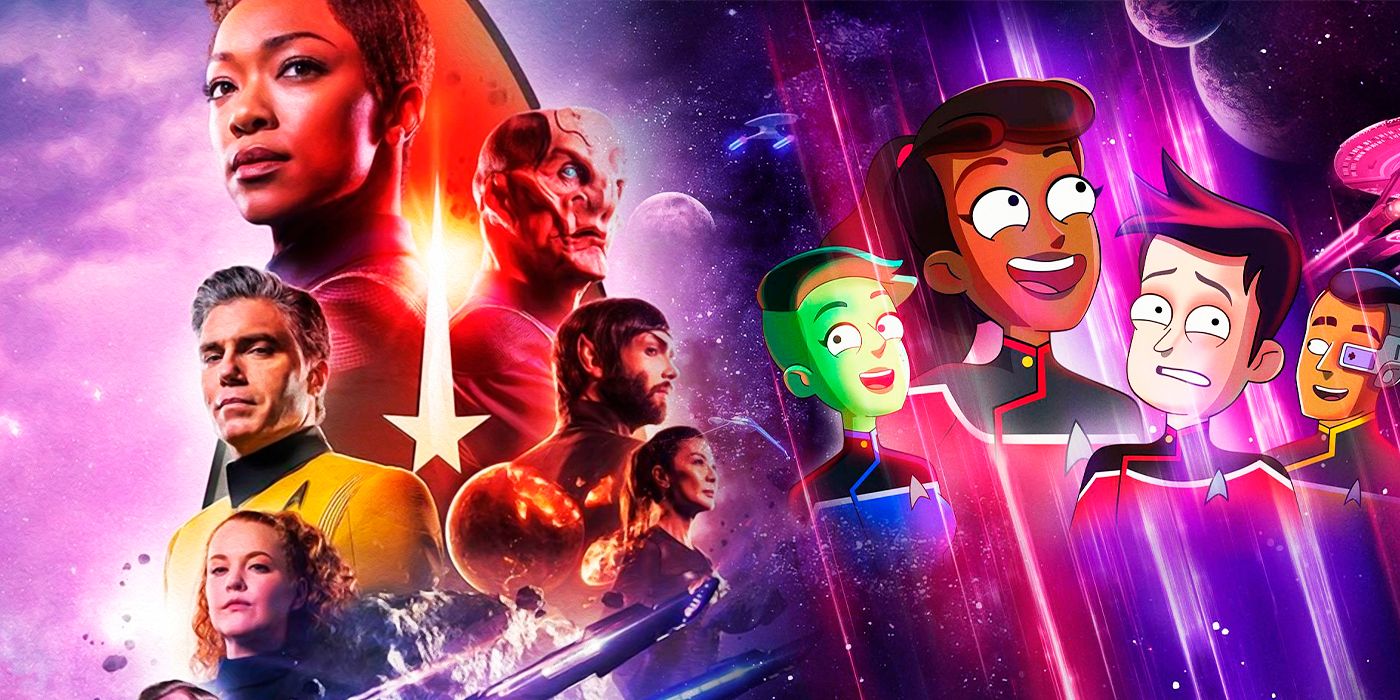
The Star Trek franchise has been a science-fiction staple for decades. The series shows how people can end a conflict before it even begins through negotiations and cleverness rather than who has the biggest gun. It also captures the essence of exploration and the excitement of boldly going where no one has gone before. However, with so many series in the universe, each tells its own story and is held in different regards amongst fans.
This article will explore where each Star Trek series stands when averaging the critic scores on Rotten Tomatoes and Metacritic. That being said, the only series that lacks a score is Star Trek: Short Treks, which acts as a companion to Star Trek: Discovery. Aside from its exclusion, this list will help new fans figure out which shows are worth watching.
9. Star Trek: Enterprise – 60.5 percent

Star Trek: Enterprise initially aired in 2001 and ran for four seasons. It was the first series to drop the Star Trek name for the first two seasons, only going by Enterprise. While not as unanimously adored as the other Star Trek vehicles, Enterprise has its own qualities that make it a worthy addition to the franchise.
It marks the earliest show in the timeline and takes place a century before The Original Series. Captain Johnathan Archer takes his crew to new planets and, through his leadership, shows audiences early negotiations with classic species like the Vulcans and the antagonistic Klingons. Overall, Enterprise has its highs and lows but is largely uneventful to the point of being forgettable.
8. Star Trek: Lower Decks – 71 percent

Taking place one year after the film Star Trek: Nemesis, Lower Decks is an animated comedy by Rick and Morty writer Mike McMahan. For decades, the Star Trek universe shows focused on some of the best ships and crews in Starfleet, but Lower Decks instead focuses on the lower-ranking crew members on the least important ship in the fleet. The premise opens the franchise up to cheeky humor that is largely absent from the series’ other entries. Lower Decks succeeds in making fun of the franchise’s many tropes and plays it safe. But in its humor it fails to take risks, putting it lower on the list.
7. Star Trek: Voyager – 71 percent

Star Trek: Voyager takes place in the same timeframe as Deep Space Nine but manages to stand out from the crowd thanks to its premise. The series follows the USS Voyager, set in a completely new galaxy, as they explore and establish relationships with different species. Voyager is also the first series to feature a female Captain, Kathryn Janeway. The show kept the franchise’s spirit alive while allowing for new alien species to expand on the lore. While it didn’t take as many risks as later additions have, Voyager chose to be expansive rather than groundbreaking.
6. Star Trek: The Next Generation – 71 percent

Star Trek: The Next Generation was a daring new idea following the conclusion of The Original Series. Set a century in the future, TNG follows a new crew of the USS Enterprise led by Captain Jean-Luc Picard. The series kept its themes of exploration intact but also put a heavier emphasis on establishing peace between species (evidenced by the Klingon Worf joining Starfleet) and finding non-violent solutions to problems. The series also helped spawn a new collection of films that helped “engage” a new generation of fans. The Next Generation’s societal impact is massive, and while it doesn’t rank highest, its effects can still be felt today.
5. Star Trek: Discovery – 78 percent

Star Trek: Discovery is a newer story that begins as a prequel set 10 years before The Original Series before branching off into something grander. The series’ first two seasons follow Commander Michael Burnham as she gets sent to the starship Discovery. The show sees her and the crew interacting with Captain Christopher Pike (the previous Captain of the Enterprise) and meeting Spock.
However, Season 3 sees the crew being sent farther into the future than the events of Star Trek: Voyager. As a result, the show grew in popularity thanks to no longer being weighed down by the lore of the series and has been able to go in a new direction for the franchise and characters.
4. Star Trek: The Original Series – 80 percent

When Gene Roddenberry created Star Trek: The Original Series, he probably had no idea the phenomenon it would create for generations of fans. Much like the premise of the shows that came after, Captain Kirk leads the crew of the USS Enterprise as they boldly go where no one has gone before.
At the time of its release in 1966, it changed television forever with its elaborate sets and meaningful, but sometimes ridiculous, stories. However, thanks to its amazing acting and scientific accuracies, Star Trek has withstood the test of time, and ranks among the best science-fiction properties in the past century.
3. Star Trek: Picard – 81.5 percent

Much like how Star Trek: The Next Generation brought the franchise to a new generation of fans, Star Trek: Picard brings that same generation back for one more adventure. But rather than introduce a new crew, it revisits Captain Picard in his twilight years to reveal there’s still more exploring for him to take part in.
Unlike shows that have come before it, Picard is far more adult and doesn’t shy away from the violence. That being said, the series still shines in its ability to tackle serious themes and the desire to chart the unknown. This is best shown with Picard, who struggles with the loss of a major TNG character. The show is a true epilogue to the past generation of the series as it brings back characters from TNG and its partner shows. While unorthodox, Picard is a must-see for fans of the franchise.
2. Star Trek: Deep Space Nine – 82.5 percent

One of the more unorthodox but massively successful additions to the franchise was Star Trek: Deep Space Nine. The series follows Commander Benjamin Sisko as he leads the Deep Space Nine space station. Nestled next to a black hole, the series opens the door for expansive stories. As a result, the show broke a norm for the series and set a precedent for multi-episode arcs. This idea would continue in later series and work well for DS9, which ran for seven seasons.
In addition, the series earned top marks for its production, writing, acting and inclusion of multiple minority characters throughout the series. While surprising, Deep Space Nine is one of the most crucial and popular entries in the franchise.
1. Star Trek: The Animated Series – 94 percent

Following the cancellation of The Original Series, Gene Roddenberry continued its legacy with an animated series that picked up where the show left off. Debuting in 1973, Star Trek: The Original Series continued the missions of the USS Enterprise, with the original cast members (with the exception of Walter Koenig) returning to voice their roles.
Although its place in canon has been debated, the influence of The Animated Series on the franchise is indisputable. Everything from holodecks to elements of Spock’s childhood to James Kirk’s middle name (Tiberius) can be traced back to the show.
About The Author