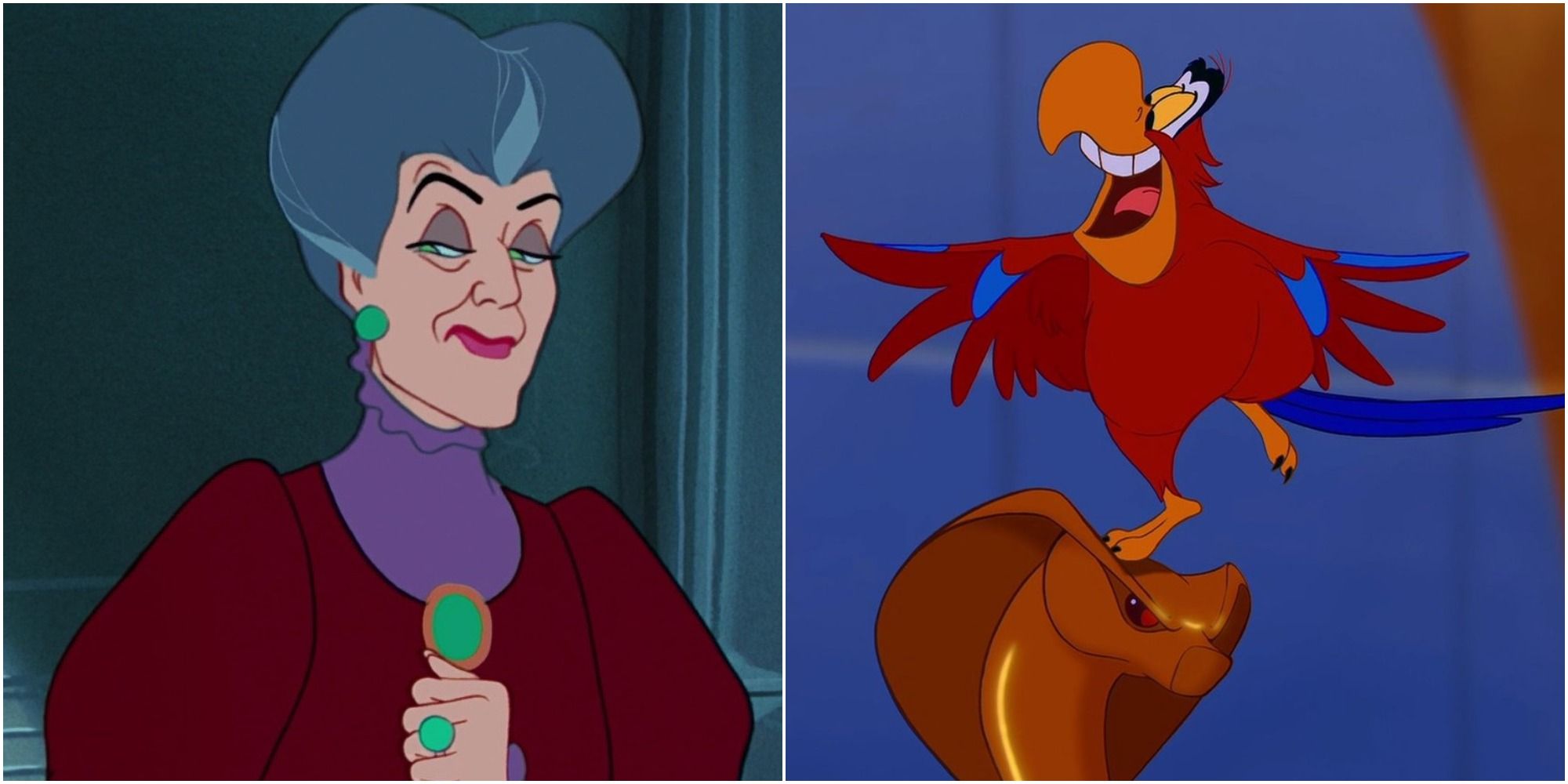
The magical universe of Disney has cemented itself in popular culture—as much for its thrilling stories and warm animation as for the morally diverse set of characters that populate its many franchises. Villains are a central concept in many Disney movies. They’re usually the main reason for the protagonist’s problems, inevitably motivating the latter to take action against them.
Villains are not naturally evil, of course; there are always mitigating factors involved—their emotional backstories can even generate feelings of sympathy from the audience. Commiserating with the antagonist is totally justifiable, as long as one doesn’t forget all the terrible things they’re responsible for.
10 Scar Is Unceremoniously Shunted To The Side — The Lion King (1994)
Scar’s self-loathing is evident from his introductory scene, even if he takes it out on his brother and newborn nephew. He’s not upset only because he doesn’t get to be king, but also because Mufasa and the rest of the pride ostracize him for being the metaphorical black sheep of the family.
Scar’s experiences are quite relatable, but the decisions he makes to rectify his misery are intensely problematic. For one, there’s just no reason to place a hit on a defenseless lion cub.
9 Ursula Wants To Help Ariel Achieve Her Dreams — The Little Mermaid (1989)
Ursula claims that her intentions are noble, that she wants nothing more than to offer Ariel everything she desires. In fact, she makes good on her promise by transforming the little mermaid into a human, albeit without a voice.
Her backstory reveals that she despises Triton and the merpeople for casting her aside, which is completely justifiable. However, tricking innocents into handing over their souls isn’t something a nice person does, regardless of their past.
8 Yzma Is Fired By A Clueless Monarch — The Emperor’s New Groove (2000)
Yzma takes care of Kuzco from his childhood, given that his parents are nowhere in the picture. She is an efficient, if a tad vicious, administrator, handling the daily activities of the Kuzconian Empire with considerable political skill.
However, Kuzco decides to fire his advisor on a whim, a thoughtless act that obviously infuriates her. Then again, it’s over-the-top brutal of Yzma to kill someone she has spent years raising.
7 Gaston Simply Wants Belle To Like Him Back — Beauty & The Beast (1991)
Gaston’s feelings for Belle are natural, although he never shows it without gloating about his own so-called achievements. It’s possible, by stretching the imagination to its extremes, to interpret Gaston’s overtures as romantic.
Falling in love is not a crime—as Gaston mentions, “when I met her, saw her, I said she’s gorgeous and I fell.” And yet, the fact that he believes he has a right to her person is patently misogynistic and completely unacceptable.
6 Hades Is Far Too Hilarious To Be Evil — Hercules (1997)
It’s very difficult to see someone as a villain if they also happen to be riotously funny, as is the case with Hades. He wants Hercules gone and his place in Olympus restored, stopping at nothing in terms of both having and eating his cake.
However, the character’s meta-comedy style is so brilliant that it occasionally obscures Hades’ actual nature: a cruel, spiteful, and hostile Greek god who has no problem subjecting virtuous souls to the torments of Hell.
5 Iago Is As Much Jafar’s Victim As Anyone Else — Aladdin (1992)
Iago might behave like he has no choice in obeying Jafar’s orders, but there is a reason he’s named after the scheming villain in Shakespeare’s Othello.
The macaw follows his owner out of his own free will—he’s most certainly not hypnotized by Jafar’s snake-staff like the Sultan. It could, perhaps, be a case of Stockholm Syndrome, but that doesn’t absolve Iago of all the lies and deceit he’s a part of.
4 Syndrome Is Inspired By Mr. Incredible — The Incredibles (2004)
Buddy Pine is a huge fan of Mr. Incredible’s exploits, expressing his desire to be the hero’s sidekick. His childlike sense of justice is easy to sympathize with, at least until he devolves into a criminal mastermind simply because his idol refuses Pine’s offer.
His response is petulant at best and malicious at worst: transforming into a vindictive, self-absorbed, and heartless villain known as Syndrome, so he can take revenge on those who he thinks rejected him.
3 Maleficent Is Spurned & Demeaned By The King — Sleeping Beauty (1959)
King Stefan invites Flora, Fauna, and Merryweather to the christening of his daughter, but intentionally skips Maleficent. It’s definitely rude of him to do so, but he has some pretty valid reasons for keeping the “mistress of all evil” away from Princess Aurora.
Unfortunately for the king and queen, Maleficent arrives at the castle anyway, expressing mock indignation at being excluded from the ceremony and casting a curse on the infant as punishment for her parents’ defiance.
2 Lady Tremaine Is A Single Parent With Three Kids — Cinderella (1950)
Cinderella’s father remarries, despite harboring feelings for his deceased wife, since he believes that his child requires a maternal presence in the household to thrive. Lady Tremaine brings with her Drizella and Anastasia, daughters from a presumably previous marriage.
This means that the death of Cinderella’s father leaves her stepmother a single parent with three kids to raise. That said, Lady Tremaine continues to abuse her vulnerable stepdaughter (and, occasionally, even her biological children).
1 Kaa Is Oppressed By Shere Khan — The Jungle Book (1967)
Kaa believes that Shere Khan’s need to kill the man-cub is based on self-gratification, which the Indian Rock Python deems contemptible (because prey exists to help the predator survive, and not to play with).
Shere Khan is a far more cunning villain, though, considering he tries to strangle information out of the pitiful snake. Nevertheless, Kaa is clearly planning to kill and eat Mowgli himself, so any oppression he endures at tiger-claw-point is offset by his own wickedness.
About The Author
