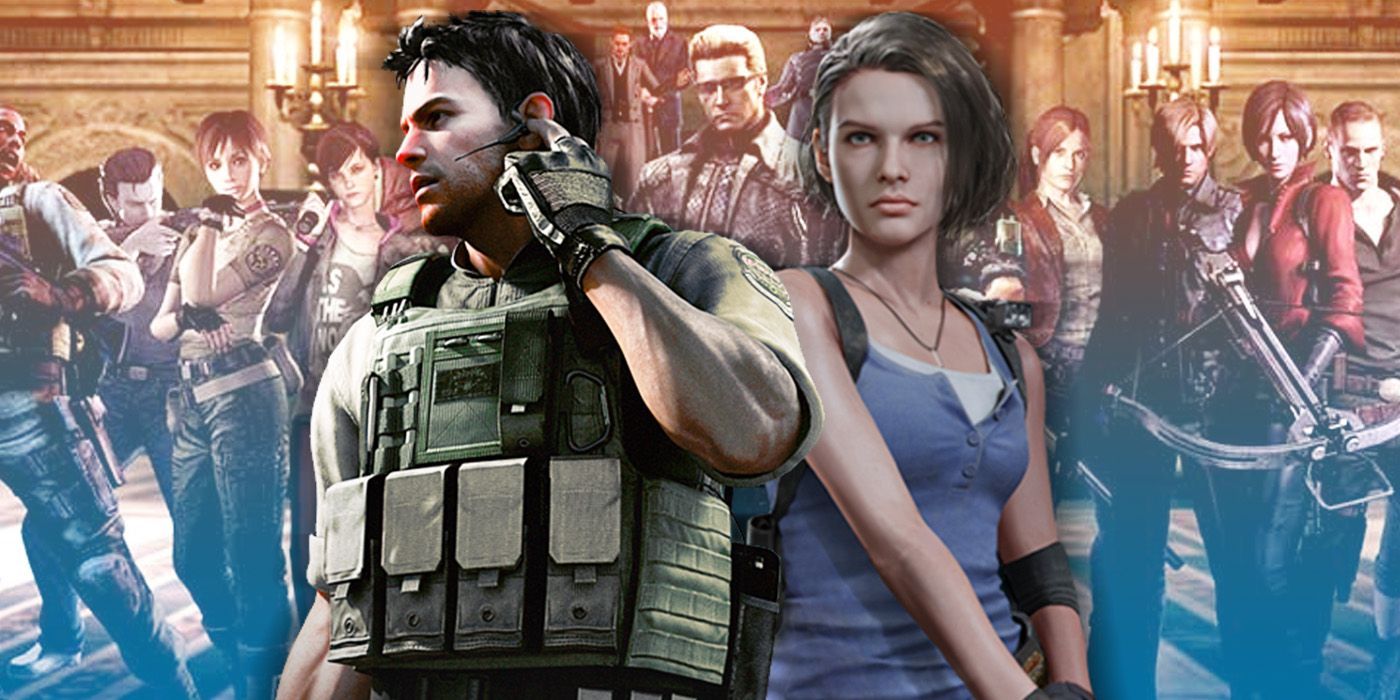
The saga of Resident Evil is never-ending, it seems. With DLC for Village on the way, we’ve updated this list to include the latest entries in the saga to give you a definitive ranking of every Resident Evil game from worst to best.
Capcom’s long-running survival-horror franchise Resident Evil has thrilled fans with intense, pulse-pounding action as they follow a rotating cast of fan-favorite characters against ravenous monsters the world over. Now is a truly great time to be a Resident Evil fan, with a television adaptation in the works at Netflix, an enhanced remake for Resident Evil 4 reportedly in development by Capcom and Resident Evil Village slated to continue the series next year.
Resident Evil has a storied history, but every great franchise has a few duds. Here is a definitive ranking of all the main entries in the video game series, based on professional critic scores on review aggregate websites Metacritic and GameRankings.
RESIDENT EVIL 6: 74/67
The lowest rated main entry, 2012’s Resident Evil 6, originally released for the PlayStation 3 and Xbox 360. One of the most ambitious titles in the series, the game featured multiple, interwoven storylines with Leon Kennedy, Chris Redfield, Ada Wong and Jake Muller at different crisis points around the world as a new bioweapon is unleashed by the shadowy organization Neo-Umbrella.
The PS3 version of the game received a solid 74% average critics’ score, while the Xbox 360 version scored a 67%. Critics were impressed mainly by the game’s design and graphics while critical of the inconsistency in quality between the various parallel storylines and the franchise’s continued emphasis on action over its horror roots.
RESIDENT EVIL ZERO: 83
2002’s Resident Evil Zero featured a single-player controlling two different protagonists for the first time in the series. Alternating between Rebecca Chambers and Billy Coen, the two solve puzzles that require them to work together. The title was a prequel to the original game in the franchise, with S.T.A.R.S. operative Rebecca teams up with convicted felon Billy to investigate a mysterious train crash outside of Raccoon City.
Initially a GameCube exclusive, critics were impressed by the level of detail and graphical capabilities on the console but less than glowing about the new gameplay mechanic. Derided as clunky and more of a hassle than an exciting addition, the two-character controls were dismissed. At the same time, the tank-based movement that had long defined the franchise was similarly called out for being outdated in comparison to its contemporaries.
RESIDENT EVIL VILLAGE: 83/84
The most recent main installment in the Resident Evil franchise to date, 2021’s Resident Evil Village continued the story of Resident Evil 7 protagonist Ethan Winters as he searched for his kidnapped daughter a remote village in Romania. Facing off against a sinister figure known as Mother Miranda and her four monstrous House Lords, Ethan found himself facing off against vampires, werewolves and other things that go bump in the night as he learned the truth behind the village.
Receiving a slightly higher aggregate score on the PlayStation 5 than its Xbox Series X|S counterpart, critics praised Village for combining the first-person gameplay of Resident Evil 7 with the classic, European horror elements that informed Resident Evil 4. With each House Lord presenting a difference in tone and style, the variety and accessibility was praised though the action-heavy ending divided some critics.
RESIDENT EVIL 5: 84/86
2009’s Resident Evil 5 featured dual protagonists Chris Redfield and Sheva Alomar, as well as the franchise’s first cooperative campaign mode. In RE5, Leon and Shiva investigate a new virus outbreak in sub-Saharan Africa linked to the Las Plagas parasite in Resident Evil 4 and the T-virus proliferated by Albert Wesker and the Umbrella Corporation.
Resident Evil 5 debuted to controversy, as gameplay featuring white protagonists battling predominantly Black Africans. Resident Evil 5 was also criticized for its inattentive A.I. partner and an inconsistent cover system. More favorably received were the fast-paced gameplay and cooperative mode, with the Xbox 360 version averaging a slightly higher score than its PS3 counterpart.
RESIDENT EVIL 7 – BIOHAZARD: 86
After leaning more towards action for its past several entries, 2017’s Resident Evil 7: Biohazard shifted the franchise back to its survival horror roots. Originally released for the PlayStation 4 and Xbox One, the gameplay shifted to a first-person perspective as new character Ethan Winters searched a derelict plantation for his missing wife, only to cross a family of ravenous cannibals in the backwoods and bayou of Louisiana.
Widely regarded as a return to form, both in terms of tone and quality, critics deemed Biohazard a legitimately terrifying experience. Particular praise was lauded on the game’s surreal visuals and effective sound design, as players delved deeper and deeper into their own personal nightmare, while the change from third to first-person was also praised.
RESIDENT EVIL: 87
The video game that started a phenomenon, 1996’s Resident Evil quickly became a PlayStation best seller. Following an elite police squad known as S.T.A.R.S., the game had the ensemble trapped in a remote mansion that was infested with zombies and other horrific monsters. Players could choose between protagonists Jill Valentine and Chris Redfield as they attempted to reunite with the rest of their team and escape from the mansion.
An immediate critical and commercial success, Capcom’s inaugural game in the series popularized the survival horror genre. The game has since received a steady supply of ports and enhanced remakes, with the most widely acclaimed being a new version of the original game built from the ground up for the GameCube in 2002. Universally acclaimed, the enhanced remake would inspire a whole generation of enhanced remakes for subsequent installments of the series.
RESIDENT EVIL 3 – NEMESIS: 88
The final main installment released for the original PlayStation, 1999’s Resident Evil 3: Nemesis takes place alongside the events of Resident Evil 2. The sequel followed Jill Valentine as she returned to Raccoon City, only to discover it overrun with zombies. Jill and mysterious new ally Carlos Olivera attempt to escape from the city while being stalked by the unstoppable Nemesis.
The addition of Nemesis was praised for giving the game a heightened sense of urgency. Players never quite knew when to expect it to appear as part of its relentless hunt. Similarly praised was the game pushing the graphical and sound capabilities of the original PlayStation as far as they could go near the end of the console’s life cycle. Nemesis proved popular enough to warrant an enhanced remake, the pacing of which was lauded while its noticeably shorter length was criticized.
RESIDENT EVIL 2: 93
While Resident Evil was a bonafide success, 1998’s Resident Evil 2 surpassed it critically and commercially. Claire Redfield arrives in Raccoon City to search for her missing brother Chris, only to find the entire city swarming with zombies. Claire teams up with police officer Leon S. Kennedy as the two try to survive and stop the outbreak.
Hailed as one of the greatest video games of all time, critics widely agreed that the sequel was a vast improvement over the already well-received original game on virtually every metric and became one of the bestselling games on the console and franchise overall. An enhanced remake released in 2019 updated the action to Resident Evil 4′s over-the-shoulder perspective to similarly strong critical acclaim and sales success.
RESIDENT EVIL – CODE: VERONICA: 94
The only Resident Evil game released on the Sega Dreamcast, 2000’s Resident Evil – Code: Veronica served as a direct sequel to Resident Evil 2. As Claire continued to search for her missing brother, the Redfield siblings found themselves targeted by Umbrella on an adventure that spanned the globe, taking the franchise out of Raccoon City for the first time.
Regarded as one of the best games in the entire series and best titles in the Dreamcast’s catalog, Code Veronica was lauded for its graphical improvements over earlier installments, taking full advantage of the Dreamcast’s hardware capabilities. Also praised was the game’s visible gothic themes and imagery, owing to its primary European setting and more tragic story.
RESIDENT EVIL 4: 96
The most universally praised game in the franchise, Resident Evil 4 originally released on the GameCube as part of a three-game exclusivity deal between Nintendo and Capcom. Set after Resident Evil 2, Leon has since become a Secret Service agent, tasked with rescuing the President’s daughter from strange captors in Spain where he discovers a different kind of nightmare.
The game was the first main entry to move away from the tank controls of previous entries, instead taking up an over-the-shoulder perspective to make the action more seamless and intuitive. This, as well as the game’s pacing and ambitious scope, were well received. Resident Evil 4 has gone on to be ported to pretty much every console since and is always a top-reviewed title.
About The Author
