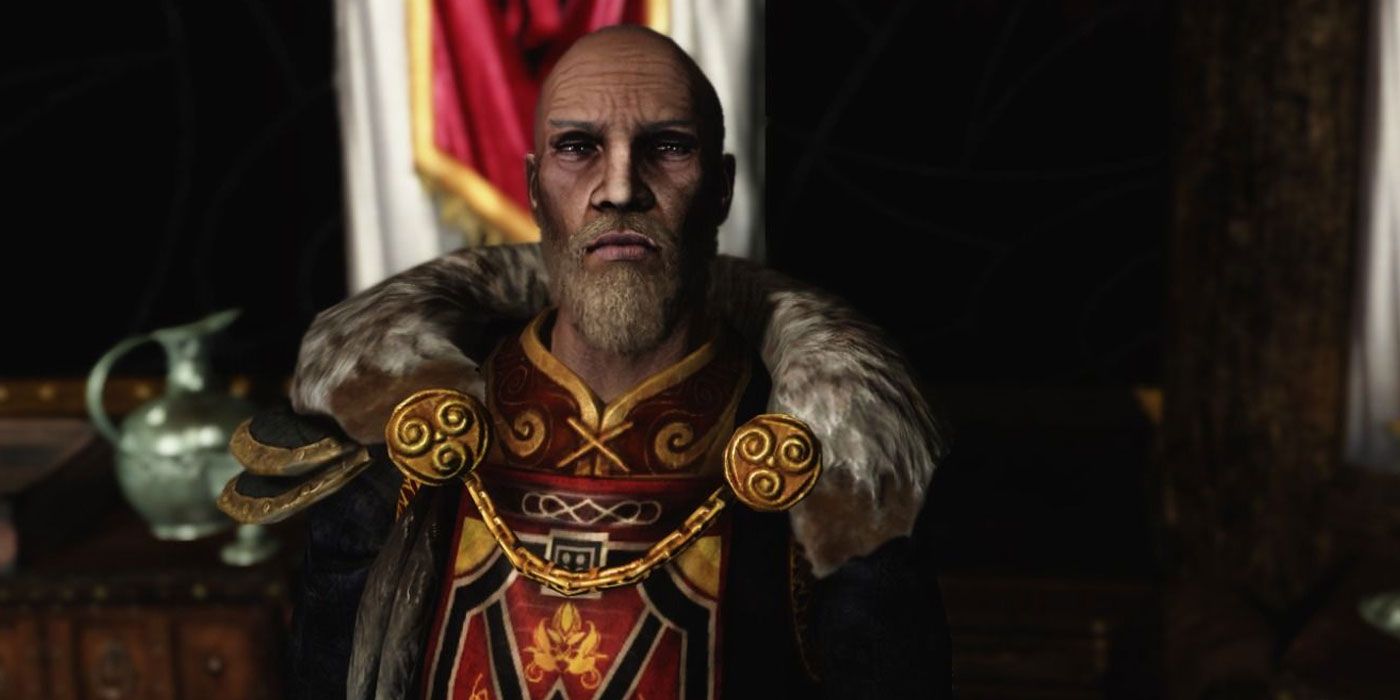
For most of The Elder Scrolls series, the Empire has been the dominant force of Tamriel and the world of Nirn. While weakened by destructive wars and crises, the Empire has managed to endure. There have been multiple Empires throughout history, most of which were centered in Cyrodiil. But it was the current Empire that managed to conquer and rule over every corner of Tamriel first.
The current Empire can trace its roots back to its founder Tiber Septim, a man whose history is steeped in legend and controversy. While most commonly referred to as Tiber Septim, he was also known as Hjalti Early-Beard to the Bretons of High Rock and Ysmir and Talos Stormcrown by the Nords of Skyrim. Beginning in service to a petty Cyrodiilic king named Cuhlecain, Tiber fought under the name General Talos to unify the central province of Cyrodiil before Cuhlecain was assassinated by unknown attackers, or according to some accounts, Talos himself, to usurp him.
As a Dragonborn with the ability to wield powerful Shouts, he managed to conquer all of the other provinces of Tamriel and unite them under his new empire’s rule, declaring that the following year should be the beginning of the Third Era. Tiber Septim died in 3E 38, beginning the rule of the Septim bloodline for more than 400 years. Upon his death, he’s also believed to have ascended to godhood as Talos, the god of war and governance. This raised the number of divine Aedra from eight to nine in the pantheon.
The Empire ruled each of the major regions as provinces and governed by local rulers, essentially acting as vassal states to the Empire. So long as they remained loyal and abided by Imperial laws, these local rulers could govern however they saw fit. While the Emperor is the head of state and holds absolute authority, the day-to-day running of the Empire rests with the Elder Council, whose responsibilities include administrating and overseeing the provinces, advising the Emperor and creating laws and regulations. Among the many institutions started by the Empire include the East Empire trading company, the Fighters and Mages Guilds, and the Blades, an intelligence organization sworn to the service of the Dragonborn. The Empire maintains control of its territories through its Imperial Legions, an armed force tasked with upholding the law, defending its citizens, and waging war against the Empire’s enemies.
Centuries of relative peace enabled the Tamrielic Empire to become the leading political, economic, cultural and military force on Nirn. However, the Empire’s rule would be tested, and Tiber Septim’s many heirs would be targeted by assassinations, uprisings, and civil wars between royal family members competing for the throne. At some point, the Empire attempted to expand its borders beyond Tamriel by conquering the mysterious continent of Akavir, though this ended in complete disaster.
Near the end of the Third Era, the Empire was ruled by Uriel Septim VII, whose reign was mostly stable but dotted with occasional strife in the other provinces. While these events were mostly resolved by various heroes to the regions, the greatest of these threats to the Empire came with the infamous Oblivion Crisis. After Uriel and his known heirs were all assassinated by a cult called the Mythic Dawn, Daedric forces loyal to Mehrunes Dagon, the Daedric Prince of destruction, began invading Tamriel. While normally the barriers between the mortal realm of Mundus and the Daedric realm of Oblivion were closed, this was only when the Dragonfires were burning and could only be kindled by a Septim Emperor.
The task of driving back the Daedra fell to Uriel’s last surviving son, Martin Septim, as well as his companion, The Hero of Kvatch. Despite many hard-won victories, the crisis reached its peak when Dagon himself entered into Mundus and personally attacked the Imperial Capital. In an act of ultimate sacrifice, Martin used the Dragonfires to transform himself into a flaming dragon as an avatar of the god Akatosh and battled the Daedric Prince, banishing him to Oblivion and closing every gate across Tamriel before turning to stone.
While the threat of the Daedra was resolved, the Septim Dynasty was now extinguished, and in the immediate aftermath of the crisis, the Empire began to fracture in what is referred to as the Fourth Era. The Elder Council’s members would wage civil war for the throne until it was taken by a Colovian warlord named Titus Mede, beginning the rule of the Mede Dynasty. Various provinces with predominantly Mer and Beast populations seceded from the Empire, the most powerful being the Aldmeri Dominion. In the wake of the Oblivion Crisis, a radical political faction of High Elves known as the Thalmor proclaimed themselves the saviors of the Summerset Isles and took power, seceding from the Empire and absorbing Valenwood and Elsweyr.
In 4E 171, after Emperor Titus Mede II rejected an ultimatum by the Thalmor, the Dominion invaded the Imperial provinces of Hammerfell and Cyrodiil, beginning the Great War. Despite many victories, the Empire’s Legions had been exhausted and Emperor Titus determined that continuing the war would mean the end of the Empire. Signing a peace treaty known as the White-Gold Concordat, the Thalmor’s demands included ceding large portions of southern Hammerfell to the Dominion, disbandment of the Blades, and the outlaw of Talos worship. Titus would be forced to relinquish Hammerfell as an Imperial territory entirely when the province’s rulers refused to give up their lands, continuing their war with the Dominion.
Meanwhile, in Skyrim, banning the worship of Talos was highly unpopular for the Nords. In 4E 201, a civil war was started between the Empire, its loyalists and a rebel militia led by Ulfric Stormcloak. The situation became even more dire with the emergence of the Dragon Crisis in Skyrim. It’s unknown which side had won the war, if at all, but by this point, it was undeniable that the Empire was not what it used to be. Many also fear that another Great War is on the horizon, as the Empire continues to rebuild its strength, while the Dominion is determined to conquer all of Tamriel.
While the upcoming Elder Scrolls VI remains shrouded in mystery, the Empire is in a dire state following the events of Skyrim. It’s anyone’s guess whether it can survive and regain its former power or if it’ll fall and begin yet another era, like so many kingdoms before it.
About The Author