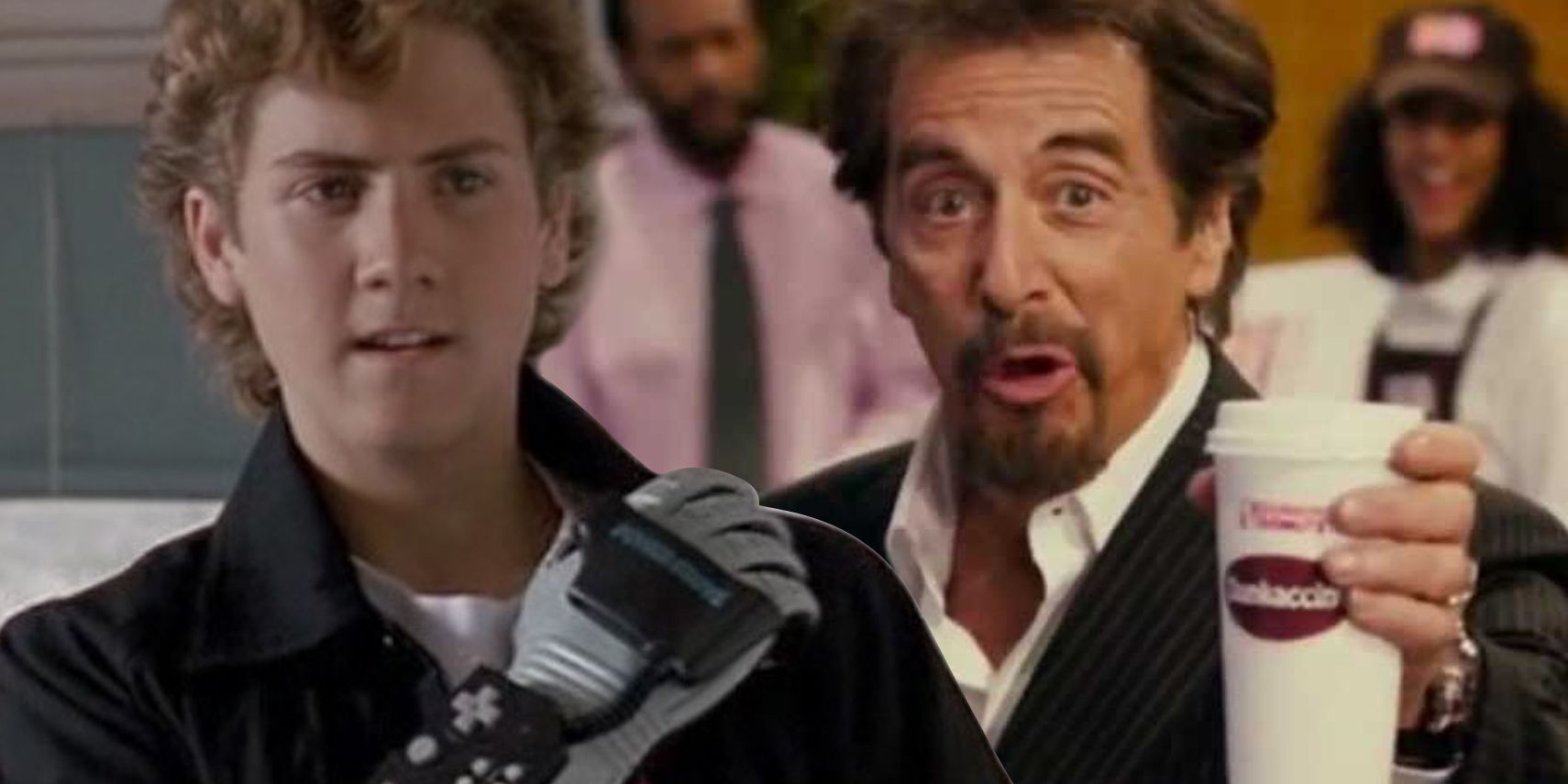
Product placement is a reality in the moviemaking business; that’s just how things are. For every Fight Club or The Lego Movie that cleverly tied its commercials to its humor and themes, there are ten Man Of Steels and Resident Evils that haphazardly gave brand names prominence for no discernable reason.
Take The Wizard, for example, which was a glorified commercial for Nintendo and the then-new Power Glove. This movie and many more are better remembered for their tactless product placements, immortalizing them as pop culture’s most hilariously transparent commercials.
10 The Back To The Future Trilogy Saved The DMC DeLorean From Obscurity
Today, the DMC DeLorean is synonymous with fantastic adventures and time travel. However, before Back To The Future became a pop culture icon, Doc Brown and Marty McFly were the car’s only fans. If not for Robert Zemeckis’ beloved trilogy, the DMC DeLorean would only be remembered for killing the company that made it.
In 1981, the DeLorean Motor Company unveiled the DMC DeLorean. Unfortunately, the futuristic car sold so poorly that DMC filed for bankruptcy a year later. Despite that, Doc Brown sang the DeLorean’s praises and the movies showed it in such spectacular action that it became a prized collector’s item years after its initial failure.
9 Mac & Me Is McDonald’s Remake Of E.T. The Extra Terrestrial
Before The Wizard, there was Mac & Me, which is considered to be one of the most blatant forms of product placement and one of the best bad movies ever made. Basically McDonald’s version of E.T. The Extra Terrestrial, this movie is so transparent in its product placement that the titular alien was named after a Big Mac and he hailed from the planet Quartus Poundus.
Other brands were featured prominently, but McDonald’s unsurprisingly took up the lion’s share of the spotlight. There’s even a subplot and elaborate dance number in a kids’ birthday party at McDonald’s, complete with a guest appearance from Ronald McDonald. Mac & Me tanked at the box office, but it was later immortalized in cult movie circles.
8 Harold & Kumar Go To White Castle Equated White Castle’s Burgers To Freedom
As its title implies, the first Harold and Kumar movie featured the stoners’ epic journey to White Castle. While this comedy isn’t above mocking its own premise, White Castle and its burgers were hyped up to a ridiculous degree. In fact, the commercial that convinces Harold and Kumar to get take out is shot like a seductive adult movie.
To Harold, Kumar, and their supporting characters, White Castle’s burgers are the best food that mankind ever cooked up. Harold & Kumar Go To White Castle even hit a climactic crescendo when Kumar equates White Castle’s burgers to the American Dream in a rousing speech that inspired Harold (and audiences) to visit White Castle as soon as possible.
7 Foodfight! Is A “Celebration” Of Food Brands
Hoping to replicate Toy Story‘s success, Foodfight! cast advertising mascots in this loose animated remake of Casablanca set in a grocery. Foodfight! isn’t only infamous for being an obvious commercial, but for being a poorly made one that suffered a troubled production cycle. Its original footage was even stolen, forcing the animators to start from scratch and leading to its rushed animation.
Foodfight! certainly earned its negative reputation, as it does nothing clever with its product placement. Brand mascots like Charlie the Tuna and Mr. Clean show up sporadically despite being featured prominently on the poster, while brands that refused to have their mascots featured were mocked with unflattering parodies.
6 The Emoji Movie Is A Commercial For Every Phone App Imaginable
The Emoji Movie is one of the most infamous movies of the past decade, especially thanks to how shameless its product placement was. To be clear, The Emoji Movie wasn’t a commercial for emojis, since they’re copyright-free. Instead, it advertised apps and websites rather than focus on its poorly thought-out story that somehow equated conformity to self-realization.
Facebook, Shazam, Twitter, WeChat, and YouTube were given prominence, but their spotlight paled in comparison to that of Candy Crush Saga, Dropbox, and Just Dance. Candy Crush and Just Dance were the settings of major action set-pieces, while Dropbox was an important plot device that helped the characters save the day.
5 The Wizard Is A Giant Ad For Nintendo Games, Systems, & More
The Wizard is unique among video game movies because it’s about gaming culture, not a specific game. That’s the best that can be said for this cult classic since it’s a feature-length commercial for Nintendo products like Nintendo’s hotline, Ninja Gaiden, Rad Racer, the Power Glove, and the then-upcoming Super Mario Bros. 3.
What makes The Wizard hilarious in hindsight is how many of the featured Nintendo products/services were phased out (the Nintendo Power Line), forgotten to time (Rad Racer), or flopped (the Power Glove) shortly after the movie’s release. Interestingly, it accurately predicted the pro-gaming scene as Video Armageddon all but set the template for today’s gaming competitions.
4 Michael Bay’s Transformers Series Set A World Record For Product Placement
Transformers was always merchandise-driven since it was originally made to sell Americanized versions of Japan’s Diaclone and Microman transforming robot toys. Michael Bay’s Transformers movies drove this to the logical extreme, featuring so much product placement in one movie (Age Of Extinction, the fourth film in the series) that it even got a world record for it.
Age Of Extinction wasn’t just criticized for featuring 55 brands like Beats and Budweiser, but for also being a commercial for China. The other movies aren’t any better, acting less as adaptations of the Cybertronian Civil War and more as commercials for each Transformer’s luxury car or state-of-the-art vehicular mode. Additionally, the US Army’s prominence in the movies led to accusations of the Transformers films being thinly-veiled recruitment ads.
3 Every Adam Sandler Comedy Ever Is Basically A Billboard
If there’s one actor who’s synonymous with product placement, it’s Adam Sandler. His comedies are more advertiser-friendly billboards than ensemble romps starring himself and friends. For example, Little Nicky used Popeye’s Fried Chicken as a plot device while Pixels prioritized Sony products over nostalgic video game references. This has led to endless criticism of his comedies and jokes made at their expense.
Arguably, the most egregious is Jack & Jill (above), which is where the so-bad-it’s-good Dunkaccino musical number came from. Before that, more than a dozen brands were given as much screen time as the stars. In fact, the first four minutes alone featured four brand shout-outs, while Dunkin’ Donuts and the Royal Caribbean Cruise Lines were integral plot points.
2 The Cars Trilogy & Planes Movies Were Made To Promote Their Own Toys
Of Pixar’s movies, the Cars trilogy and Planes stick out because they’re uncharacteristically lukewarm at best. Despite that, Lightning McQueen’s saga and Mater’s hijinks boast the most spin-offs and merchandise in Pixar’s repertoire. This was the plan from the start since Cars was made to sell toys and little else.
When Cars first hit cinemas in 2006, its tie-in merchandise quickly sold out and never dipped in demand. Pixar capitalized on this and created the succeeding Cars media with toy sales in mind, introducing new characters for the toy makers’ sake more than the story’s. In 2011, Cars’ toys alone racked up almost $11 billion in sales.
1 Star Wars Was A Preemptive Commercial For Its Own Toys
Before Star Wars began in 1977, toylines tied to blockbusters were unheard of. Lucas, meanwhile, saw the potential fortune his galaxy could make, so he secured the movies’ toy rights over a pricey director’s salary. Thinking that Star Wars would flop, 20th Century Fox quickly agreed to Lucas’ offer, only to regret it later.
Upon Star Wars’ debut, demand for toys of its cast, vehicles, and more was so astronomical that Kenner Products sold empty boxes/vouchers when the figures sold out almost instantaneously. Since then, many of Star Wars’ creative decisions were made with toys in mind – for better or worse. Lucas also admitted that he owes his fortune to the toys more than the movies.
About The Author