Cinema necessitates multiple cooks in the kitchen. Combined with the need for revision inherent to the creative process, many films end up different from how they were originally envisioned.
There are 10 famous films with alternate endings conceived, scripted, or even filmed which differed from the final product, along with the history behind and motivation for the change.
10 Ridley Scott Wanted A Bleak Ending For “Alien”
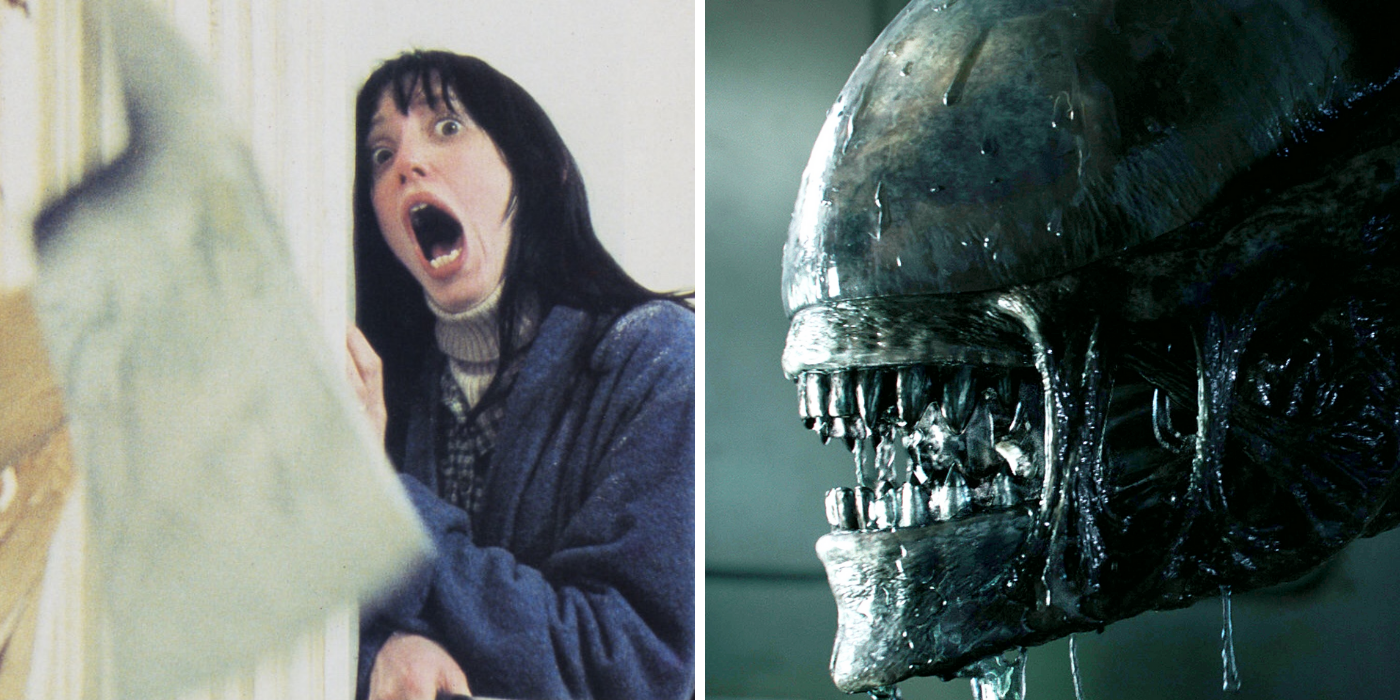
Alien pushed the boundaries of horror cinema—the infamous chestburster scene reportedly made test audiences scream, faint, and vomit. Almost as shocking in 1979 was Ellen Ripley (then-unknown Sigourney Weaver) emerging as the final girl. Alien, of course, became Weaver’s breakout role and Ripley is as much an icon as the film itself. That said, if director Ridley Scott had his intended ending, that might’ve not been so.
“I thought that the alien should come in, and Ripley harpoons it and it makes no difference, so it slams through her mask and rips her head off,” Scott recounted in an interview with Entertainment Weekly. “It would mimic Captain Dallas [Tom Skerrit] saying, ‘I’m signing off.” Threatened with termination, Scott shot the final ending; Ripley triumphs over the alien then returns to cryo-sleep for the voyage home.
9 “Clue” Almost Had One More Ending
As a nod to its board game roots, Jonathan Lynn’s Clue featured three different endings. During the movie’s theatrical run, different theaters screened different endings—since the movie’s release on home media, all three endings are included, with the final one being presented as what “really” happened.
However, there were plans for a fourth ending, wherein Wadsworth the Butler (Tim Curry) is the murderer. His motive? To commit the perfect murder after having failed to achieve perfection elsewhere. To eliminate all the witnesses, he poisoned all the guests with champagne he served them earlier. However, the murder is not so “perfect” after all—the police arrive to arrest Wadsworth, and a subsequent escape attempt is foiled by the grounds’ guard dogs.
8 The Original Ending Of “Doctor Strangelove” Was Too Ill-Timed & Farcical
In Stanley Kubrick’s Doctor Strangelove, there is a table of pastries in the War Room. This was meant as a lead-in to the original ending. General Turgidson (George C. Scott) tackles the Russian Ambassador (Peter Bull) after accusing him of photographing the War Room’s “big board.” The Russian Ambassador throws a pie at Turgidson, mistakenly hitting President Muffley (Peter Sellers)—the room erupts into an enormous pie fight.
Kubrick ultimately found the scene too ill-fittingly farcical. Plus, since Strangelove was in post-production when President Kennedy was assassinated, President Muffley being “struck down” hit too close to home. Though unavailable, the footage of the pie fight survived and was once screened at London’s National Film Theatre in 1999.
7 “Election” Had A Very Different, Very Inappropriate Ending Filmed
In Alexander Payne’s Election, Jim McAllister (Matthew Broderick) rigs the student body president election against Tracy Flick (Reese Witherspoon). When his sabotage is discovered, he’s fired. Years later, he sees her in Washington DC as a congressional intern; still bitter, he hurls a soda cup at the limo she’s riding in.
In an alternate ending, however, McAllister has found work as a car salesman and reconciles with Tracy before she departs for college. This saccharine ending is at odds with Election‘s satirical bent, something the chosen ending preserves.
6 “The End Of Evangelion” Had Three Different Endings Considered
By The End Of Evangelion, Shinji and Asuka are the only two who’ve returned from Instrumentality, the merging of all souls as one. Asuka meets Shinji strangling her with a caress of his cheek, but when he breaks down sobbing, she replies “Disgusting.” It doesn’t seem like a happy ending, but there are flickers of optimism—if two people as broken as Shinji and Asuka can choose existence over Instrumentality, there may be hope for humanity still.
Hideaki Anno’s plans for Evangelion were in constant flux. One ending, similar but less chilling, has Shinji still lying on the shoreline, with graves for the main cast before him. Asuka kicks down hers, telling Shinji “Idiot – no way I’ll let you kill me.” In another, it’s not Asuka who lies by Shinji’s side, but Rei. At least, that’s what Shinji thinks—he’s actually holding onto her severed arm. The implication, that only Shinji had the will to leave Instrumentality and he will be alone forever, would’ve pushed the ending into nihilism.
5 “Get Out” Could’ve Ended With A Downer Rather Than A Triumph
Jordan Peele’s Get Out is a modern classic—it’s astonishingly polished for a debut and its commentary is damningly relevant. A script as airtight as Get Out doesn’t get that way without revision; Peele had a few possible endings devised, but only two were filmed.
The one Peele ultimately chose features Chris (Daniel Kaluuya) rescued by his friend Rod (Lil Rel Howery). Another filmed ending instead has a cop arriving on the scene as Chris is strangling Rose (Allison Williams). Sentenced to prison, a resigned Chris is visited by Rod. Another discarded ending featured Rod discovering the procedure had been performed on his friend—”Chris” tells him “I don’t know who you’re talking about.”
4 The Original Ending For “Little Shop Of Horrors” Was Closer To The Original
Frank Oz’s 1986 Little Shop Of Horrors adapts the 1982 Broadway musical, itself adapted from the 1960 Roger Corman film. The 1986 version ends with Seymour (Rick Moranis) and Audrey (Ellen Greene) vanquishing the man-eating, outer space plant Audrey II (Levi Stubbs) and settling in at the suburbs. However, one of Audrey II’s offspring grows in their front yard, indicating the horror may not be over yet.
In the original ending, Audrey II devours both its namesake and Seymour then continues its reproduction unabated. Cue a montage of Audrey II’s skyscraper-sized spawn ravaging the Earth. Test audiences reacted poorly, and so this ending was replaced for the theatrical cut. However, in 2012, the fully-restored director’s cut was released to Blu-Ray, including the original ending.
3 It Took “Se7en” A Few Revisions To Get Its Famous Ending
After Andrew Kevin Walker first wrote Se7en, New Line Cinema executives had him revise the script to lighten it up. However, director David Fincher accidentally received Walker’s original draft. Fincher, still raw from studio interference on Alien 3, refused to make the movie unless the first draft was used as the shooting script.
Even still, the film’s ending, wherein Detective Mills (Brad Pitt) shoots John Doe (Kevin Spacey) after learning the killer murdered his wife (Gwyneth Paltrow), went through multiple iterations. One ending, storyboarded but not filmed, had Detective Somerset (Morgan Freeman) shoot Doe instead. Fincher’s preferred ending was a smash cut to black after Mills shoots Doe, but in the end, he bowed to studio pressure and had a bit more resolution.
2 “The Shining” Originally Had An Epilogue
Kubrick’s The Shining originally had an epilogue resolving the fates of Wendy (Shelley Duvall) and Danny (Danny Lloyd). Overlook manager Stuart Ullman (Barry Nelson) visits the two in the hospital, informing Wendy that Jack’s (Jack Nicholson) body hasn’t been found.
Before Ullman leaves, he tosses Jack’s tennis ball to Danny, implying Ullman is a tool of the Overlook. This epilogue was included in The Shining‘s earliest screenings in NYC and LA, but Kubrick, sensing audience disapproval of the scene, had it cut. It’s believed all prints of the scene have since been destroyed, making it unlikely anyone will ever see it again.
1 “Vertigo” Was Nearly A Victim Of The Hays Code
Alfred Hitchcock’s Vertigo spits in the face of the clean resolutions favored by Hollywood; the film ends abruptly with Scottie (James Stewart) despairing the loss of his lover Madeleine/Judy (Kim Novak) for a second time. There was a thankfully failed attempt to “rectify” this ending, though.
Midge (Barbara Bel Geddes) listens to a radio report on the arrest of mastermind Gavin Elster (Tom Elmore) before Scottie arrives at her apartment; the pair let the air hang between them. Midge and Elster disappeared from the final cut, so this scene offered greater resolution and compliance with one of the Hays Code’s stringent standards—that evil characters be punished. The footage of the extra ending survives and has occasionally been included on home media releases of Vertigo.
About The Author