WARNING: The following contains spoilers for Loki Episode 4, “The Nexus Event,” now streaming on Disney+.
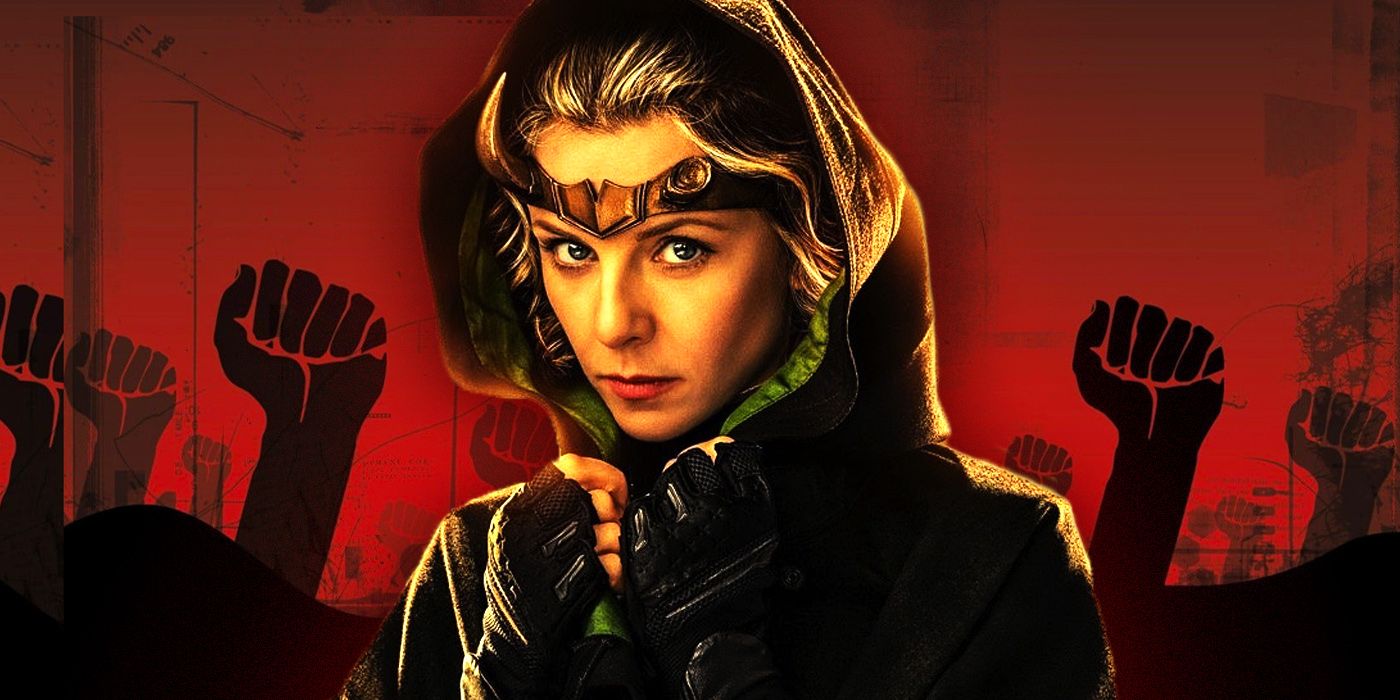
So far, Marvel Studios’ television series for Disney+ have leaned into an exploration of gender roles in a way the movies of the Marvel Cinematic Universe rarely did. WandaVision offered impressively meta commentary on women’s evolving public and private lives, as well as how they’ve been portrayed on TV. The Falcon and the Winter Soldier contrasted sensitive Sam Wilson with John Walker’s machismo to make a statement about real strength and heroism. And now Loki has not only given the MCU its first major queer player, it’s also included an entire plotline about the oppression of one problem-causing woman, whose story might just turn out to be more interesting than the protagonist’s.
In Loki Episode 1, Mobius convinces the TVA to refrain from pruning Loki for the time being in hopes that he’ll be able to help them catch a more dangerous variant. The audience then learns (perhaps sooner than most expected) that that variant is Lady Loki, who goes by the name Sylvie. She is seen enchanting and sometimes killing Minutemen, and she does “bomb” the Sacred Timeline many times over with stolen reset charges. But the TVA is vague about her supposed misdeeds, and subsequent episodes show that she’s dangerous because she knows the organization is, to some extent, a fraud. Lady Loki’s no saint, but as seen in this week’s episode, she’s definitely not the villain the TVA made her out to be.
The fourth episode of Loki begins with a disorienting visit to Asgard. A little girl play-acts with her toys that the Valkyrie have defeated a dragon and saved the day. Just then, portals appear and the TVA arrests her for crimes against the Sacred Timeline. The girl, who later is confirmed to be Sylvie in her youth, doesn’t appear to have done anything wrong. The audiences watches her go through the same protocols that prime Loki endured upon his arrival to the TVA. She’s brought to trial, but manages to escape, with a TemPad no less.
As far as she can tell, her only crime (at least initially) was being born the Goddess (as opposed to the God) of Mischief. She believes a female Loki was too much chaos for the TVA and the Sacred Timeline. They sought to erase her from existence, but her escape caused more chaos in the form of nexus events wherever and whenever she went. Eventually, she figured out that she could hide in apocalypses, where her temporary presence didn’t register. Sylvie tells Loki that she grew up in “the ends of a thousand worlds.”
Her storyline could be interpreted as an allegory for the challenges faced by non-conforming women, or more broadly, non-conforming people. To someone who deals with systemic limitations because of gender (or sexuality, race, creed, disability, etc.), and the wealth and power differentials they create, the world can feel a little more like Lamentis-1 than Asgard. The fact that Sylvie has been fighting against the TVA for a “long time” and that, as she says, “it sucks,” is another fitting metaphor. Generations upon generations of women have fought for the rights to vote, own property, work outside the home and be safe from abuse and harassment. Often, the obstacles in their way were frustratingly bureaucratic in nature, not unlike the TVA.
Near the end of the episode, Sylvie confronts Ravonna Renslayer about why she was apprehended in the first place. Ravonna was a mere Minuteman at the time, but was also (maybe not so coincidentally) the very agent who brought her in. Ravonna replies, not very believably, that she doesn’t even remember. The truth could simply be what Sylvie believes, or there might be some revelation still to come that colors our perception of Lady Loki. However, a look back at the seemingly ordinary moment of her arrest might hold a clue.
Little Lady Loki was playing at being a hero when those portals popped up out of nowhere. Lokis are, according to the Timekeepers and the Sacred Timeline, supposed to be scamps and not saviors. Sylvie is divergent (and, thus, threatening to whoever is really running the TVA) in that she’s a woman and someone who’s after a righteous correction to the way things are. She shares what she knows about TVA employees (that they’re mind-wiped former Variants) with B-15 and Loki, who passes on that information to Mobius. In Loki Episode 2, Sylvie told Loki that what she was trying to do was bigger than him. It sure seems like she’s on a mission to liberate Variants and defend free will.
Loki‘s mid-credits scene — that thankfully assures the audience that Loki prime hasn’t been pruned to death — introduces more Loki Variants. There’s Kid Loki, Classic Loki, Boastful Loki and Crocodile Loki waiting for our Loki in whatever alternate timeline dumpster fire in which he landed. While these Variants will likely factor more into the main plot and possibly offer some Guardians of the Galaxy style comic relief, it’s nonetheless interesting that Loki has been represented so far as a queer person, a woman, an elderly person and a Black person. These are all types of characters that, until fairly recently, have either been excluded or otherwise sidelined — even marginalized — in storytelling. It remains to be seen how Kid Loki and Crocodile Loki fit into this idea, if at all.
As they think they’re about to die, Sylvie wonders if what makes a Loki a Loki is that they always seem to lose. Loki tells her they often lose, and painfully, but they survive. As such, Lokis — with Lady Loki as their leader — may come to represent not just mischief, but perseverance and defiance in the face of systems that preserve order for the powerful few, who are considered the “norm,” at the expense of the innocent many, who are considered the “other.” It’s a lofty theme for a show about robot space lizards, but so far, Marvel Studios has proven itself to be capable of combining deep and nuanced sociological ideas with wildly entertaining fun.
Loki stars Tom Hiddleston, Owen Wilson, Gugu Mbatha-Raw, Wunmi Mosaku, Sophia Di Martino, Richard E. Grant, Sasha Lane and Eugene Cordero. New episodes air Wednesdays on Disney+.
About The Author
