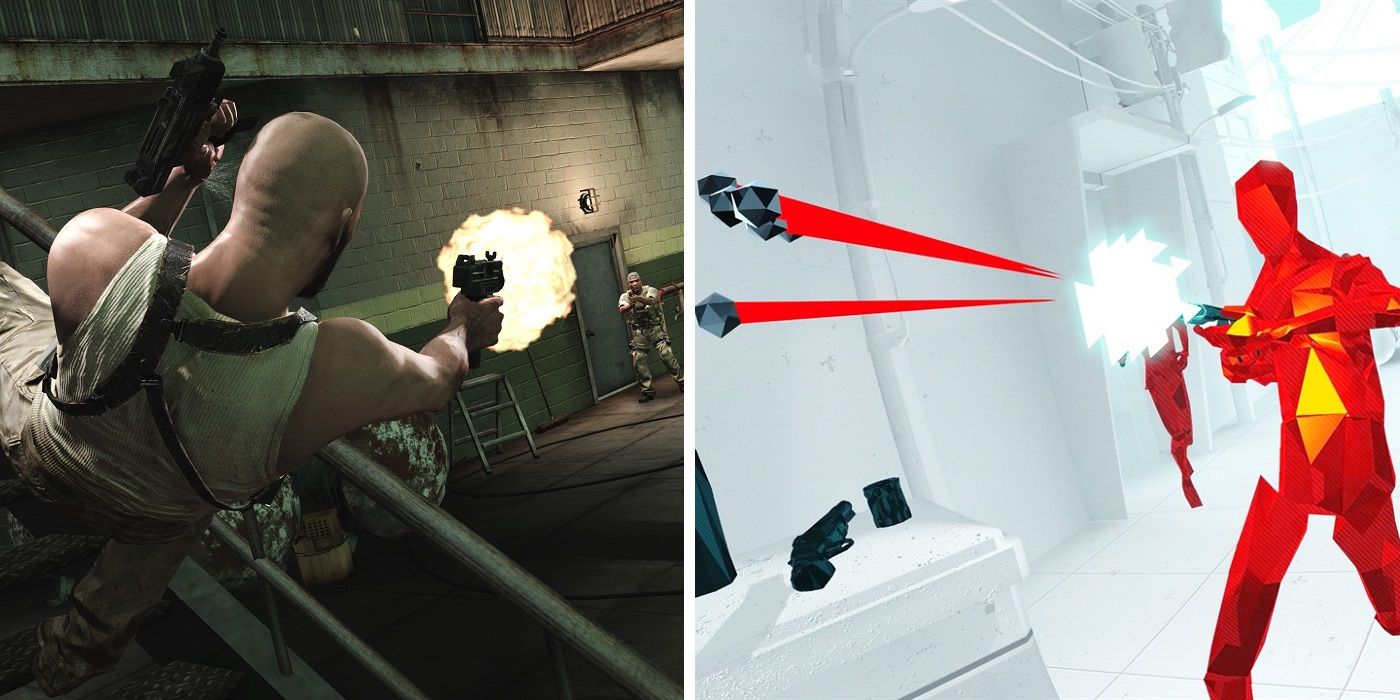
Ever since Keanu Reeves stunned millions with his slow-mo, computer generated antics in The Matrix franchise, people have dreamt of having the power to slow down time, either literally or mentally, to be able to have godlike reaction time. This power has come to be known as “bullet time;” and besides inspiring a lot of people to do their best impersonation of Keanu Reeves doing the limbo, it’s inspired one of the most fun and cinematic game mechanics around.
Whether a video game character is being gunned down by enemies or fighting a vicious boss, bullet time as an inspiration for game mechanics has allowed many players the precious seconds needed to change the pace of their game. Some games just happen to do it better than others, even when compared to The Matrix.
10 The Max Payne Trilogy Practically Defined Bullet-Time In Video Games
While there are video games for The Matrix, ironically, none have been as defining for the bullet-time mechanic in video games as the Max Payne trilogy. As to be expected from a franchise with zero subtlety in calling itself Max Payne, these games are all about glorified action.
Surrounding the titular cop turned hero of the night, Max Payne allows the player to take on hordes of drug dealers and gang members in intense shootouts. The series’ iconic cinematic and action-packed gameplay is thanks entirely to the series’ use of bullet time which gives Max the ability to literally dive into action with as much panache and consequence as any action movie.
9 Fallout 3 Introduced V.A.T.S.
Before Todd Howard got his hands on the iconic Fallout franchise (for better or worse), it was an asymmetric, turn-based game where the player was able to do more than just choose an enemy to shoot that turn, but also what body part. Fallout 3 was the series’ first dive into first-person, open-world action, yet it was somehow still able to integrate a similar combat system.
With the Vault-Tec Assisted Targeting System (or V.A.T.S.), the player is able to both slow down time cinematically as well as pick off individual body parts on their target. Much more than a callback or gimmick, V.A.T.S. have grown to become a staple of the modern Fallout titles.
8 Red Dead Redemption’s Deadeye Mode Is Great For a Shoot Out
Rockstar Studios had been playing around with their version of the bullet time mechanic with their Western-themed Red Dead franchise, dubbing it “Deadeye.” Starting with Red Dead Revolver, the player is rewarded for skillful play by having accurate and critical shots build up their Deadeye meter. Filling it allows them to slow down time and target enemies for a flurry of quick shots.
This cowboy version of bullet time has only improved and perfected as the series has gone on, with Red Dead Redemption 1 and 2 providing players with some timeless and gritty memories of cowboy shootouts.
7 John Woo’s Stranglehold Shows Beautiful, Slow-Mo Action
If there is anyone more famous for slow-mo gun fights than The Matrix franchise, it’s John Woo. The action movie icon has developed some of the most ridiculous yet stylishly cinematic action movies ever to grace the big screen. And while his legacy has more than been solidified with films like Face/Off or Bullet In The Head, John Woo still took the opportunity to collaborate with Midway Games to make Stranglehold.
A direct sequel to landmark action film (and slow-mo side-diving pioneer) Hard Boiled, Stranglehold continues Investigator “Tequila” Yuen’s journey to waste bullets. It’s no surprise that this game would incorporate some classic bullet time to compliment John Woo’s idiosyncratic directing style.
6 Bayonetta Brings Witch Time To Demon Fights
While Bayonetta isn’t typically finding herself in the middle of gun fights, her video game franchise has incorporated a form of bullet time that has made Platinum Games’ iconic melee combat all the more rewarding and exciting.
Activating “Witch Time” allows Bayonetta and the Umbra Witches to slow down enemies within their immediate vicinity as well as speed them up to unleash rapid, vicious attacks. This ability has been gratifying within the main Bayonetta franchise— and just outright frustrating in the Super Smash Bros. games.
5 Mirror’s Edge’s Reaction Time Is An Adrenaline Rush
While combat and gunplay are still crucial factors within DICE’s Mirror’s Edge franchise, they’re not a priority over the games’ famous uses of speed and parkour (almost to the point that it would’ve been better as a movie). Faith Connors is a courier responsible for efficiently delivering messages that certain groups probably shouldn’t get their hands on. This often puts her at odds with a variety of enemies, meaning that she has to try her best in most instances to avoid them, hence her incredible abilities to dash and jump through elaborate, city skylines.
Not even gun fights can halt her action, as the game still encourages the player to continue uninterrupted marathons to reach top speed. Doing so rewards the player with “Reaction Time,” which slows down Faith’s world and helps her fight and disarm enemies with relative ease.
4 TimeShift Is As Advertised For Combat
There are plenty of video games about time travel (a concept already difficult for some films to get right), but not enough of them properly utilize it for combat. In TimeShift, time travel leaks into every facet of the game: Its story, style, and, of course, the way it has the player beat down enemies.
With a special mech suit, the player is able to stop, slow down, and even reverse time to better suit their needs in combat— meaning that they can either better avoid attacks, get to tricky enemies, or even steal people’s weapons. TimeShift really doesn’t get enough credit nowadays for the way it better actualized time manipulation in video games.
3 Vanquish Makes People Feel Like They’re Wearing A Superpowered Suit
Platinum Games just has a way of making stylish and appealing gameplay that can favor players at any skill level. It doesn’t matter if someone is new, a long-time gaming vet, or someone who has played their game for more than 1,000 hours. Their games are just fun to return to.
And, in a time when video games and anime are already rife with mech suits, Platinum Games still managed to stand out with Vanquish. Here, bullet time (or AR Mode in the game) doesn’t just happen when the player can stand still and think. It can be pulled out in the middle of other actions such as melee fights or sliding across the ground. This makes AR Mode more than just a cinematic piece but a satisfying way to segue between action and accentuate combos.
2 F.E.A.R. Tries To Make You Fearless
Despite being a horror game, F.E.A.R. still tries to buff up the player to motivate them into going into action. In the game, the player controls a member of the “First Encounter Assault Recon” whose next case is the franchise’s legendary villain, Paxton Fettel.
While going it alone against supernatural threats may seem foolhardy, the members of F.E.A.R. are individually equipped with incredible powers to help them deal with major threats, primarily the games’ Slow-Mo ability. This allows players to both slow down time as well as shoot at faster rates, giving them a decent amount of time to do some crowd control in a horror game that could otherwise overwhelm the unprepared.
1 SUPERHOT Is Basically Bullet Time: The Game
There are few better examples in video games, let alone in any other medium, that captures slow motion in such a gratifying yet perpetually exciting fashion. In SUPERHOT, bullet time isn’t just a skill or power up. It’s just how time works in the game. The world, enemies, and enemy gun fire will slow down when the player stops moving and will resume to normal once they pick up the controller again.
While this might seem to make the game ridiculously easy on paper, SUPERHOT masterfully uses its enemy placement and setting to overwhelm the player with information and decisions. Bullet time here doesn’t make the player feel empowered but encourages them to think more critically about the way they shoot, slash, or throw ash trays. It’s as much a puzzle game as an FPS, if not more so.
About The Author
