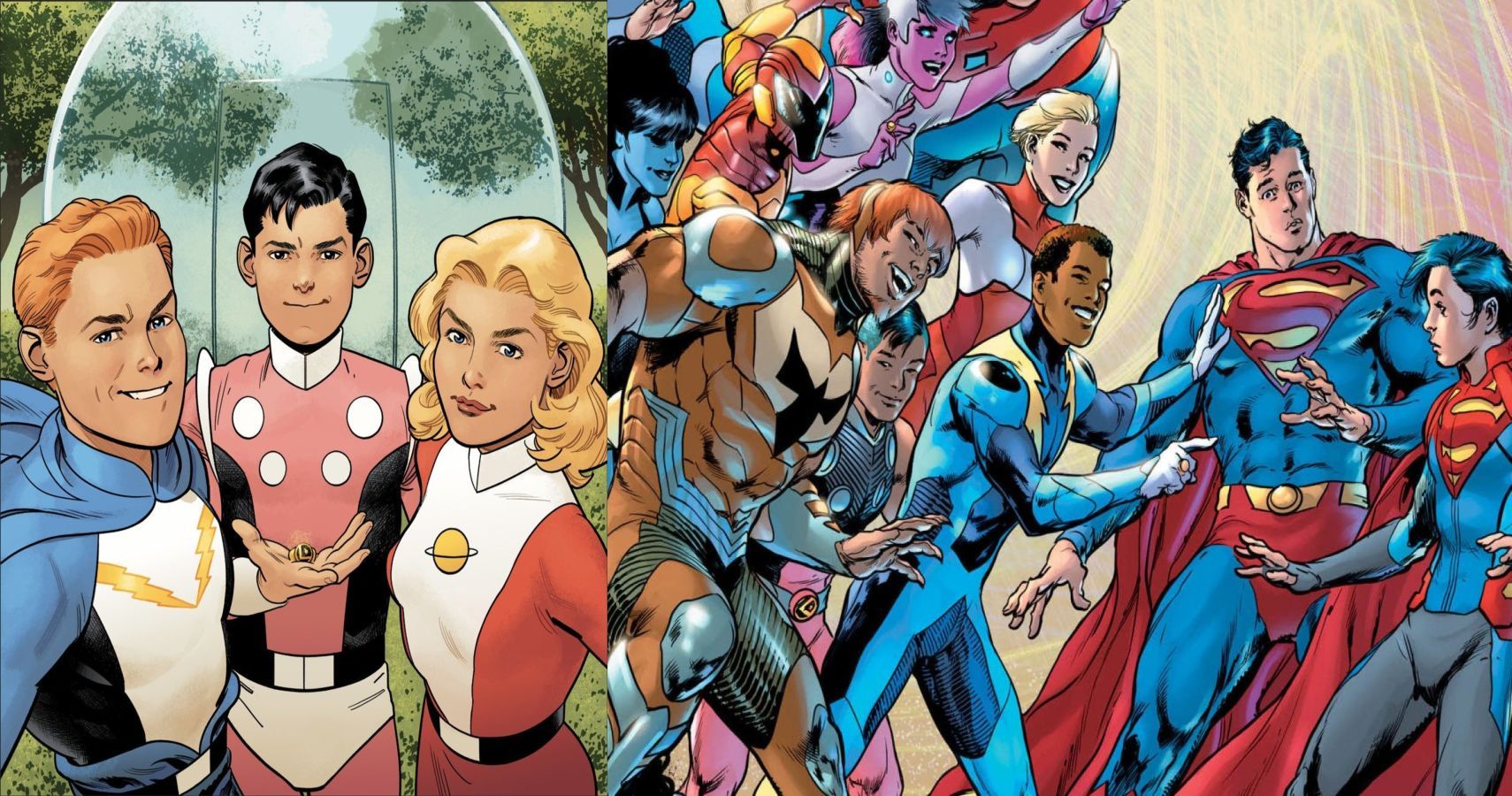
The Justice League of America wasn’t the first superhero group during DC’s Silver Age. That label goes to a team of 30th-century teens known as the Legion of Super-Heroes. Introduced in Adventure Comics #247 by Henry Boltinoff, this lineup became a huge entity during most of the 1960s.
There has been at least one new incarnation of the Legion, if not more, in the DC Comics lineup since their introduction. During this time, the group has gone through several changes. This includes different rosters, responsibilities, and locations within the Multiverse. Overall, the LSH’s transformation has been interesting to observe.
10 The Team’s Membership Has Grown
When the Legion returned to the pages of Adventure as its full-time feature, they were already more than a dozen strong. Core members like Phantom Girl, Colossal Boy, and Brainiac 5, were securely ensconced in the lineup. The roster continued to grow in the mid-60s when writer Jim Shooter introduced characters like Karate Kid and Princess Projectra, and Ferro Lad.
In 1979, when the Legion completely took over the original Superboy’s title, the team boasted nearly three dozen heroes. It would be a number they maintained through most incarnations. This includes Brian Michael Bendis’ run on the team starting in 2019.
9 Their Influences Have Changed
The Legion has always been influenced in some way by 20th and 21st-century heroes. The original Superboy was their initial choice. When the Teen of Steel’s timeline was eliminated in Crisis on Infinite Earths, the reasons for the Legion’s origins shifted to the Daxamite Mon-El. Through the manipulations of the wizard Glorith and writer Keith Giffen, he became the past hero known as Valor.
This continued through the Zero Hour and Threeboot versions of the team. Then, thanks to Geoff Johns, Superboy/Superman returned to prominence as the Legion’s motivator. By the time Bendis took over the title in 2019, the hero that encouraged the team to form was Superman’s powerful son Jon Kent.
8 They Face Deadlier Threats
Early Legion adventures featured single issues where Superboy would join the team to defeat a small-time criminal. Sometimes, their schemes would be devious enough to delay the Legionnaires. However, it was only for a short time.
Things changed in the mid-1960s. Jerry Siegel introduced the destructive Computo. Then, one year later, Jim Shooter increased their challenges with Universo, the Fatal Five, and the dreaded Sun-Eater. By the time the team of Paul Levitz and Keith Giffen took over, the Legion ended up battling Darkseid and a reinvigorated Legion of Super-Villains.
7 Legionnaires Have Died Over The Years
There were few comics in the 1960s that featured the death of superheroes. Adventure Comics is the exception. During their run on the series, the Legion faced the death of their members. Some of them, like the loss of Lightning Lad, were temporary. Others, like that of Ferro Lad against the Sun-Eater, remained permanent for decades.
These aren’t the only losses. One of Triplicate Girl’s bodies died at the hands of Computo. Karate Kid lost his life in a battle with Nemesis Kid. The original Invisible Kid and Chemical King were victims of Validus and the Dark Circle, respectively, in the 1970s.
6 There Are Several Incarnations Of The Team
Comic book teams are known for their reinvention. The Justice League, Titans, and Avengers have reformed countless times over the decades. However, most of their members weren’t reincarnated like those of the various Legion of Super-Heroes.
It started during DC’s Zero Hour event. The team established in the Silver Age ceased to exist in favor of a rebooted group. This team lasted nearly a decade and was replaced by another Legion, known as the Threeboot team. The original Legionnaires, now older, reappeared between Infinite Crisis and Final Crisis. Then there’s the post-Doomsday Clock group that seemed familiar to Superman but was comprised of an entirely different lineup.
5 They Grew Up Over Time
In Adventure Comics #354, Jim Shooter and artist Curt Swan produced an imaginary story about an Adult Legion. It would be a concept utilized again in Legion of Super-Heroes #300. However, by that time, the Legion was already older.
The original Legionnaires weren’t as young as the Teen Titans when they started their heroic adventures. They were in their mid-to-late teens. So, it was logical that they would become adults, get married, and have children. In 2007, when the Superman and the Legion of Super-Heroes story ran in Action Comics, the team members were in their mid to late-20s.
4 They Became More Diverse
It’s no surprise the Legion of Super-Heroes was pretty white during most of the 1960s. Only the introduction of the blue-skinned Shadow Lass changed things up. It wouldn’t be until the 1970s that creators diversified the Legion’s lineup.
In fact, artist Dave Cockrum intended to do this during his early 70s run with the team. Versions of future X-Men Storm and Nightcrawler were to be part of a 30th-century spin-off group. In SLoSH #216, writer Carey Bates added the first Black hero, Tyroc, to the team. Ten issues later, Paul Levitz introduced the First Nation’s Dawnstar. Further incarnations of the group, including the latest, have expanded the team’s unique diversity of alien races.
3 They Survived A Dystopian Future
After several years of absence, Keith Giffen returned to the Legion and made some major changes. These resulted in a new series co-scripted and drawn by him that showed what happened to the Legion, and the galaxy, after the devastation of the Magic Wars. Known as the “Five Years Later” storyline, Giffen showed how several disbanded Legionnaires coped in a dystopian 30th and 31st century.
It wasn’t as bright as their previous life. The few active members of the new Legion operated out of a ramshackle asteroid headquarters. Because of Glorith’s machinations with time, new characters and threats emerged. Eventually, they ended up disappearing during DC’s Zero Hour event.
2 They Added Members From The Legion Academy And Substitute Heroes
The team’s membership remained steady throughout the 60s and 70s. In the early 1980s, the trickle of new inductees included Blok, a new Invisible Kid, and White Witch. However, as the decades floated by, the LSH turned to the Legion Academy and Legion of Substitute Heroes to fill their ranks.
Legion Academy students like Cosmic Boy’s brother, Magnetic Kid, the telepathic Tellus, and Comet Queen joined over the years. After several decades of leading the Substitute Heroes, Polar Boy was elected into the Legion’s ranks and eventually became its leader. Under Geoff Johns, Night Girl became his teammate.
1 They Spent A Lot Of Time In The Present
Save for the occasional adventure in Superboy’s Smallville, the Legion of Super-Heroes stayed in the 30th century. Overall, it was done to maintain the timestream. The smallest shift in the past could create a butterfly effect that devastated their own lives.
However, that rule seemed to be trampled on as the team entered the next decades. Karate Kid was the first Legionnaire to spend excessive time in the 20th century. He was followed by Cosmic Boy and Timber Wolf. By the time the post-Zero Hour team came to fruition, nearly a dozen Legionnaires ended up at the end of the 20th century during the Final Night event. They continued to cross into the 21st century several times in various incarnations.
About The Author