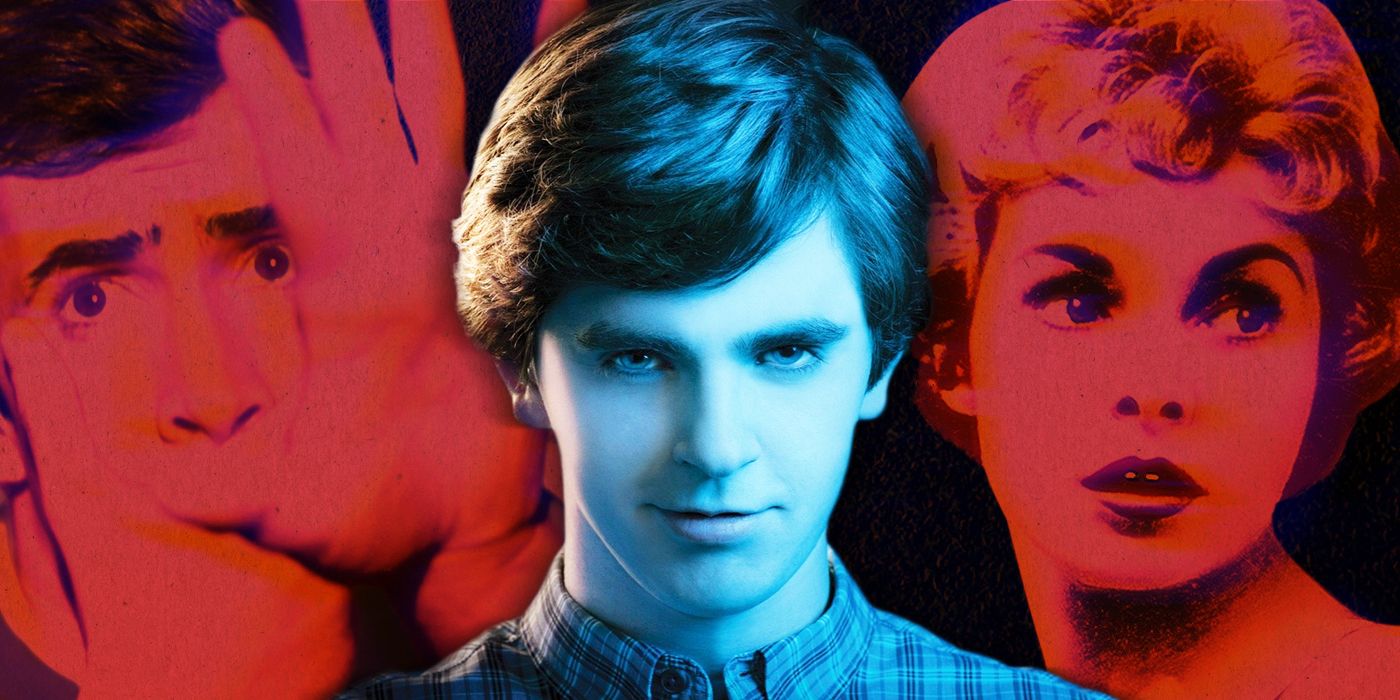
Norman Bates earned a place in pop culture after debuting on the big screen in Alfred Hitchcock‘s 1960 masterpiece, Psycho. Audiences watched in horror as Norman battled with his cruel, controlling mother, who had a deadly bloodlust for women. The twist was Mother had been dead for years, propped up in the fruit cellar, and Norman took on her personality. It was a chilling revelation that rightfully earned the film legendary status. In 2013, A&E’s Bates Motel filled in the gap from Norman’s teenage years to the events of Psycho. Although the prequel series kept Psycho‘s spirit, it differed from the source material in various ways.
Click the button below to start this article in quick view.
Bates Motel Modernized
Hitchcock adapted Psycho from Robert Bloch’s 1959 novel of the same name less than a year after its release. As such, the film is modernly set and features then-cutting-edge special effects. For audiences now, Psycho‘s 1960 setting provides a certain charm. Bates Motel also chose a modern setting, bringing Norman and his mother, Norma, into the millennium. While the actual motel and the Bates’ residence remains almost identical to their ’60s counterparts, the cast utilizes cell phones, flash drives and laptops.
Although it was a risky move, it was intentional for creators Carlton Cuse and Kerry Ehrin. While the world around the Bates family is very much contemporary, their motel and house are still ’60s. The stylistic choice reinforces the idea that Norman and Norma live in their own little, twisted bubble.
Norma Bates
Obviously, when it comes to Bates Motel‘s Norma the biggest difference is she’s alive. As a prequel series, Bates Motel travels back to the time before Norman killed his mother. As such, it masters the art of showing, not telling, allowing audiences to witness the twisted mother/son relationship firsthand. It follows Norma and Norman moving to Oregon to run the motel and the downward spiral that proceeds.
In Psycho, Norma is just a corpse. However, viewers hear a fair bit of commentary from her, although it’s really spoken by Norman’s Mother personality. She is a lot more harsh and cruel than Bates Motel‘s Norma, who plays largely as a toxic but sympathetic character nonetheless. Thanks to Vera Farmiga’s stellar performance, Norma’s backstory is properly fleshed out. Putting a face to Pyshco‘s mysterious, sinister Mother gives Bates Motel a unique edge, even with the inherent spoiler that she will eventually be killed. And much to viewers’ surprise, Farmiga’s Norma rises as a fan favorite.
Dylan Masset
Norman’s half-brother Dylan is strictly part of Bates Motel fandom. He does not exist in either the film or book. Despite this, Dylan adds an interesting layer to the story as Norma’s estranged son conceived incestually — initially unbeknownst to him — when she was raped by her brother as a teenager. Norma’s obsession with Norman frequently leaves Dylan neglected. Nonetheless, he desperately seeks her approval, making him one of Bates Motel‘s most tragic characters.
Sheriff Alex Romero
Aside from establishing him as White Pine Bay’s head honcho, Romero’s screen time lacks in Season 1. Later, he becomes a significant player in the Bates family’s drama. His love for Norma complicates things. He struggles to balance his growing suspicions of Norman with being a law enforcement officer and a Bates family friend. By Season 4, he is married to Norma and technically Norman and Dylan’s step-father.
Like Dylan, Romero does not exist outside of Bates Motel. However, one could argue he is a stand-in for Psycho‘s Joe Considine. Considine begins a relationship with Norma and convinces her to purchase the motel. Norman is consumed with jealousy when they become engaged, believing Considine plans to take his mother away from him. This drives Norman to kill them both by poisoning them with strychnine and framing it as a murder-suicide. While Considine and Romero are vastly different characters, they meet similar fates. Fearing his mother is too preoccupied with the sheriff, Bates Motel‘s Norman resents Romero before finally killing him in Season 5.
Marion Cran Survives
Bates Motel had high expectations when reimagining Marion Cran. Originally portrayed by Janet Leigh, Marion stole the spotlight in Psycho‘s infamous shower scene. On the run after stealing money from her employer, Marion spends the night at the Bates Motel, where she crosses paths with a seemingly innocent Norman. Although the two hit it off, Mother doesn’t like her, and Marion meets her untimely demise in a brutal shower stabbing.
Bates Motel creators wanted to pay homage to Psycho while adding their own spin. As such, they cast Rihanna as the young, beautiful fugitive. She has a similar story to the film’s Marion and “befriends” Norman at the motel. Her shower scene keeps audiences on the edge of their seats — but Norman doesn’t strike. As such, Rihanna’s Marion survives her experience at the motel and leaves town, money in hand.
Shower Scene Twist
Just as they took a risk modernizing the story, Bates Motel creators took an even bigger one when switching up the shower scene. The prequel swaps Marion for her boyfriend, Sam Loomis. In Psycho, Loomis is the hero, teaming up with Marion’s sister Lila to discover her whereabouts. Although Bates Motel‘s Loomis shares his film counterpart’s debt problems, the similarities pretty much end there. This Loomis is manipulative and cruel. He’s not divorced; he’s married. Marion is not his girlfriend; she’s the other woman much to her surprise.
After running into Loomis and his wife in town, Norman sees through his charade. Later, when he returns to the motel after breaking Marion’s heart, Norman strikes when he is most vulnerable — in the shower. Bates Motel‘s shower sequence plays out similarly to Psycho‘s, just slightly gorier. The difference is Norman commits the crime as himself, not Mother. Not only does this differ from the film, but it’s the only time Norman doesn’t kill as Mother in Bates Motel. It’s a significant moment in the prequel series. The creators put a lot of thought behind the scene, saying they wanted Sam to be a metaphor for Norman’s violent father, who was the one really responsible for all of Norman — and Norma’s — problems.
Norman Bate’s Fate
Sticking with Psycho‘s overall feel, the film’s ending is just as iconic. Thanks to Lila Crane and Sam Loomis, Norman is found out and apprehended by the police. At this point, Norman’s completely devolved into Mother. The film ends with Anthony Perkin’s Norman’s terrifying, leering stare, with Mother boosting she’s innocent because she wouldn’t even harm a fly. Norman is ultimately sent to a psychiatric institution which is explored in later installments.
In Bates Motel‘s Season 5 finale, the series concluded with a different ending. After killing his mother, Norman doesn’t want to live without her. He invites his brother Dylan to dinner, where he has Norma’s body propped up at the table. Determined to die, Norman rushes Dylan with a knife, forcing his brother to shoot him. Norman dies with a smile as he reunites with Norma in death. While Bates Motel‘s final episode neatly ties things up, some argue Norman didn’t quite get the fate he deserves.
About The Author