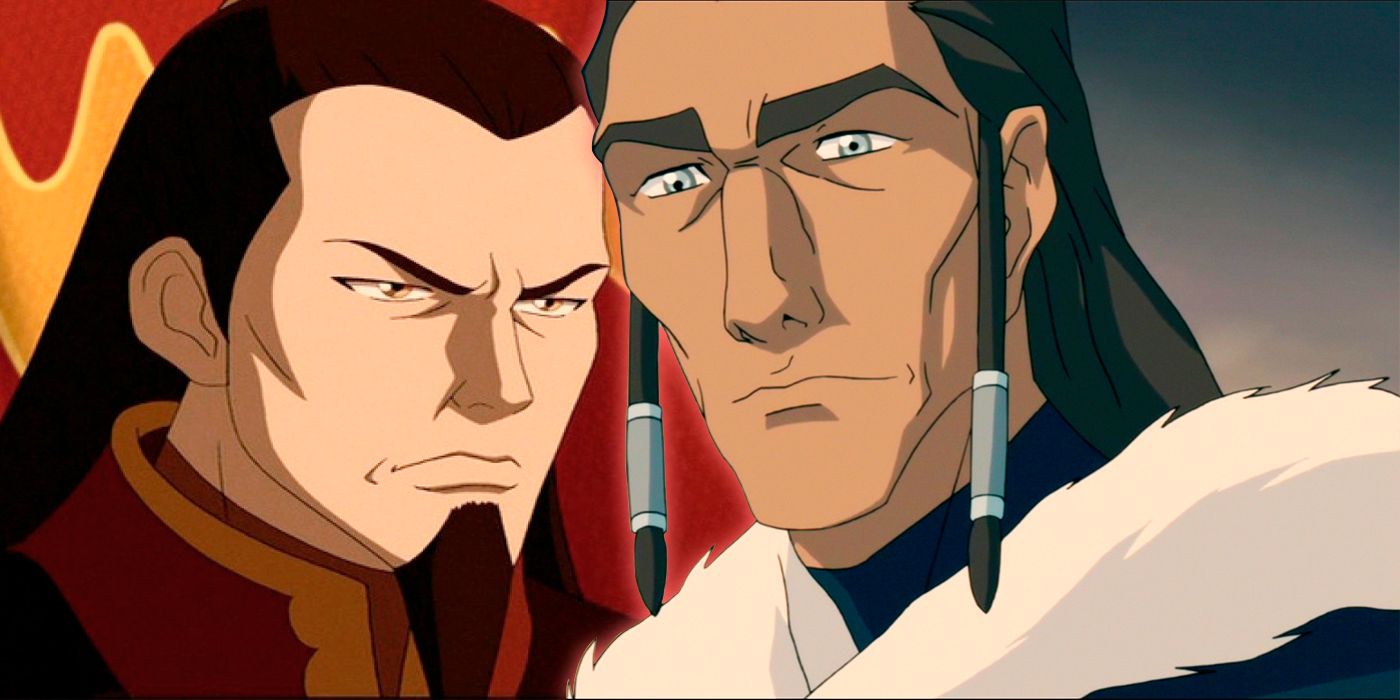
Avatar: The Last Airbender receives a titanic level of praise. But though its sequel series, The Legend of Korra, has many ardent fans, it often gets a disproportionate level of criticism. The comparison between the two series too often glosses over The Last Airbender‘s flaws while haranguing Korra for the same problems, and nowhere is that clearer than in comparing villains Ozai and Unalaq.
Despite being the central antagonist to the series, Ozai receives comparably less criticism than Unalaq, whose relegation to one of four seasons would presumably lessen his deleterious effect on the series. By contrasting the characters, we can gain insight into why this is and why it has very little to do with the writing of the characters themselves.
Click the button below to start this article in quick view.
It should come as little surprise that Unalaq receives such a disproportionate level of criticism in Korra given his central role in the largely-derided Book Two of the series. Titled “Book Two: Spirits,” the second season introduced Unalaq as the Chief of the Water Tribes and seemingly as a benevolent mentor to Korra seeking the spiritual restoration of his people. However, he was soon revealed as a power-hungry monarch seeking dominion over both Water Tribes who schemed his way to power by betraying his brother. Ultimately he sought the release of the dark spirit Vaatu and the power transforming into a Dark Avatar would grant him.
Unalaq’s developments came with such rapidity and with so little explanation that it’s understandable why he would be a focal point of criticism. The character’s dark intentions seemed predictable from the start, and his ultimate motivations boiled down to a cartoonish lust for power with virtually no concern for anyone else. The audience was meant to accept that the reason for his actions was apparent enough since it was tantamount to any villain’s ambitions to control the world. Yet in criticizing him, too few fans think to draw parallels to his clearest antecedent in the Avatar franchise: Ozai.
Fire Lord Ozai received even less attention to fleshing out his motivation, and it barely ever came up throughout the original series. Though the story’s widely-regarded attention to detail, characterization and moral nuance ran throughout most aspects of the series, the central antagonist across its three seasons never received such treatment. He was born into a family of evil monarchs, schemed his way onto the throne, and sought the destruction of all who opposed him and the elevation of his status. In terms of granting the plausibility of such ambitious motivations for their own sake, Ozai is every bit as egregious as Unalaq.
If anything, Ozai’s flatness and lack of nuance is a more significant problem for the series. Whereas Unalaq was only introduced in the second season and disposed of in its finale, Ozai loomed over every season of Avatar without receiving the attention a primary antagonist deserves. After all, the central conflict of the series involved the Avatar’s mission to master the four elements so he could defeat the Fire Lord and restore balance to the world — yet the Fire Lord was the most two-dimensional part of the entire setup.
To criticize one villain without recognizing the faults of the other is unfair. Still, the inconsistency itself is consistent with a trend among critics of Korra to provide far more charity to the original series than its sequel. The motivations for doing so are multi-faceted and complicated, ranging across everything from sexism or homophobia to foundational disapproval of how Korra built upon the hallowed world of Avatar. Unalaq may even have the bad luck of occupying the series’ weakest season, connecting him to flaws far greater than his character was directly responsible for.
At the end of the day, both series have immense strengths that deserve their credit. But few things in life are perfect, and that goes doubly so for TV shows. So in recognizing strengths and flaws, a truly fair comparison needs to be consistent when putting one series up against the other. After all, harmony is what Avatar has always been all about.
About The Author