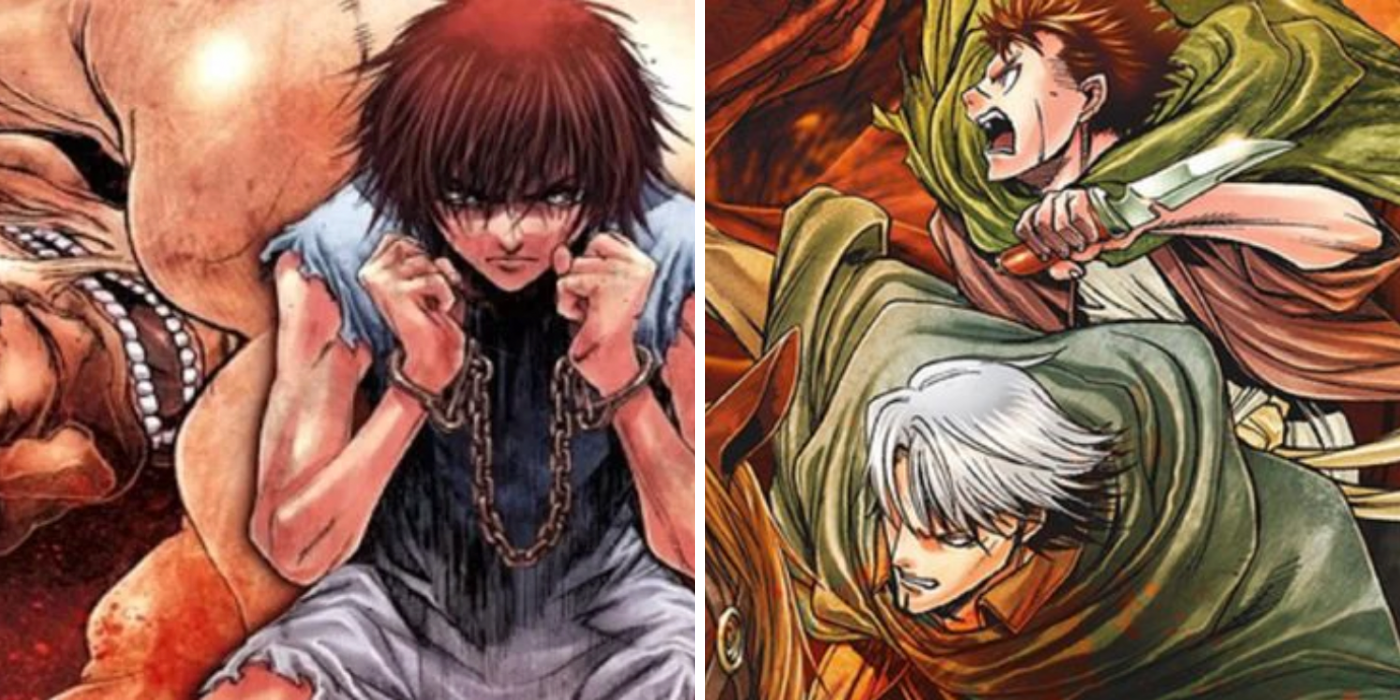
Attack on Titan is one of the best manga series of all time. It follows humanity’s battle against their predators, the Titans, and focusing on a military branch known as the Survey Corps. The series has sold millions of copies, but not a lot of fans know about the spin-offs that are also really good.
Now that the main manga has ended, readers may want to experience some of these spin-offs, with the best arguably being Attack on Titan: Before the Fall. Though readers don’t need to remember anything about the main series to enjoy this underrated spin-off, there are some things they should know.
10 It’s A Prequel That Takes Place Decades Before The Main Series
Newcomers to the franchise can enjoy Before the Fall almost as much as those that are already Attack on Titan fans. The reason behind this is because Before the Fall begins seventy years before Eren’s adventure started.
The events that took place seventy years prior serve as a prologue to the rest of the spin-off, most of which takes place fifteen years after that. With fifty-five years between the majority of the plot in these two stories, most of the characters in Attack on Titan haven’t been born yet, so the missions they go on and answers they learn are irrelevant to this plot.
9 It Began As A Light Novel
Unlike the main series, a lot of Attack on Titan‘s spin-offs began as light novels, with this one being a great example. There are three books in the series, which released between the end of 2011 and the middle of 2012, though the second and third were released together in English.
They were published by Kodansha and Vertical, which had also published other light novels in the franchise, Lost Girls and Harsh Mistress of the City.
8 There Is Also A Manga Adaptation
A manga adaptation released two years after the first light novel came out. However, the manga begins by covering the events of the second book.
There are seventeen volumes, which were released between 2013 and 2019, making it the second-longest series in the franchise, right after the original Attack on Titan, which ended earlier this year.
7 The Manga Is Different Than The Light Novel
Though the manga is based on Kuklo’s journey from the second and third books in the light novel and they begin the same way, the two versions of the story have a lot of differences after the first few volumes.
Though some fans of the light novels may have been disappointed to see that the story changed and wouldn’t be the manga adaptation they expected, the manga turned out to be even better than the light novels in some ways. And if someone starts reading one version of the story and doesn’t like it that much, they may enjoy the other a lot more, so it’s worth reading both.
6 Hajime Isayama Is Not The Writer Or The Artist Of This Series
Hajime Isayama is the creator of Attack on Titan, writing and illustrating every volume of the main series. However, other authors and artists have worked on the spin-offs.
The Before the Fall light novel was written by Ryo Suzukaze and illustrated by THORES Shibamoto. Suzukaze returned to write the manga, but Satoshi Shiki replaced Shibamoto as the artist.
5 One Of The Main Characters Is Known As “The Titan’s Son”
Kuklo, the main character of the manga, as well as the main character in the second and third light novels, is one of the most interesting characters in the franchise. Rather than being a Titan shifter, like Eren and Annie, he was cursed by being born while his mother was eaten by a Titan.
When the Titan spit her out, Kuklo was found and was given the title “the titan’s son,” causing many people to hate, fear, and abuse him. He was kept as a prisoner his whole life and was eventually bought by Dario Inocencio, whose daughter, Sharle, freed Kuklo early on in the story. Now getting to live his life as the human he always was, Kuklo chose to become a member of the Survey Corps.
4 The Creator Of Vertical Maneuvering Gear Is Another Main Character
Vertical maneuvering gear is one of the most important things in the entire franchise. Without it, the Survey Corps never would have been able to defeat Titans, and most of the characters’ lives would be completely different. However, not a lot about the device is known by readers of the main series.
Only by reading Before the Fall will they know how the creator, Angel Aaltonen, the main character of the first light novel who would eventually join Kuklo in his journey, came up with the idea of having people swing around the Titans, reach their necks, and kill them.
3 A Lot Of Experiments Were Conducted On Titans
Research on Titans isn’t anything new to fans of Attack on Titan. Hange would constantly perform experiments on captured Titans, as well as on Eren, early on in the series.
However, in order to get the knowledge they learned in the main series, the characters from Before the Fall had to run a lot of experiments of their own, which would teach them how to design equipment, like the vertical maneuvering gear, and weapons that could hurt their enemies.
2 The Survey Corps Looked Very Different In This Spin-Off
Throughout the decades, the Survey Corps became completely different compared to what they once were. In the main series, a lot of civilians despised this branch of the military. But in Before the Fall, they were praised, even though the members back then weren’t nearly as strong as characters like Mikasa and Levi.
The Survey Corps was led by captains Jorge and Carlo Pikale, with the former becoming the head instructor of the Training Corps, similar to the 104th Cadet Corps’ instructor, Keith. Kuklo’s father, Heath, was a squad leader that died before his son was born. Though these three soldiers were loved by many, they didn’t have much experience or skill compared to those from the main series.
1 Paradis Also Looked Different
Paradis, the main setting of Attack on Titan, was also very different in Before the Fall. For starters, rather than having a lot of fields and forests, the island was a wasteland outside of Wall Maria.
There were also different parts of Paradis in Before the Fall that were never shown in Attack on Titan, such as the Industrial City. Other areas inside of the walls, like Shiganshina District, appear in both stories, allowing readers to see how the setting has both changed and stayed the same.
About The Author
