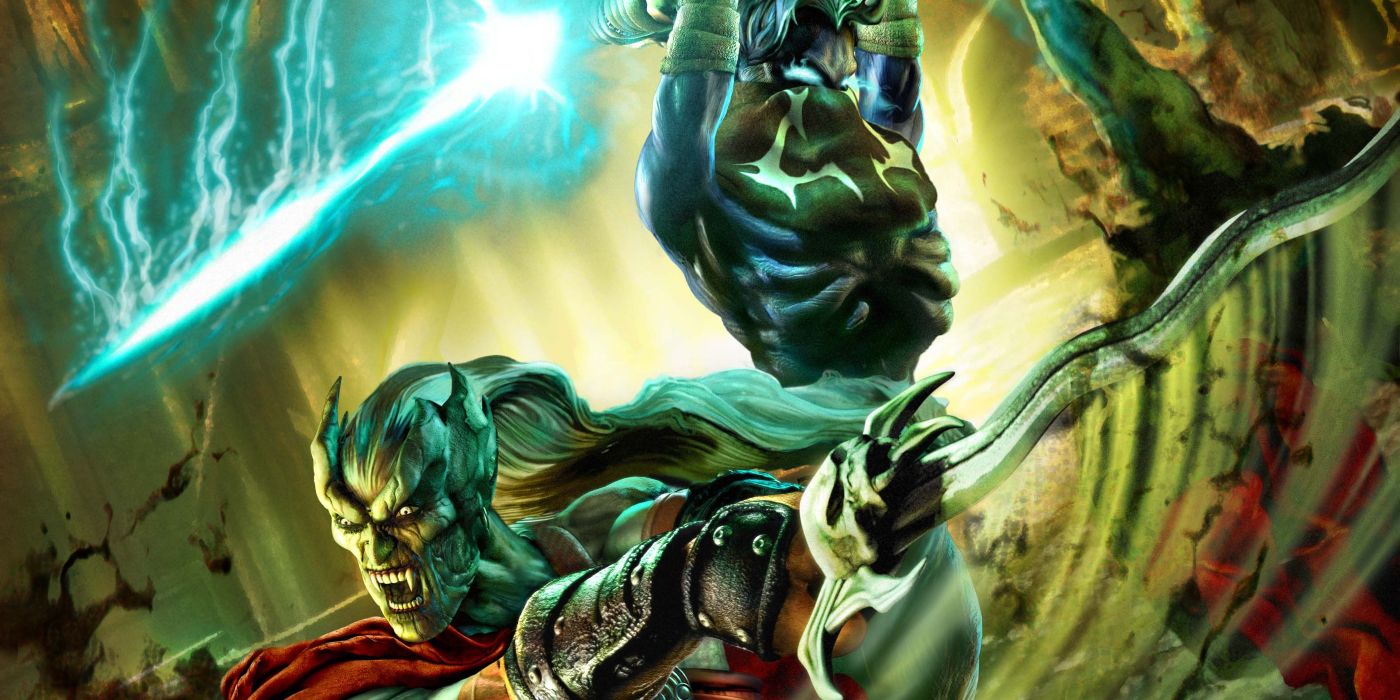
Legacy of Kain was one of the best-written game franchises of all time. With a script that combined dark fantasy with cosmic horror, delivered by some of the best actors in the business, it’s easy to see why so many fans are still holding out for a final conclusion nearly twenty years after the last game.
It’s also a franchise that is simply never going to get that conclusion, nor should it. There have been several attempts to raise the series from the dead — from the direct continuation The Dark Prophecy to the distant sequel Dead Sun — but all of them were canceled. With its key staff having since moved on to new projects, it’s becoming increasingly clear that the saga will never get its final chapter. After so much time, however, that’s probably a good thing.
Click the button below to start this article in quick view.
The biggest problem with trying to resurrect Legacy of Kain is simply that it was a product of its time. It was a child of the mid-90s and grew up in the early 2000s, putting it right in the historical sweet spot where edginess had an appeal and publishers were more willing to gamble on outlandish ideas. The first game, Blood Omen, was a dark and morbid vampire story. It stripped the species of all glamour and sex appeal in the name of underscoring what frightening beasts they were. Later games expanded on this darkness, introducing Lovecraftian deities and soul-eating abominations to tyrannize the land of Nosgoth. Such bleakness would have been excessive in the hands of less-skilled writers, but Legacy of Kain succeeded through sheer charisma.
Title character Kain is not a good person, crossing so many moral lines that he became an antagonist for almost half the series, yet he was surprisingly charming for a parasitic despot. In his own words, he saw himself as a dark god whose duty it was to thin the human herd, and each game did a fantastic job of letting players experience just how powerful he was compared to puny mortals.
The series’ atmosphere was made all the richer by actors like Simon Templeman, Michael Bell and Tony Jay all giving the performance of a lifetime. Every sentence oozes with dark satisfaction, making even throwaway taunts memorable. The cast is beautifully eloquent without being pretentious, and there’s next to no swearing because they’re all clever enough to craft far more creative insults.
This is where the problems with a modern revival begin. Over the last two decades, “dark fantasy” has become equated with sex, gore and swearing. While there’s nothing inherently wrong with these ideas, they just don’t fit the classily gothic atmosphere that fans loved. Nowhere is this more apparent than in the reaction to the proposed continuation. Legacy of Kain: Dead Sun was to be a distant sequel that reinvented the franchise for a modern audience. Unfortunately, while the series’ mechanics could have certainly used the update, its storytelling mistook darkness for crassness. Released footage revealed an overworld full of half-naked enemies.
To its credit, Dead Sun had many interesting ideas. As a standalone game, it may have found an audience. As part of a franchise known for excellent writing, however, the divided fan reaction indicates it’s unlikely to have been beloved. However, while it makes sense for an ill-fitting sequel to be canceled, it’s also uncertain that a more appropriate one would be approved.
Original developers Crystal Dynamics had their own continuation in mind back in 2004, but The Dark Prophecy, too, was canceled. Even if it could be revived, the series’ critical staff, from writer Amy Hennig to artist Daniel Cabuco, have since moved on to new work. After almost twenty years, it’s unlikely they’ll reunite for some all-star grand finale.
Legacy of Kain is a beautiful series, in many ways a jewel in the crown of videogame storytelling, but it died long ago. It lived in a brief and brilliant moment in time, yet couldn’t keep up with its passage. The multiplayer game Nosgoth may have breathed a little more life into it but, like Dead Sun, it just wasn’t the same. It’s likely nothing ever will be. That’s not a bad thing, though. As ironic as it is that the vampire epic can’t achieve resurrection, it’s failing to do so means something else now has a chance to enthrall the audience it left behind. Perhaps its fans’ time would be better spent seeking a successor than trying to make a dead heart beat. Perhaps in that sense, Kain’s real legacy is, as the man himself put it, “The first bitter taste of that terrible illusion: hope.”
About The Author