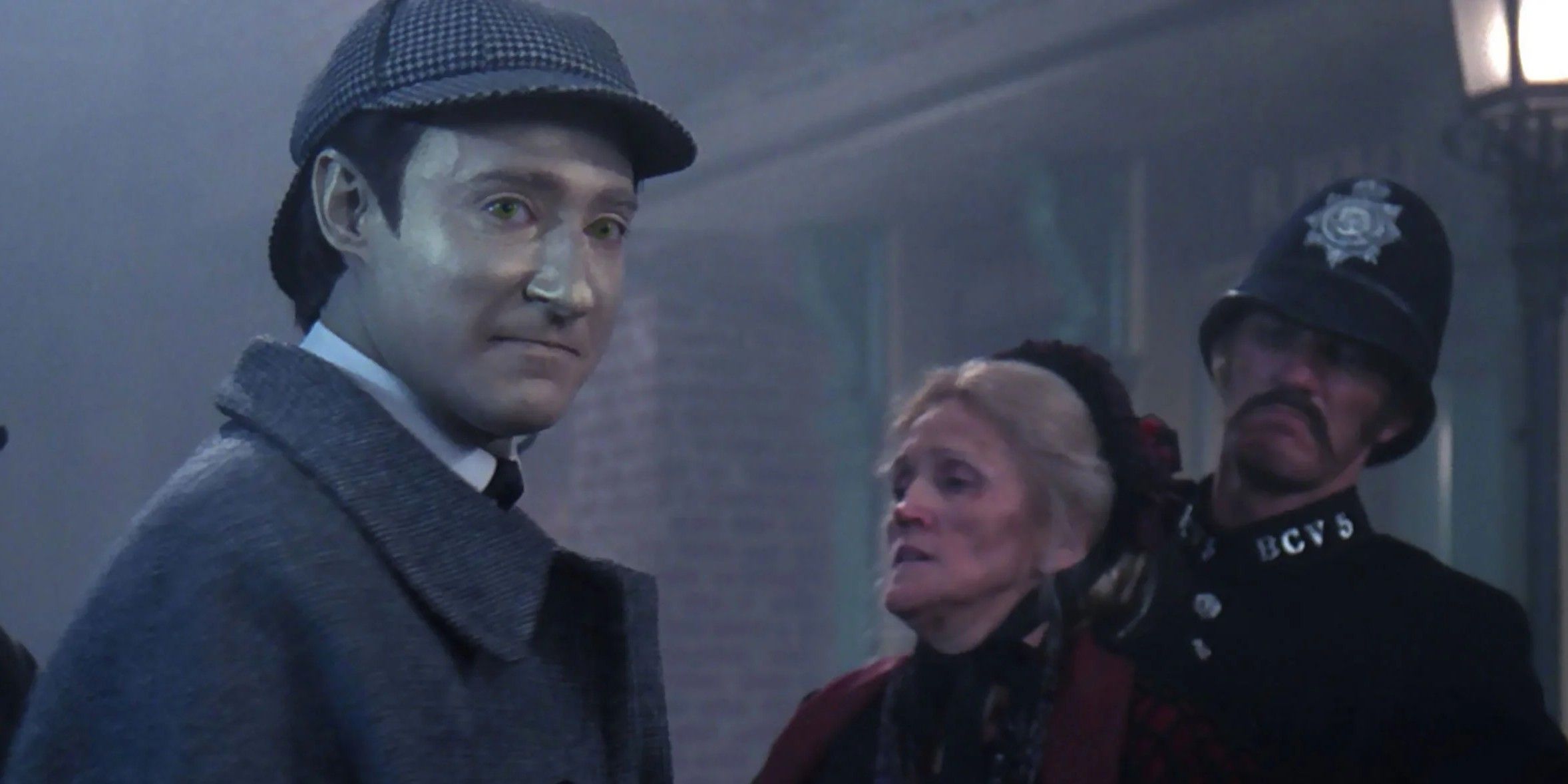
Star Trek: The Next Generation included a number of memorable holodeck episodes, allowing the 24th century characters to occasionally interact with more familiar 20th century IP within the ship’s holographic space. One particularly beloved instance of this is Season 2, Episode 3, “Elementary, Dear Data,” which allowed the cast to engage with Sherlock Holmes stories. While this episode is memorable for its mystery, characters and costumes, it also introduced a jarring plot hole in how the holodeck functions.
“Elementary, Dear Data” focuses on Data and Geordi La Forge re-enacting Holmes-style mysteries in the holodeck. When it’s revealed that Data knows all of the stories by heart and solves them without waiting for the story to unfold, Dr. Pulaski claims that Data would never be able to solve a truly unique mystery as he doesn’t fully comprehend the human soul. To prove her wrong, La Forge asks the holodeck to create a brand new mystery with an opponent smart enough to defeat Data — a plan that backfires when the holodeck creates the infamous Holmes villain Moriarty, who is able to wrest control of the U.S.S. Enterprise from within his holodeck program.
Click the button below to start this article in quick view.
After enlisting the help of Captain Picard, the crew is able to defeat Moriarty by simply explaining that there is no way to convert holodeck creations into more permanent matter that can survive in the real-world, so Moriarty accepts his fate and returns control of the ship to Picard. However, in the original ending, it is revealed that things created in the holodeck, including human beings, are able to leave and enter the real world. Picard knew this the whole time and chose to lie to Moriarty in order to reclaim his ship and protect his crew, and screenwriter Maurice Hurley claimed that this lie was necessary since Moriarty was “maybe the most profound criminal mind in literature,” and the tactic made Picard look clever. Unfortunately, creator Gene Roddenberry nixed the ending as he did not want Picard to appear deceitful.
The ending as aired introduces a major plot hole, which is entirely fixed by the original ending. After their initial meeting, Moriarty hands Data a sheet of paper on which he has drawn an image of the U.S.S. Enterprise, indicating that he knows of the ship’s existence and has knowledge beyond the confines of the holodeck program. However, Data is able to take this drawing out of the program to show Captain Picard, meaning things created in the holodeck are able to leave and exist in the real world.
Cutting the original ending where it comes to light that Picard lied to Moriarty, leaves the presence of the holodeck drawing unexplained. Some fans speculate the drawing was created by the replicator interacting with the holodeck to create a real sheet of paper rather than a hologram one, allowing the drawing to exist in the real world but not other holodeck-created entities. Regardless of whether this explanation is possible, the issue goes unaddressed on the show.
The two possible endings to “Elementary, Dear Data” reflect different sides of Captain Picard — one clever and cold, denying existence to Moriarty for the safety of his ship, and the other kind only providing an unpleasant truth to the character. Even if one could have prevented a glaring plot hole, it’s clear that the episode as it aired was still a compelling story, earning two Emmy nominations and quickly becoming a fan-favorite.
About The Author