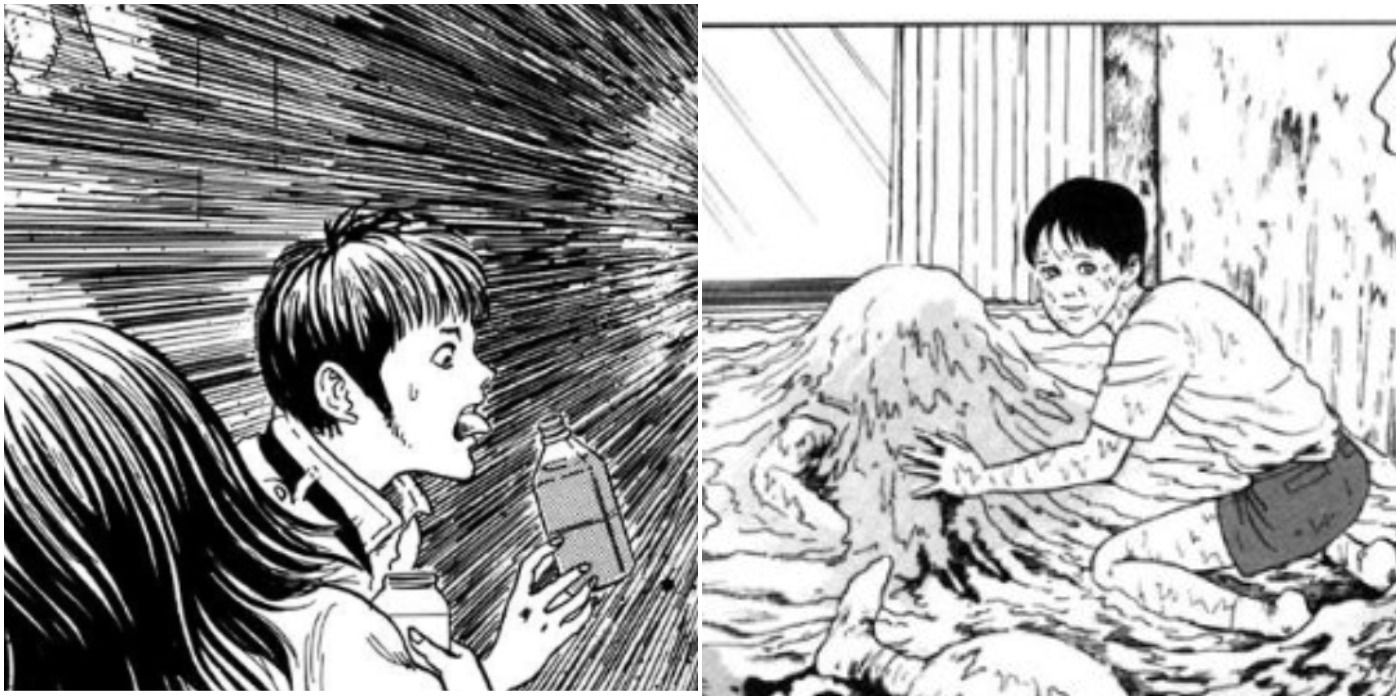
One of the reasons Junji Ito is hailed for his work in horror is that he manages to find new ways to disturb his readers. Finding innovative ways to take something ordinary like spirals, marionettes, or furniture, and find ways to make them terrifying.
Be that as it may, even Ito is prone to reusing tropes now and again. There is nothing inherently wrong with tropes so long as they aren’t overused and almost act as a signature for fans to recognize. Even so, it’s hard to ignore these ten recurring tropes.
10 Characters Driven Mad By Love Are Often Seen
Love is a powerful force that can drive people to go to extreme lengths to have their feelings reciprocated. Junji Ito often uses as motivation for his unhinged characters like the chair-dwelling stalker in “The Human Chair”, Kazuya Tani from “Bloodsucking Darkness”, or Naoya Goda from Hellstar Remina.
Men aren’t the only ones who succumbed to this obsession. Women have fallen victim to this type of insanity too such as Miss Hayama from “How Love Came To Professor Kirida” or the Intersection Bishounen’s admirers from “Lovesick Dead” but a majority of the time it is men. It shows how toxic some relationships can get and what love can drive people to do.
9 Entities With Unexplained Origins Make Frequent Appearances
Junji Ito has a gift when it comes to inventing unique monstrous entities that can rival the likes of H.P. Lovecraft’s creations. From the Spiral, Remina (the planet, not the girl), the Hanging Balloons, or Miss Fuchi. They make a distinct impression in the minds of readers despite knowing little about what they are.
Ito rarely reveals what these creatures are, where they came from, or why they act the way they do. In doing so, he adds an extra layer of mystery to these monsters and lets their actions define them. Besides, it’s unrealistic to expect the characters to find something that explains everything about the entity they are facing by chance.
8 Their Works Often Involve Plots That Explore Trapping and Immobilizing People
One of the worst fates a character can have in Junji Ito’s stories to end up trapped and immobilized. Some stories have characters who surrender their agency like the stalker in “The Human Chair”, the people trapped in their holes in “The Enigma of Amigara Fault”, or Yukihiko and his family in “Marionette Mansion”.
Others don’t get a choice like the countless people piled in walking machines in Gyo, the mummified villagers in “Blood Bubble Bushes”, or Mrs. Sonobe in “Bronze Statue”. Anyone reading these will get claustrophobic thinking of these characters robbed of mobility. Unable to escape or seek the sweet release of death.
7 Mob Mentality And The Danger It Poses
There’s something about rational people devolving into a mob mentality that is utterly chilling. Just look at quickly people are willing to resort to human sacrifices to save themselves like in Hellstar Remina or “Dying Young”.
Or how the people in “The Town Without Streets” punish the couple trying to get some privacy or the people in “Map Town” hunt the couple who took the treasure. Perhaps it has to do with humanity easily tossing away logic and reason and taking all their anger out on a select few. Arguably becoming more monstrous than any ghosts or actual monsters.
6 Some Materials Feature Characters Doing Anything to Avoid Death
No one can be blamed for fearing death but some people go too far in their attempts to avoid the inevitable. As mentioned previously with Hellstar Remina and “Dying Young”, people are willing to gang up on others and kill if it guarantees their life.
Then there is “The Long Dream” where the doctor believes inducing patients into eternal dreams will free them from their fear of death. Then there’s “The Sword of the Reanimator” which reveals Keiji’s family has relied on a reanimator to resurrect them. It just goes to show how desperate people can get when faced with their mortality.
5 Some Works Explore Unexplained Transformation
It’s one thing for a supernatural entity to appear out of nowhere, but what about someone who started human suddenly changing? Uzumaki justifies the bizarre transformations due to the Spiral but stories like “The Groaning Drain” don’t explain how someone like Kari can contort his body into a drainage pipe and survive.
It’s also not established what caused Yuuko from “Slug Girl” to grow a slug for a tongue or for Chiemi’s hair in “The Long Hair in the Attic” to come to life. These moments leave readers scratching their heads but don’t necessarily ruin the story. If anything, it shows that ordinary people can become monsters.
4 His Works Often Show That Parents Are the Worst
As if Junji Ito’s characters didn’t have enough to worry about with maniacs and monsters, they are ridden with terrible parents. There are the self-centered parents that don’t care at all for their kids like in “Greased”, “Heart of a Father”, and “The Groaning Drain”.
Then there are the adults who care to the point of obsession like “Venus in the Blind Spot”, “Layers of Fear”, and “Flesh-Colored Horror”. One would think there would be a middle ground but even those parents have issues like in “The Town with No Roads”. It’s enough to make readers glad their parents aren’t as bad.
3 His Works Often Feature Plots That Tackle Addiction
It should go without saying addiction can be extremely harmful but Junji Ito explores this often in his stories. “Smashed” and “Used Record” show that addicts are willing to place themselves and those around them in harm to get their fix. “The Ice Cream Truck” hyperbolizes the damage certain addictions can do to bodies, especially at a young age.
“Blood Bubble Bushes” can even be seen as a commentary on how addictive substances can distort and ruin communities. While not as frightening as eldritch abominations, Ito shows addiction can be just as deadly.
2 Some Pieces Use Locations As Characters
Most readers are so wrapped up in how the characters in a story change and progress that they rarely notice the locations evolve as well. Uzumaki is one of the obvious contenders as it shows the landscape and buildings forming into a single spiral. Then there is the village in “Blood Sickness of the White Sands Village” that has blood vessels beneath the ground feeding off the villagers’ blood.
The same goes for “The Town Without Streets” where the city is walled in and reflects the people’s voyeuristic tendencies. It gives the locations personality and makes them as memorable as the characters inhabiting it.
1 They Often Use Horror As An Allegory
It’s easy to write off Junji Ito’s works as nothing more than nightmare fuel but some of his stories serve as allegory. Gyo focuses on zombified fish on walking machines but it is also an allegory on WMDs created during WWII. “The Enigma of Amigara Fault” and its plot about customized holes also critiques modern society’s consumerism and how businesses promise people products “made for them”.
Even Hellstar Remina uses Remina’s celebrity status to reflect on idol culture and how the girls are deified. Once people realize what the stories are really about, it’s impossible not to look at the stories the same way again.
About The Author